K3 Exact Dice Order vs Total: Why the Same Sum Can Mean Different Results
Discover how dice order differs from combined totals in Jai Club K3, why different three-dice arrangements can produce the same sum and how to interpret matching patterns.

In this article
- What Is an Exact Dice Combination in K3?
- K3 Total vs Exact Dice Order
- Examples of Different Dice Orders With the Same Sum
- Why Different Orders Matter in Mathematics
- Exact Order vs Matching Patterns
- How Many Ordered K3 Outcomes Exist?
- Why Totals 10 and 11 Have Many Combinations
- Can the Same Total Have Both a Pair and Three Different Values?
- How K3 Result Histories Should Be Read
- Does Dice Order Affect the SUM?
- Can Exact Dice Order Be Predicted From the Total?
- K3 Dice Order vs 5D Number Positions
- Frequently Asked Questions
- What is an exact K3 dice combination?
- Can different K3 combinations have the same total?
- Does changing dice order change the total?
- How many ordered K3 results are possible?
- How many Triple outcomes exist?
- Can a total reveal whether the dice contain a pair?
- Does an exact dice chart predict future results?
- Conclusion
Jai Club K3 exact dice order is a topic associated with the difference between the individual values shown by three dice and the combined total those values produce. Although two results can have the same total, they do not necessarily contain the same dice or the same arrangement of values.
This distinction is easy to overlook when a result-history table emphasises only the sum. For example, the dice combinations 1-4-6 and 2-3-6 both add up to 11. A total-based display may show the same number for both rounds, while the complete three-dice records reveal that they are different outcomes.
This guide explains why dice order matters in some mathematical descriptions, how different combinations can share a total, and why total-based comparisons cannot fully describe every K3 result.
What Is an Exact Dice Combination in K3?
An exact dice combination describes the values appearing on the three dice. A commonly discussed K3 format uses three six-sided dice, each showing one value from 1 through 6.
For example, 2-4-6 describes three component values. Their combined total is 12, but the complete combination also contains information about the individual dice.
If the dice are treated as distinguishable positions, the arrangements 2-4-6 and 6-4-2 are different ordered outcomes. They have the same three values and the same total, but the positions differ.
Whether a particular game evaluates order is a separate rule question. Some numerical classifications depend only on the total or on whether values match, while other game designs may distinguish particular arrangements.
K3 Total vs Exact Dice Order
The total is calculated by adding the three dice values. Exact order describes where those values appear within an ordered result.
For example, 1-3-5 has a total of 9. The arrangements 1-5-3, 3-1-5, 3-5-1, 5-1-3 and 5-3-1 also total 9. If the dice are distinguishable and each arrangement is counted separately, these are six ordered outcomes.
The distinction becomes especially important in probability calculations because the number of ordered arrangements depends on whether the values are all different, partly repeated or completely identical.
The Jai Club K3 Game guide introduces the three dice and the way their totals are displayed.
Examples of Different Dice Orders With the Same Sum
| Dice values | Total | Pattern |
|---|---|---|
| 1-4-6 | 11 | All distinct |
| 2-3-6 | 11 | All distinct |
| 3-3-5 | 11 | Matching pair |
| 4-4-3 | 11 | Matching pair |
| 6-1-4 | 11 | Same values as 1-4-6, different order |
| 2-5-4 | 11 | All distinct |
All six examples add to 11, but their individual values and matching patterns are not identical.
This demonstrates why two rounds sharing the same total should not automatically be described as repeating the same complete dice result.
Why Different Orders Matter in Mathematics
Three distinguishable dice produce six possibilities for each individual die. The number of ordered outcomes is therefore 6 × 6 × 6, or 216.
When all three dice values are different, a selected group of values can appear in six orders. For example, 1, 3 and 5 can be arranged in six different ways.
When exactly two dice have the same value, there are only three distinct arrangements. The combination 2, 2 and 5 can appear as 2-2-5, 2-5-2 or 5-2-2.
When all three dice show the same value, there is only one distinct arrangement of that exact set of values. For example, 4-4-4 is unchanged by rearranging the dice.
These facts explain why the relationship between unordered combinations and ordered outcomes is not always one-to-one.
Exact Order vs Matching Patterns
Matching patterns describe whether the three dice values repeat. They do not necessarily depend on which distinguishable die occupies which position.
For example, 2-2-5 and 5-2-2 both contain exactly one matching pair. Under an unordered combination view, they use the same values. Under an ordered view, they are different arrangements.
A Triple such as 3-3-3 contains three identical values, so changing the order produces no new sequence.
This matters because a history table containing only the total and a matching-pattern label cannot reconstruct the complete ordered sequence in every case.
How Many Ordered K3 Outcomes Exist?
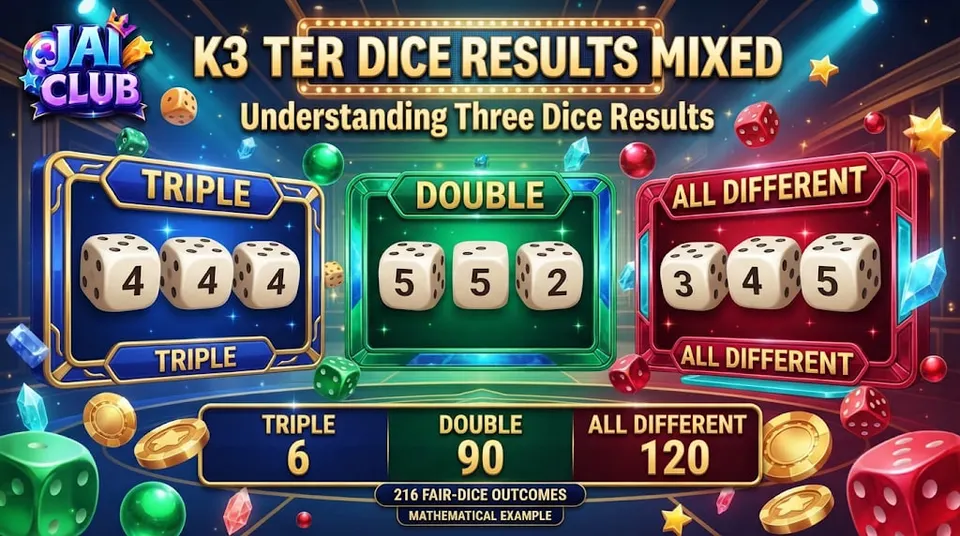
Under the standard model of three independent six-sided dice, there are 216 ordered outcomes. These can be divided into three mutually exclusive categories.
| Category | Ordered outcomes |
|---|---|
| All three dice distinct | 120 |
| Exactly one matching pair | 90 |
| All three dice identical | 6 |
| Total | 216 |
The six Triple outcomes are 1-1-1 through 6-6-6. The ninety exactly-one-pair outcomes arise from choosing the repeated value, choosing a different third value and selecting which position contains that different value.
These calculations assume fair independent physical dice or an equivalent uniform mathematical model. They are not verified payout or result probabilities for a Jai Club service.
Why Totals 10 and 11 Have Many Combinations
Totals near the middle of the possible range can be produced by many different dice arrangements. Under the fair three-dice model, totals 10 and 11 each have twenty-seven ordered outcomes.
By contrast, a total of 3 requires 1-1-1, while a total of 18 requires 6-6-6. Each extreme has only one possible ordered outcome.
This difference explains why a total chart and a complete combination chart contain different levels of information.
For the full mathematical distribution, see the K3 Dice Total Chart: Numbers 3–18.
Can the Same Total Have Both a Pair and Three Different Values?
Yes. A total can arise from arrangements with different matching patterns.
For example, 2-2-5 produces 9 and contains a pair. The combination 1-3-5 also produces 9 but has three distinct values.
The total alone therefore cannot determine whether the result contains a pair. It provides one arithmetic property of the three dice, but does not reveal all details of the component values.
This is one reason that a result table showing individual dice is more informative than a total-only history.
How K3 Result Histories Should Be Read
A K3 history table may show the complete three-dice result, its total and other classifications. The exact fields depend on the provider and interface.
When comparing two completed periods, first check their period identifiers. Then compare the component dice values before deciding whether the same complete result has repeated.
Two entries with total 12 may differ as 2-4-6 and 3-3-6. Their totals match, but their matching patterns and component values do not.
A result-history chart should not be interpreted as a record of identical outcomes merely because one column contains repeated totals.
Does Dice Order Affect the SUM?
No. Changing the order of the same three values does not affect their arithmetic total.
For example, 1 + 4 + 6 equals 6 + 4 + 1, and both equal 11. This is a property of addition, which is commutative.
However, a game may distinguish positions for other purposes. Whether exact order matters for any particular game category must be established through its published rules.
The mathematical fact that order does not affect the sum should not be confused with a claim that every ordered game outcome is treated identically.
Can Exact Dice Order Be Predicted From the Total?
No. A total often corresponds to several different possible dice arrangements.
For example, knowing only that the total is 11 does not reveal whether the result is 1-4-6, 3-3-5, 2-3-6 or another valid combination.
Likewise, historical totals do not reliably determine the exact values of future independently generated dice results.
Mathematical combination counts explain possible arrangements, not guaranteed future outcomes.
K3 Dice Order vs 5D Number Positions
K3 and 5D both involve multiple component values, but their numerical structures differ. K3 commonly uses three values from 1 through 6, while 5D uses five positions containing digits from 0 through 9.
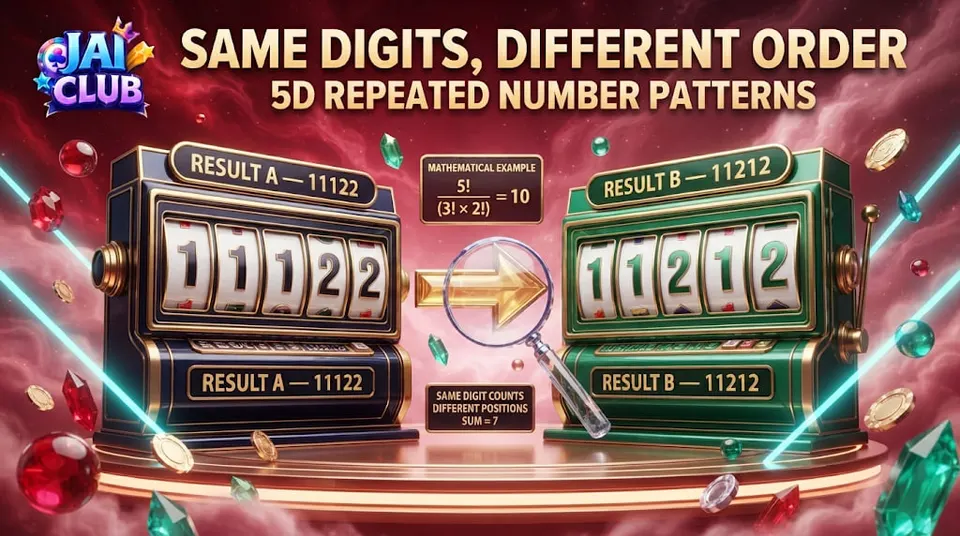
In both formats, changing the order of the same component values leaves their combined sum unchanged. However, the ordered result changes.
For a comparison of the two formats, read Jai Club K3 vs 5D.
Frequently Asked Questions
What is an exact K3 dice combination?
It is the complete set of three dice values, potentially including their positions when the game distinguishes them.
Can different K3 combinations have the same total?
Yes. Several different three-dice arrangements can produce identical totals.
Does changing dice order change the total?
No. Addition produces the same total regardless of the order.
How many ordered K3 results are possible?
There are 216 under the standard model of three independent six-sided dice.
How many Triple outcomes exist?
There are six exact Triple outcomes, one for each face value from 1 through 6.
Can a total reveal whether the dice contain a pair?
Not always. Different combinations with the same total can have different matching patterns.
Does an exact dice chart predict future results?
No. It describes possible outcomes rather than guaranteeing the next independent result.
Conclusion
The difference between exact dice order and combined total is central to understanding K3 results. Several arrangements can share one sum, while matching patterns such as pairs and Triples provide additional information about the component dice.
A total chart helps explain possible sums, but the full dice values are needed to identify a complete result. The actual importance of order depends on the specific provider's rules.
Disclaimer: JaiClubGame.online is an independent educational website and is not officially affiliated with Jai Club. Mathematical examples assume three fair independent six-sided dice and do not establish actual Jai Club odds or settlement rules. Real-money gaming involves financial risk and may be restricted or prohibited under applicable laws.