Jai Club K3 Game: Three Dice, Total Numbers & Results
Explore how the Jai Club K3 game uses three dice, totals from 3 to 18, Odd and Even classifications, Big and Small labels, matching dice and result records.
In this article
- Jai Club K3 Game: Three Dice, Total Numbers & Results
- What Is the Jai Club K3 Game?
- How Do Three Dice Work in K3?
- Jai Club K3 Total Numbers Explained
- What Does Big and Small Mean in Jai Club K3?
- What Does Odd and Even Mean in K3?
- What Are Double Dice Combinations?
- Examples of Two Matching Dice
- What Is a Triple in Jai Club K3?
- What Does Three Different Mean?
- Why Are Some Dice Totals More Common Than Others?
- Understanding Jai Club K3 Game Results
- What Is a K3 Period Number?
- Can Jai Club K3 Results Be Predicted?
- K3 vs WinGo: What Is Different?
- Frequently Asked Questions
- What does K3 mean in Jai Club Game?
- What is the minimum total in K3?
- What is the maximum K3 total?
- What is a K3 triple?
- What does Odd mean in K3?
- Are Jai Club K3 results predictable?
- Does every K3 game use identical Big and Small rules?
- Conclusion
Jai Club K3 Game: Three Dice, Total Numbers & Results
The Jai Club K3 Game is commonly described as a number-based game involving three virtual dice. Unlike WinGo, which typically uses a single result digit, K3 produces three dice values that can be combined into a total.
These values may also be classified using terms such as Big, Small, Odd, Even, Double and Triple.
Understanding these classifications can help readers interpret the Jai Club K3 game interface and its result history.
This article explains the mathematical structure of K3, common dice combinations and the terminology associated with the game. Specific platform rules may differ.
What Is the Jai Club K3 Game?
K3 is a three-dice game format in which each die has six possible face values, numbered 1 to 6.
A completed result consists of three individual numbers.
For example:
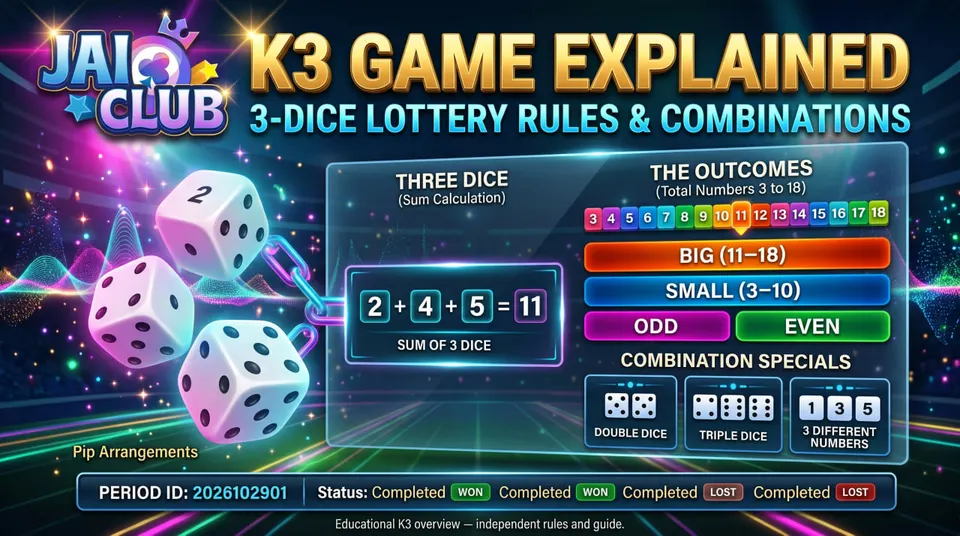
Die 1: 2 | Die 2: 4 | Die 3: 5
The combined total is:
2 + 4 + 5 = 11
The result can therefore be described using the individual dice, their sum and other classifications defined by the game.
Jai Club-related gaming websites describe K3 as one of the number-based formats associated with the platform.
However, available options, timer durations and classification rules should always be checked against the specific game version.
How Do Three Dice Work in K3?
Each die has six faces.
With three dice, the possible total ranges from 3 to 18.
The lowest total occurs when all three dice show 1.
1 + 1 + 1 = 3
The highest total occurs when all three dice show 6.
6 + 6 + 6 = 18
If all three dice are independent and fair, there are:
6 × 6 × 6 = 216 possible ordered outcomes.
These outcomes do not all produce different totals.
For example, several different combinations can produce a total of 10.
This distinction matters when interpreting the mathematical structure of K3.
Jai Club K3 Total Numbers Explained
The total is calculated by adding the three dice values.
| Example Dice | Total | Number Type |
|---|---|---|
| 1, 1, 1 | 3 | Odd |
| 2, 3, 4 | 9 | Odd |
| 2, 4, 5 | 11 | Odd |
| 3, 5, 6 | 14 | Even |
| 6, 6, 6 | 18 | Even |
The Odd or Even classification depends on the combined total, not on whether every individual die is odd or even.
For example, the combination 2, 4 and 5 produces an odd total of 11 even though two of the dice are even.
What Does Big and Small Mean in Jai Club K3?
Big and Small are commonly used to divide the possible dice totals into two ranges.
Some K3 descriptions classify totals from 3 to 10 as Small and totals from 11 to 18 as Big.
However, other implementations exclude certain triple combinations, such as 1-1-1 or 6-6-6, from standard Big/Small categories.
Because these rules differ, a universal classification should not be assumed.
The game's actual rule screen determines how each total is treated.
What Does Odd and Even Mean in K3?
Odd and Even refer to the mathematical parity of the combined dice total.
An odd number cannot be divided evenly by two.
An even number can be divided evenly by two.
Examples:
- Total 7 is Odd.
- Total 10 is Even.
- Total 13 is Odd.
- Total 16 is Even.
Some K3 implementations also apply special conditions to triple results, so mathematical parity and eligibility under a particular game rule are not necessarily identical.
What Are Double Dice Combinations?
A double occurs when at least two dice show the same face value.
For example:
3, 3, 5
Two dice show 3, making this a matching-pair combination.
Some game formats distinguish between an exact pair and a result where all three dice match.
These distinctions may appear as separate categories in the game interface.
Examples of Two Matching Dice
| Dice | Description |
|---|---|
| 2, 2, 5 | Matching pair of 2s |
| 4, 1, 4 | Matching pair of 4s |
| 6, 3, 3 | Matching pair of 3s |
The position of the matching dice does not change the mathematical fact that two values are equal.
However, game-specific selection conditions may distinguish between different combinations.
What Is a Triple in Jai Club K3?
A triple means that all three dice display the same number.
Examples include:
- 1, 1, 1
- 2, 2, 2
- 3, 3, 3
- 4, 4, 4
- 5, 5, 5
- 6, 6, 6
There are six possible ordered outcomes with all three dice matching.
In a theoretical fair three-dice model, the probability of any triple is:
6 ÷ 216 = approximately 2.78%.
This is a mathematical illustration rather than a verified probability statement about any specific digital implementation.
What Does Three Different Mean?
A three-different result occurs when all three dice display different values.
For example:
2, 4, 6
Each number is different from the others.
By comparison, 2, 2, 6 contains a matching pair, while 4, 4, 4 is a triple.
Understanding these classifications helps explain why a K3 interface may show separate tabs or labels for different dice patterns.
Why Are Some Dice Totals More Common Than Others?
In a theoretical fair three-dice system, not every total has the same probability.
A total of 3 can only occur as 1-1-1.
A total of 10 can occur through multiple ordered dice combinations.
That is why totals near the centre of the possible range appear more frequently in the mathematical model than totals at the extremes.
| Total | Number of Ordered Combinations |
|---|---|
| 3 | 1 |
| 6 | 10 |
| 9 | 25 |
| 10 | 27 |
| 11 | 27 |
| 12 | 25 |
| 15 | 10 |
| 18 | 1 |
These counts describe theoretical fair dice. They do not guarantee the distribution of any particular short sequence of results.
They also do not establish that a specific digital game uses certified independent fair dice.
Understanding Jai Club K3 Game Results
K3 result history may contain information such as:
- Period number
- Three individual dice values
- Combined total
- Odd or Even classification
- Big or Small label
- Completed result status
A hypothetical entry could display:
Period: DEMO-K3-105
Dice: 2, 4, 5
Total: 11
Parity: Odd
Status: Completed
This is fictional demonstration data.
The actual Jai Club K3 result table may use different identifiers, colours or headings.
What Is a K3 Period Number?
A period number identifies an individual game round.
It helps distinguish one completed dice result from another.
A period identifier should not be confused with the three dice values or their total.
If two pages display different results, it is important to establish whether they refer to the same period and game mode.
The precise format of period identifiers varies between implementations.
Can Jai Club K3 Results Be Predicted?
In a properly functioning system based on independent random dice, previous outcomes do not determine future results.
For example, several results with low totals do not establish that the next result must be high.
Likewise, the absence of a triple in recent history does not guarantee that one will appear soon.
Mathematical probabilities describe possible outcomes over repeated independent trials. They cannot identify the result of the next individual round.
K3 vs WinGo: What Is Different?
K3 and WinGo are both commonly discussed as timed number-based game formats, but their result structures differ.
| Feature | K3 | WinGo |
|---|---|---|
| Main result | Three dice values | Commonly one digit |
| Value range | Each die 1–6 | Commonly 0–9 |
| Derived total | 3–18 | Single-digit result |
| Common classifications | Total, Odd/Even, matching dice | Colours, Big/Small |
| Historical records | Dice and total | Digit and colour |
For information about WinGo result records, visit the WinGo category.
You can also explore the K3 & 5D category for more number-based game explanations.
Frequently Asked Questions
What does K3 mean in Jai Club Game?
K3 commonly refers to a three-dice game format in which results are expressed as individual dice values and their combined total.
What is the minimum total in K3?
The minimum possible total is 3, produced when all three dice show 1.
What is the maximum K3 total?
The maximum possible total is 18, produced when all three dice show 6.
What is a K3 triple?
A triple is a result where all three dice display the same value, such as 4-4-4.
What does Odd mean in K3?
Odd means the combined total is an odd number, such as 7, 9, 11 or 13.
Are Jai Club K3 results predictable?
Past results do not reliably predict future outcomes in an independent random system.
Does every K3 game use identical Big and Small rules?
No. Some descriptions include all totals within their mathematical ranges, while others apply exclusions to certain triple outcomes. The actual game rules should be checked.
Conclusion
The Jai Club K3 Game is based on a three-dice result structure that can be described using totals, parity and matching patterns.
Understanding the difference between individual dice, combined totals, doubles and triples makes result tables easier to interpret.
While the mathematics of three fair dice can be calculated precisely, that does not create a guaranteed prediction method for future game outcomes.
Disclaimer: JaiClubGame.online provides educational information and does not claim official affiliation with Jai Club. This article is not a betting recommendation or prediction service. Games involving money carry financial risks and may be restricted or prohibited in your jurisdiction.