Jai Club Crash Game History: What Do Past Multipliers Mean?
Understand Jai Club crash game history, previous multiplier results, low and high multiplier streaks, chart patterns and the limits of predicting future rounds.
In this article
- Jai Club Crash Game History: What Do Past Multipliers Mean?
- What Is Jai Club Crash Game History?
- What Does a Crash Multiplier Represent?
- Example Crash Game Result History
- Why Do Some Crash History Results Have Different Colours?
- What Is a Low Multiplier Streak?
- What Is a High Multiplier Streak?
- Understanding Crash Game History Charts
- Can You Calculate the Average Crash Multiplier?
- Why Can an Average Be Misleading?
- Average vs Median Crash Multiplier
- Do Crash Games Follow Patterns?
- What Is the Gambler's Fallacy?
- Can Crash Game History Reveal RTP?
- What Does Provably Fair History Mean?
- What Should You Check When Reading Jai Club Crash Results?
- Jai Club Crash Games vs WinGo Result History
- Frequently Asked Questions
- What is Jai Club crash game history?
- What does a 1.00× crash result mean?
- Can low multipliers predict a high multiplier?
- What does a purple multiplier mean?
- Is the average crash multiplier the same as RTP?
- Can crash history charts predict the next Aviator result?
- Can I verify old crash game results?
- Conclusion
Jai Club Crash Game History: What Do Past Multipliers Mean?
A Jai Club crash game history panel commonly displays the final multipliers from previous rounds. Some interfaces show these results as a row of coloured numbers, while others use tables or graphical charts.
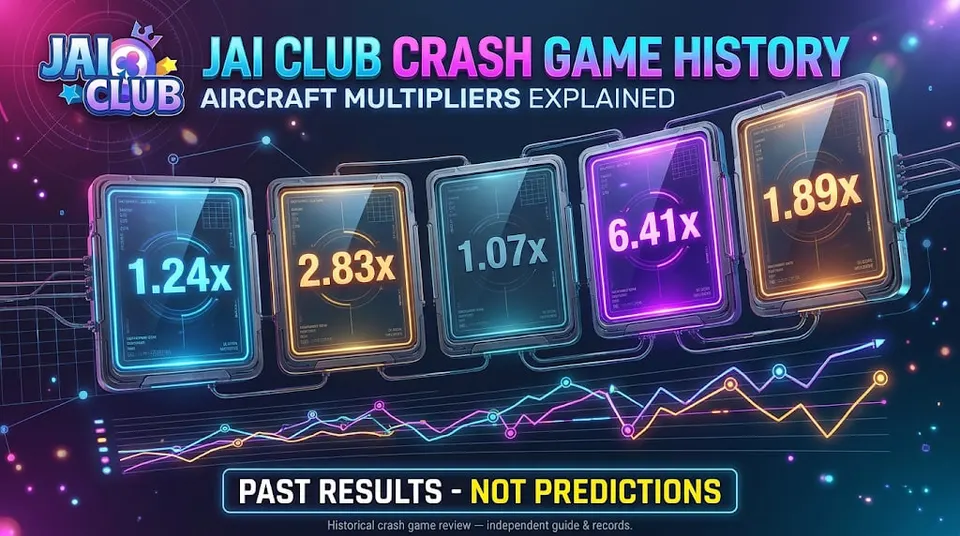
A typical history might contain values such as 1.24×, 2.83×, 1.07× and 6.41×.
But what do these numbers actually represent? Does a streak of low multipliers mean a high multiplier is approaching? And can a crash game history chart reveal the next outcome?
This article explains how to interpret previous crash multipliers and why historical patterns should not be confused with reliable predictions.
What Is Jai Club Crash Game History?
Jai Club crash game history refers to a record of previously completed rounds in a multiplier-based game.
In an Aviator-style game, each completed round may have a final multiplier known as the crash point.
The interface may display the most recent results first, allowing readers to review a sequence of past rounds.
Commonly displayed information can include:
- Final crash multiplier
- Round identifier
- Recent result sequence
- Colour-coded multiplier values
- Completion status
- Additional verification information, where supported
The available fields depend on the specific game provider and interface version.
What Does a Crash Multiplier Represent?
A crash multiplier records the value at which a particular round ended.
For example, if a fictional round finishes at 1.35×, the history may display 1.35×.
A different round might finish at 7.20×.
These values describe completed outcomes rather than future targets.
Example Crash Game Result History
| Demo Round | Final Multiplier | Description |
|---|---|---|
| CR-105 | 1.24× | Low multiplier |
| CR-104 | 2.83× | Intermediate multiplier |
| CR-103 | 1.07× | Low multiplier |
| CR-102 | 6.41× | Higher multiplier |
| CR-101 | 1.89× | Low multiplier |
These values are entirely fictional.
The descriptions are illustrative categories, not official classifications used by Jai Club.
Why Do Some Crash History Results Have Different Colours?
Some crash game interfaces use colours to distinguish multiplier ranges.
For example, one interface may display lower values in one colour and higher values in another.
This makes it easier to visually scan recent results.
However, the exact colour scheme and multiplier boundaries are not universal.
A purple value in one crash game does not necessarily have the same meaning as a purple value in another game.
Colours are visual classifications, not independent evidence that the next round will behave differently.
What Is a Low Multiplier Streak?
A low multiplier streak is a sequence of consecutive rounds that finish within a relatively low range.
For example:
1.18× → 1.42× → 1.09× → 1.31×
These numbers form a fictional example of four consecutive low results.
The streak describes the previous four rounds.
It does not establish that the fifth round must reach a high multiplier.
In an independently generated random game, previous results do not force future outcomes to compensate for earlier ones.
What Is a High Multiplier Streak?
A high multiplier streak is a sequence containing several larger values.
For example:
5.40× → 8.12× → 4.77×
Whether these qualify as high results depends on the classification method being used.
Such sequences may look unusual, especially when viewed on a short chart.
However, observing consecutive higher multipliers does not mean that the next outcome must be low.
A streak is a description of past observations, not proof of a future rule.
Understanding Crash Game History Charts
A chart provides a visual representation of historical data.
Some crash game histories use a line chart, while others show coloured tiles, bars or simple number sequences.
A chart may help readers identify:
- Which round had the highest recorded multiplier
- Which round had the lowest result
- The order of recent outcomes
- Whether there were consecutive low or high values
- How the displayed results vary
The chart cannot independently reveal the game's underlying random process.
It also cannot establish that the next multiplier will follow a visible pattern.
Can You Calculate the Average Crash Multiplier?
Yes. The arithmetic average of a recorded sample can be calculated by adding the values and dividing by the number of rounds.
Consider these five fictional results:
1.20×, 1.50×, 2.00×, 3.00×, 7.30×
Their sum is 15.00.
Therefore:
15.00 ÷ 5 = 3.00×
The sample's arithmetic average is 3.00×.
However, this does not mean the next result should be 3.00×.
It also does not mean the game has an RTP of 300%.
The arithmetic mean of historical crash points and Return to Player are different statistical concepts.
Why Can an Average Be Misleading?
Crash multiplier distributions can be strongly skewed.
A relatively small number of large results can substantially increase the arithmetic average.
For example, consider:
1.10×, 1.20×, 1.30×, 1.40×, 25.00×
The average is 6.00×.
Yet four of the five rounds ended below 1.50×.
This shows why an arithmetic average may not describe a typical result very well.
Other statistical measures, such as the median and distribution across multiplier ranges, may provide additional context.
However, none of these measures can guarantee a particular future result.
Average vs Median Crash Multiplier
The average, also called the arithmetic mean, is calculated by dividing the total of all recorded values by their count.
The median is the middle value after sorting the results.
For the fictional sequence above:
1.10×, 1.20×, 1.30×, 1.40×, 25.00×
The average is 6.00×.
The median is 1.30×.
The substantial difference shows how one unusually large value can influence the average.
These calculations describe the sample, not an assured long-term outcome.
Do Crash Games Follow Patterns?
A sequence of random results can sometimes appear to form a recognisable pattern.
For example, several low multipliers may be followed by one large multiplier.
A reader may then incorrectly assume that the same sequence must occur again.
This is a common interpretation error.
In a game where each round is generated independently, one completed crash point does not determine the next.
The appearance of a pattern in previous results is not sufficient evidence of a predictable process.
What Is the Gambler's Fallacy?
The gambler's fallacy is the mistaken belief that a random event becomes more or less likely simply because of previous independent outcomes.
For example, imagine ten fictional crash rounds ended below 2.00×.
It would be incorrect to conclude that the next round must exceed 2.00× merely because many recent rounds were low.
The probabilities of future outcomes depend on the game's actual mathematical design, not on the emotional expectation that a particular result is overdue.
Can Crash Game History Reveal RTP?
Not directly.
Return to Player is a theoretical long-term payout measure based on the complete game rules and mathematical design.
A list of historical crash multipliers alone usually does not contain all information needed to calculate the game's actual theoretical RTP.
A correct assessment may require the game-specific mathematical model, payout rules, house edge and relevant verification data.
Do not assume that the highest multiplier in a history panel establishes the game's RTP.
What Does Provably Fair History Mean?
Some crash games provide cryptographic verification information associated with completed rounds.
A verification system may expose data such as a server seed, client seed, nonce or result hash.
When properly implemented, these mechanisms can allow a completed outcome to be checked against a published commitment.
However, the precise verification method differs between providers.
A visible result history alone does not prove that a game is provably fair.
The specific verification algorithm and supporting data must be available for meaningful verification.
What Should You Check When Reading Jai Club Crash Results?
When interpreting a crash game history panel, examine the following information if available:
- The game title and provider
- The selected mode or version
- The order of completed rounds
- The final multiplier for each round
- The round identifier or timestamp
- Whether the figures are actual results or illustrative examples
- Any published explanation of the game mechanics
These details help prevent confusion when comparing screenshots from different websites.
Jai Club Crash Games vs WinGo Result History
Crash games and WinGo may both have result history panels, but the recorded information is different.
| Feature | Crash Games | WinGo |
|---|---|---|
| Primary result | Final multiplier | Usually a number 0–9 |
| Common visual | Multiplier history | Number and colour history |
| Round structure | Crash-point based | Commonly timed periods |
| Additional labels | Multiplier ranges | Big/Small, colours |
| Prediction guarantee | None | None |
For more information about period-based results, browse the WinGo category.
Readers interested in crash mechanics can also explore our Crash Games category.
Frequently Asked Questions
What is Jai Club crash game history?
It is a record of completed crash game rounds and their final multipliers.
What does a 1.00× crash result mean?
It typically represents a round ending at the starting multiplier or an instant-crash condition, depending on the game's rules.
Can low multipliers predict a high multiplier?
No. A series of low values does not guarantee that the next round will be high.
What does a purple multiplier mean?
Its meaning depends on the game interface. Some platforms use colours to distinguish multiplier ranges.
Is the average crash multiplier the same as RTP?
No. The arithmetic average of recorded multipliers and theoretical Return to Player are different measures.
Can crash history charts predict the next Aviator result?
A history chart alone cannot reliably predict the next outcome in an independently random game.
Can I verify old crash game results?
Some games provide cryptographic verification tools, but this depends on the provider and its implementation.
Conclusion
Jai Club crash game history provides information about completed multiplier-based rounds.
It can be used to understand past results, review the order of rounds and describe variations between low and high multipliers.
However, historical averages, streaks and chart patterns do not guarantee future outcomes.
Understanding the difference between recorded information and prediction claims is essential when interpreting crash game data.
Disclaimer: JaiClubGame.online is an independent educational website and is not officially affiliated with Jai Club. All example results in this article are fictional. We do not provide predictions, gambling recommendations or guaranteed winning methods. Real-money games involve financial risk and may be restricted or prohibited by applicable laws.