Jai Club 5D Game: Five-Digit Results, Positions & Sum
Understand how Jai Club 5D Game results are organised using five digit positions, number classifications, total sums, period identifiers and result history.

In this article
- Jai Club 5D Game: Five-Digit Results, Positions & Sum
- What Is the Jai Club 5D Game?
- Understanding the Five Positions in 5D
- Why Do Positions Matter?
- How Does the Jai Club 5D Sum Work?
- Individual Numbers vs the Total Sum
- What Does Big and Small Mean in Jai Club 5D?
- Understanding Odd and Even in 5D
- How Many Possible Five-Digit Results Exist?
- Does Every Sum Have the Same Probability?
- What Does Jai Club 5D Result History Show?
- What Is a Jai Club 5D Period Number?
- Why Is 5D Different From WinGo?
- What Is the Difference Between K3 and 5D?
- Can Previous 5D Results Predict the Next Number?
- Frequently Asked Questions
- What does 5D mean in Jai Club Game?
- What are A, B, C, D and E in 5D?
- What numbers can appear in Jai Club 5D?
- What is the highest possible 5D sum?
- What is the lowest possible 5D sum?
- Does the 5D sum represent a sixth digit?
- What is the difference between Jai Club K3 and 5D?
- Can a Jai Club 5D result chart predict future outcomes?
- Conclusion
Jai Club 5D Game: Five-Digit Results, Positions & Sum
The Jai Club 5D Game is commonly associated with a five-position number format. Unlike WinGo, which usually displays a single result digit, 5D presents multiple digits that can be read individually or combined into a total.
A typical 5D interface may display five positions labelled A, B, C, D and E, along with number classifications and completed round information.
But what does each position mean? How is the sum calculated? And why is a five-digit result different from a single WinGo number?
This article explains the basic structure of Jai Club 5D results, common terminology and the mathematical relationship between individual digits and their total.
What Is the Jai Club 5D Game?
5D is commonly described as a number-based game format involving five result positions.
Each position may contain a digit from 0 to 9.
A hypothetical result might appear as:
3 – 8 – 1 – 6 – 0
The digits represent five separate positions, which may be labelled A through E.
The five values can also be added together to produce a total.
For the example above:
3 + 8 + 1 + 6 + 0 = 18
This gives two different ways of describing the result: its individual digits and its combined sum.
The exact controls and classification rules depend on the version of the game.
Understanding the Five Positions in 5D
Many 5D-style game interfaces use five labelled positions.
| Position | Example Digit |
|---|---|
| A | 3 |
| B | 8 |
| C | 1 |
| D | 6 |
| E | 0 |
Each position represents a distinct part of the complete result.
For example, the value in Position A is 3, while the value in Position B is 8.
These are not interchangeable when a game evaluates results by their positions.
A number appearing in Position C does not automatically mean the same number appeared in Position A.
Why Do Positions Matter?
Position labels help identify which digit belongs to which part of the result.
A five-digit sequence such as 38160 is different from 83160, even though both contain the same collection of digits in a different order.
This distinction is fundamental to position-based number formats.
How Does the Jai Club 5D Sum Work?
The sum is the total of all five digits.
Consider the fictional result:
4 – 7 – 2 – 5 – 9
The sum is:
4 + 7 + 2 + 5 + 9 = 27
Another example is:
0 – 1 – 3 – 2 – 4
The sum is:
0 + 1 + 3 + 2 + 4 = 10
The smallest mathematically possible sum is 0, when every digit is zero.
The largest possible sum is 45, when every digit is nine.
These boundaries follow directly from having five positions containing digits from 0 to 9.
Individual Numbers vs the Total Sum
The individual result digits and the total sum represent different types of information.
For example:
| Position | Digit |
|---|---|
| A | 7 |
| B | 2 |
| C | 5 |
| D | 1 |
| E | 9 |
| Sum | 24 |
Position A contains the digit 7.
The sum of all positions is 24.
The sum is calculated from the five values; it is not necessarily a separate randomly generated sixth digit.
This distinction matters because different 5D interfaces may present position information and sum-related classifications in separate areas.
What Does Big and Small Mean in Jai Club 5D?
Many number-based game formats classify a digit between 0 and 9 as Big or Small.
A commonly used mathematical grouping is:
Small: 0, 1, 2, 3, 4
Big: 5, 6, 7, 8, 9
For example, Position A showing 7 would be classified as Big under this system.
Position B showing 2 would be classified as Small.
However, Big and Small classifications for the combined sum are a separate matter.
Some game formats divide the possible total from 0 to 45 into lower and upper ranges. The exact boundary and conditions should be confirmed using the individual game's rules.
Do not assume that the classification for an individual digit is automatically identical to the classification for the five-digit sum.
Understanding Odd and Even in 5D
Odd and Even are mathematical classifications based on whether a number is divisible by two.
Even digits include:
0, 2, 4, 6, 8
Odd digits include:
1, 3, 5, 7, 9
In a 5D result, these classifications may be applied to individual positions.
For example:
| Position | Digit | Classification |
|---|---|---|
| A | 3 | Odd |
| B | 8 | Even |
| C | 1 | Odd |
| D | 6 | Even |
| E | 0 | Even |
The total sum may also be classified as Odd or Even.
In this example, the sum is 18, which is Even.
Understanding the difference between individual-digit parity and total parity helps prevent confusion when reading a 5D result table.
How Many Possible Five-Digit Results Exist?
If each of five positions can independently contain one of ten digits, the total number of possible ordered sequences is:
10 × 10 × 10 × 10 × 10 = 100,000
These sequences range from 00000 through 99999.
Leading zeros matter in this format.
For example, 00123 and 12300 are different five-position sequences.
This mathematical calculation does not prove that every digital 5D implementation generates outcomes independently or uniformly. That requires information about the actual system.
Does Every Sum Have the Same Probability?
In a hypothetical model with five independent, uniformly random digits, different sums do not have equal probabilities.
A sum of 0 can occur only when all five digits are zero.
A sum near the middle of the range can occur through many different combinations.
This means the mathematical distribution of possible sums differs from the distribution of individual digits.
However, these probabilities do not identify the next result.
Even when a theoretical model is known, individual random outcomes remain uncertain.
What Does Jai Club 5D Result History Show?
A 5D result history table may contain several fields associated with completed rounds.
Typical information can include:
- Period identifier
- Five-digit result
- Individual position values
- Total sum
- Number classifications
- Completion status
For example:
| Period | Result | Sum | Status |
|---|---|---|---|
| DEMO-501 | 38160 | 18 | Completed |
| DEMO-502 | 47259 | 27 | Completed |
| DEMO-503 | 01324 | 10 | Completed |
These are fictional demonstration records.
They are not live Jai Club results or evidence of a particular outcome sequence.
What Is a Jai Club 5D Period Number?
A period number identifies a particular game round.
It distinguishes one completed result from the next.
The identifier does not describe the actual five-digit outcome and should not be confused with any of the A–E positions.
Different game modes may also maintain separate period sequences.
Before comparing records, confirm that they refer to the same game mode and period.
Why Is 5D Different From WinGo?
WinGo commonly uses a single result digit between 0 and 9, along with colour and size classifications.
5D is based on multiple digit positions.
| Feature | WinGo | 5D |
|---|---|---|
| Main result | Single digit | Five digits |
| Typical digit range | 0–9 | 0–9 per position |
| Positions | Usually one result | Five positions |
| Combined sum | Not central to standard WinGo | Commonly displayed |
| Common records | Digit, colour, period | Positions, sum, period |
These differences explain why a result from one format cannot be interpreted using the rules of the other.
What Is the Difference Between K3 and 5D?
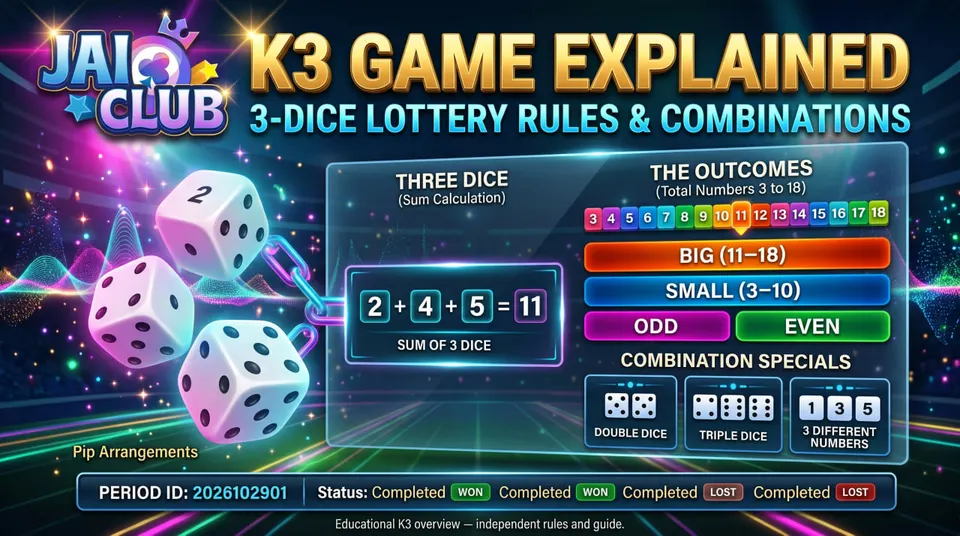
K3 and 5D both use multiple number values, but their structures are different.
K3 commonly produces three dice values between 1 and 6.
5D commonly produces five digits between 0 and 9.
For example, the K3 dice combination 2-4-5 gives a total of 11.
The 5D sequence 3-8-1-6-0 gives a total of 18.
A three-dice total and a five-digit sum are not calculated from the same set of possible outcomes.
For further information, visit the K3 & 5D category and read our article about Jai Club K3 Game and Three-Dice Results.
Can Previous 5D Results Predict the Next Number?
In a properly functioning game based on independently generated random outcomes, earlier results do not determine the next five-digit sequence.
For example, a repeated digit in Position A does not establish that another particular digit must appear in the following round.
Likewise, the absence of a certain total from recent history does not mean that the total is due to appear.
Historical data describes completed rounds. It should not be interpreted as a guaranteed prediction system.
Frequently Asked Questions
What does 5D mean in Jai Club Game?
5D commonly refers to a number-based game format involving five result positions.
What are A, B, C, D and E in 5D?
They identify the five digit positions within a complete result.
What numbers can appear in Jai Club 5D?
A commonly documented format uses digits from 0 to 9 in each position.
What is the highest possible 5D sum?
The maximum possible sum is 45, produced by five digits of 9.
What is the lowest possible 5D sum?
The minimum possible sum is 0, produced by five digits of 0.
Does the 5D sum represent a sixth digit?
Not in the mathematical format described here. The sum is derived by adding the five individual digits.
What is the difference between Jai Club K3 and 5D?
K3 commonly uses three dice numbered 1 to 6, while 5D commonly uses five digit positions containing values from 0 to 9.
Can a Jai Club 5D result chart predict future outcomes?
Past results alone cannot reliably predict the next outcome in an independently random game.
Conclusion
The Jai Club 5D Game uses a five-position number structure that can be understood through individual digits, their classifications and the total sum.
Position labels such as A, B, C, D and E help organise the result, while the sum provides another way of describing the five values together.
Understanding these distinctions makes historical records easier to read without mistaking them for predictions.
Disclaimer: JaiClubGame.online is an independent information website and is not officially affiliated with Jai Club. This article is educational and does not provide betting recommendations or guaranteed predictions. Real-money games involve financial risk and may be restricted or prohibited in your jurisdiction.