How Many Ways Can Three K3 Dice Produce the Same Total?
Explore how different ordered three-dice combinations can produce the same total, why middle sums have more possibilities and how the 216-outcome mathematical model works.

In this article
- What Does a K3 Total Mean?
- Three Dice Me Kitne Outcomes Hote Hain?
- Why Dice Order Matters
- EXAMPLE: Three Ways to Produce Total 10
- Why Some Combinations Have More Arrangements
- How Many Ways Can Three Dice Produce Each Total?
- Why Total 10 and Total 11 Have the Most Combinations
- EXAMPLE: Calculating Total 9 Probability
- Total vs Exact Dice Combination
- How to Count a Total Manually
- Why Total 3 Has Only One Outcome
- Why the Distribution Is Symmetrical
- EXAMPLE: Matching Opposite Totals
- Triple, Double and All-Different Results
- K3 Total Aur Pattern Me Kya Difference Hai?
- Can a Previous Total Change the Next Round?
- Are K3 Digital Games the Same as Physical Dice?
- Frequently Asked Questions
- How many ordered combinations are possible with three dice?
- Which K3 totals have the most combinations?
- How many combinations produce total 9?
- Can different dice patterns have the same total?
- Does dice order affect the total?
- Why are totals 3 and 18 uncommon?
- Does a previous result affect the next independent round?
- Are these official Jai Club K3 odds?
- Conclusion
Three K3 dice can produce the same total in several different ways. For example, the combinations 1-3-6, 2-3-5 and 2-4-4 all produce a sum of 10, although their individual dice values are different.
The number of possible combinations is important when understanding three-dice mathematics.
Under a model involving three independent fair six-sided dice, there are 216 equally likely ordered outcomes.
These outcomes can be grouped by total sums ranging from 3 to 18.
This guide explains how combination counting works, why dice order matters and how to distinguish the probability of a total from the probability of one exact arrangement.
What Does a K3 Total Mean?
A K3 total generally refers to the sum of three displayed dice values.
Each conventional six-sided die can show a number from 1 to 6.
The smallest possible total is:
1 + 1 + 1 = 3.
The largest possible total is:
6 + 6 + 6 = 18.
Therefore, there are sixteen possible numerical totals from 3 through 18.
However, these totals do not all have the same probability.
Their likelihood depends on how many ordered combinations produce each sum.
Three Dice Me Kitne Outcomes Hote Hain?
One six-sided die has six possible results.
Three independent dice have:
6 × 6 × 6 = 216
possible ordered outcomes.
The word ordered matters because each die occupies a distinguishable position.
For example, the outcomes 1-2-3 and 3-2-1 are different ordered arrangements.
Both have the same total of 6.
Under the fair independent model, each ordered result has a probability of 1/216.
This is a mathematical assumption, not a verified Jai Club probability model.
Why Dice Order Matters
Consider the values 1, 3 and 6.
They can appear in six distinct ordered arrangements:
1-3-6
1-6-3
3-1-6
3-6-1
6-1-3
6-3-1
All six produce a total of 10.
If a game evaluates only the sum, these arrangements belong to the same total category.
If a game evaluates the exact dice order, they are different outcomes.
The relevant rules determine which information matters.
EXAMPLE: Three Ways to Produce Total 10
| Dice values | Total | Pattern |
|---|---|---|
| 1, 3, 6 | 10 | All different |
| 2, 3, 5 | 10 | All different |
| 2, 4, 4 | 10 | Exactly two matching |
| 3, 3, 4 | 10 | Exactly two matching |
EXAMPLE ONLY: These are mathematical combinations rather than actual Jai Club records.
The example shows that the same total can come from different matching patterns.
A sum alone does not reveal the exact dice arrangement.
Why Some Combinations Have More Arrangements
Three different dice values can be arranged in six ways.
For example, 1-3-6 has six permutations.
A group containing two matching dice has only three distinct arrangements.
For example, 2-4-4 can be ordered as:
2-4-4
4-2-4
4-4-2
A Triple such as 3-3-3 has only one distinct arrangement.
These differences are important when counting ordered outcomes.
How Many Ways Can Three Dice Produce Each Total?
The full distribution for three independent fair six-sided dice is:
| Total | Ordered combinations | Probability |
|---|---|---|
| 3 | 1 | 0.46% |
| 4 | 3 | 1.39% |
| 5 | 6 | 2.78% |
| 6 | 10 | 4.63% |
| 7 | 15 | 6.94% |
| 8 | 21 | 9.72% |
| 9 | 25 | 11.57% |
| 10 | 27 | 12.50% |
| 11 | 27 | 12.50% |
| 12 | 25 | 11.57% |
| 13 | 21 | 9.72% |
| 14 | 15 | 6.94% |
| 15 | 10 | 4.63% |
| 16 | 6 | 2.78% |
| 17 | 3 | 1.39% |
| 18 | 1 | 0.46% |
| Total | 216 | 100% |
Percentages are rounded.
The exact fractions are obtained by dividing the combination count by 216.
The result is a symmetrical distribution.
Why Total 10 and Total 11 Have the Most Combinations
Totals near the centre of the possible range can be produced through more value arrangements.
For example, total 10 has 27 ordered outcomes.
Total 11 also has 27.
By contrast, total 3 is possible only through 1-1-1.
Total 18 is possible only through 6-6-6.
The middle totals therefore have more qualifying combinations.
This is a property of the mathematical model rather than a recent-game trend.
EXAMPLE: Calculating Total 9 Probability
Under the fair three-dice model, total 9 has 25 qualifying ordered outcomes.
Therefore:
P(Total 9) = 25/216.
This is approximately:
11.574%.
A total of 9 is therefore theoretically more likely than a total of 4, which has only three qualifying ordered outcomes.
However, this does not mean that total 9 must appear more frequently in every short sample.
Actual sequences can fluctuate around the theoretical distribution.
Total vs Exact Dice Combination
A total describes the sum.
An exact combination describes the values and their order.
For example, total 9 includes the exact ordered outcome 1-2-6.
It also includes 2-3-4 and other arrangements.
Under the independent fair model, one exact ordered outcome has probability:
1/216 ≈ 0.463%.
However, the broader total 9 category has probability:
25/216 ≈ 11.574%.
These are different events.
They should not be compared using the same probability baseline.
How to Count a Total Manually
One method is to list all possible values for the first two dice.
For each pair, calculate the value required on the third die to reach the target total.
For example, to make total 9:
Third die = 9 − First die − Second die.
If the required value lies between 1 and 6, the combination is valid.
If it falls outside that range, the combination is impossible.
Repeating this for all first-die and second-die values gives the total number of ordered outcomes.
This method can be used to verify the complete distribution.
Why Total 3 Has Only One Outcome
The smallest value on each standard die is 1.
Therefore, the smallest possible sum is 3.
To obtain that sum, every die must show the minimum value.
The only valid arrangement is 1-1-1.
There are no alternative values that produce the same total.
This explains why the combination count at the lower extreme is one.
The upper extreme works in the same way for 6-6-6.
Why the Distribution Is Symmetrical
Every die value can be paired with its opposite value under the transformation:
New value = 7 − Original value.
For example, 1 becomes 6 and 2 becomes 5.
If the original three-dice sum is S, the transformed sum becomes 21 − S.
Therefore, every combination producing total 8 corresponds to one producing total 13.
The number of combinations is equal.
This is why the distribution is symmetrical around totals 10 and 11.
EXAMPLE: Matching Opposite Totals
| Original dice | Original total | Transformed dice | New total |
|---|---|---|---|
| 1, 2, 3 | 6 | 6, 5, 4 | 15 |
| 2, 3, 5 | 10 | 5, 4, 2 | 11 |
| 1, 4, 5 | 10 | 6, 3, 2 | 11 |
The transformation demonstrates the symmetry mathematically.
It does not predict the next K3 outcome.
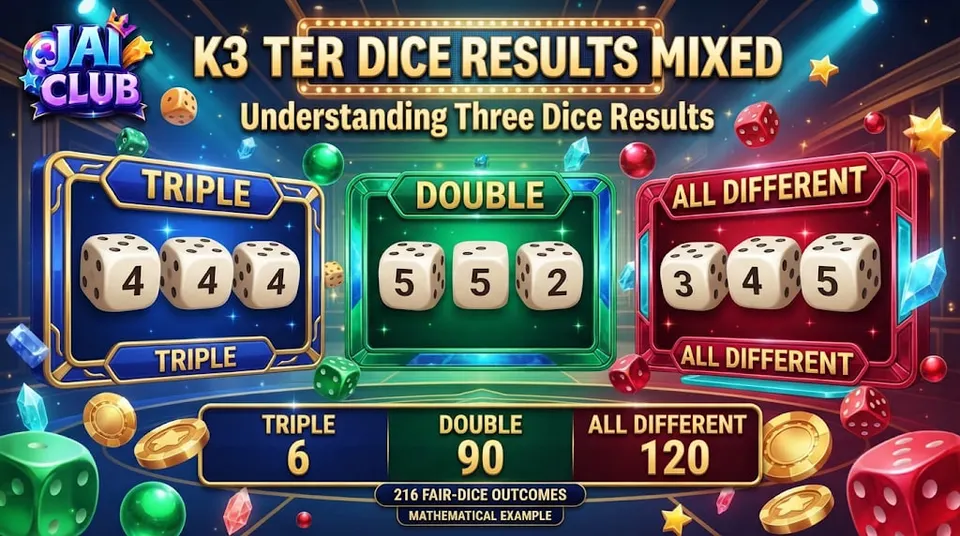
Triple, Double and All-Different Results
Three dice can also be classified by their matching pattern.
Triple means all three values match.
Exactly Double means two match and the third is different.
All Different means none of the values match.
These categories are separate from the total sum.
For example, 4-4-4 has total 12 and is a Triple.
The combination 5-5-2 also has total 12 but contains exactly two matching dice.
The combination 3-4-5 has total 12 and contains three different values.
The sum alone cannot identify the matching pattern.
K3 Total Aur Pattern Me Kya Difference Hai?
A total is a numerical calculation.
A matching pattern describes the relationship between individual dice values.
The two can overlap.
For example, a result may be classified as total 12, Even and Triple.
However, game settlement rules can treat these categories differently.
The mathematical classifications do not automatically establish payout conditions.
Readers should consult the actual product rules before making provider-specific interpretations.
Can a Previous Total Change the Next Round?
Not under the independent fair-dice model.
For example, if total 10 appears in one round, the probability of total 10 in the next independent round remains 27/216.
A previous occurrence does not force the next result to change.
Likewise, a long absence of total 10 does not make it guaranteed.
Historical records can be counted, but their sequence does not automatically establish future predictions.
Are K3 Digital Games the Same as Physical Dice?
Digital games may use software to generate numerical outcomes.
The exact mathematical model depends on the implementation.
The fair three-dice distribution is a useful benchmark for understanding combinations.
However, it should not automatically be treated as an audited description of a particular digital game.
Actual probability and settlement claims require reliable game-specific documentation.
For more general K3 information, read the Jai Club Game FAQ.
Frequently Asked Questions
How many ordered combinations are possible with three dice?
There are 216 under the independent fair six-sided dice model.
Which K3 totals have the most combinations?
Totals 10 and 11 each have 27 ordered combinations.
How many combinations produce total 9?
Exactly 25 ordered outcomes under the standard model.
Can different dice patterns have the same total?
Yes. Triple, Double and All-Different arrangements can produce the same sum.
Does dice order affect the total?
It does not change the sum, but it changes the exact ordered outcome.
Why are totals 3 and 18 uncommon?
Each can be produced by only one ordered outcome.
Does a previous result affect the next independent round?
No. Previous outcomes do not change fixed theoretical probabilities under an independent model.
Are these official Jai Club K3 odds?
No. The figures describe a mathematical model, not independently verified provider odds.
Conclusion
Three K3 dice can produce the same total through many different arrangements.
Under the standard independent fair-dice model, the 216 ordered outcomes form a symmetrical distribution of totals from 3 to 18.
Understanding combination counts helps distinguish sums, exact dice order and matching patterns without turning historical statistics into unsupported predictions.
Editorial method: All counts use exact combinatorics for three independent fair six-sided dice.
Disclaimer: JaiClubGame.online is an independent educational website. Actual provider rules and game probabilities must be verified separately.