Triple, Double or Mixed? Understanding Three Dice in K3
Understand the difference between three identical dice, exactly two matching dice and three different dice, including exact mathematical probabilities and why dice patterns differ from total sums.
In this article
- What Is a K3 Triple?
- K3 Double Kya Hota Hai?
- What Is a Mixed Dice Result?
- Triple vs Double vs Mixed
- How Many K3 Outcomes Are Possible?
- EXAMPLE: Counting Triple Outcomes
- How Many Exactly Double Outcomes Exist?
- How Many All-Different Outcomes Exist?
- Complete K3 Pattern Probability Table
- Why a Triple Is Less Common
- Triple Sum vs Double Sum
- EXAMPLE: Three Results With Total 12
- K3 Triple Me Odd Even Kaise Work Karta Hai?
- Exact Triple vs Any Triple
- Does a Double Always Mean Two Consecutive Positions?
- Can a Triple Appear Twice in a Row?
- Does a Recent Triple Change the Next Round?
- Can Digital K3 Odds Differ From Fair Dice?
- Why Payout Rules Are Separate
- Frequently Asked Questions
- What is a Triple in K3?
- K3 Double Kya Hota Hai?
- What does Mixed mean in this guide?
- How many Triple outcomes exist?
- What is the probability of an exact Double pattern?
- How many All-Different outcomes exist?
- Can Triple and Double have the same total sum?
- Does a previous Triple predict the next result?
- Are these verified Jai Club K3 odds?
- Conclusion
A K3 dice result can be grouped by whether the three dice show identical, partly matching or completely different values.
Under a standard three-dice model, a Triple means all three dice match. A Double means exactly two dice match, while a Mixed or All-Different result means every die shows a different value.
These patterns are separate from the total sum of the dice.
For readers researching Jai Club K3 Triple Dice, the distinction matters because several combinations can have the same sum without belonging to the same matching pattern.
This guide explains the mathematical categories using three independent fair six-sided dice. The word Mixed is used here as an educational label for all-distinct outcomes, not as a verified settlement category of every Jai Club K3 game.
What Is a K3 Triple?
A Triple occurs when all three dice have the same value.
For example:
1 + 1 + 1
3 + 3 + 3
6 + 6 + 6
Each outcome contains three identical dice.
Under a conventional six-sided model, there are six possible ordered Triple outcomes.
These range from (1,1,1) through (6,6,6).
A Triple is therefore a specific matching pattern rather than merely a high or low sum.
K3 Double Kya Hota Hai?
A Double means exactly two dice show the same value and the third die shows something different.
For example:
2, 2, 5
4, 1, 4
6, 3, 3
Each result contains one matching pair.
The remaining die has a different value.
A Triple should not be counted as exactly one Double because all three dice match.
This distinction is important when calculating probabilities.
The word exactly prevents the categories from overlapping.
What Is a Mixed Dice Result?
For this mathematical comparison, Mixed means all three dice have different values.
For example:
1, 3, 6
2, 4, 5
6, 1, 2
No die shares its value with another.
These outcomes can produce different sums, and several arrangements may have the same total.
However, not every K3 game uses the word Mixed as an official result label.
Some providers may use terminology such as All Different or other categories.
The actual product rules should be checked.
Triple vs Double vs Mixed
| Category | Matching pattern | Example |
|---|---|---|
| Triple | All three values equal | 4, 4, 4 |
| Exactly one Double | Two equal, one different | 4, 4, 2 |
| Mixed / All Different | Three different values | 4, 2, 6 |
These categories describe the pattern of dice values.
They do not automatically specify payout conditions.
A game may evaluate the same dice through several other rules, including total sum or Odd/Even classification.
How Many K3 Outcomes Are Possible?
Each ordinary six-sided die has six possible values.
With three independent dice, the total number of ordered outcomes is:
6 × 6 × 6 = 216.
The word ordered matters.
For example, (1,2,3) and (3,2,1) are different ordered outcomes.
They have the same sum and matching pattern, but the individual dice occupy different positions.
The 216-outcome model provides the foundation for comparing Triple, Double and All-Different probabilities.
EXAMPLE: Counting Triple Outcomes
A Triple requires all three dice to match.
The possible outcomes are:
(1,1,1)
(2,2,2)
(3,3,3)
(4,4,4)
(5,5,5)
(6,6,6)
There are exactly six ordered Triple outcomes.
Under the fair independent model:
P(Triple) = 6 ÷ 216 = 1/36.
That is approximately 2.78%.
The calculation is theoretical and does not establish actual provider odds.
How Many Exactly Double Outcomes Exist?
To count outcomes with exactly two matching dice, begin by choosing the repeated value.
There are six possibilities.
Next, choose the different value.
There are five remaining possibilities.
Finally, select which of the three dice positions contains the different value.
There are three possibilities.
The count is:
6 × 5 × 3 = 90.
Therefore, exactly 90 of the 216 ordered outcomes contain one matching pair and one different value.
The theoretical probability is:
90 ÷ 216 = 5/12 ≈ 41.67%.
How Many All-Different Outcomes Exist?
To count three different dice values, choose the first value in six ways.
The second value must be different, leaving five choices.
The third value must differ from both earlier values, leaving four choices.
Therefore:
6 × 5 × 4 = 120.
There are 120 ordered outcomes containing three different values.
The theoretical probability is:
120 ÷ 216 = 5/9 ≈ 55.56%.
This is the largest of the three matching-pattern categories under the fair-dice model.
Complete K3 Pattern Probability Table
| Pattern | Ordered outcomes | Theoretical probability |
|---|---|---|
| Triple | 6 | 2.78% |
| Exactly one Double | 90 | 41.67% |
| All Different | 120 | 55.56% |
| Total | 216 | 100% |
The percentages are rounded.
The exact fractions add up to one.
Every ordered three-dice outcome belongs to exactly one of these categories.
This is because a result must have either three identical values, exactly two matching values or three different values.
EXAMPLE MODEL: Three independent fair six-sided dice.
Why a Triple Is Less Common
A Triple requires all three dice to show the same value.
After the first die is known, the second and third must match it.
By comparison, an All-Different outcome allows many more combinations.
For example, once the first value is chosen, the second can take five different values and the third can take four values not already used.
This creates many more All-Different arrangements.
The difference comes from the number of qualifying outcomes rather than a recent historical pattern.
Triple Sum vs Double Sum
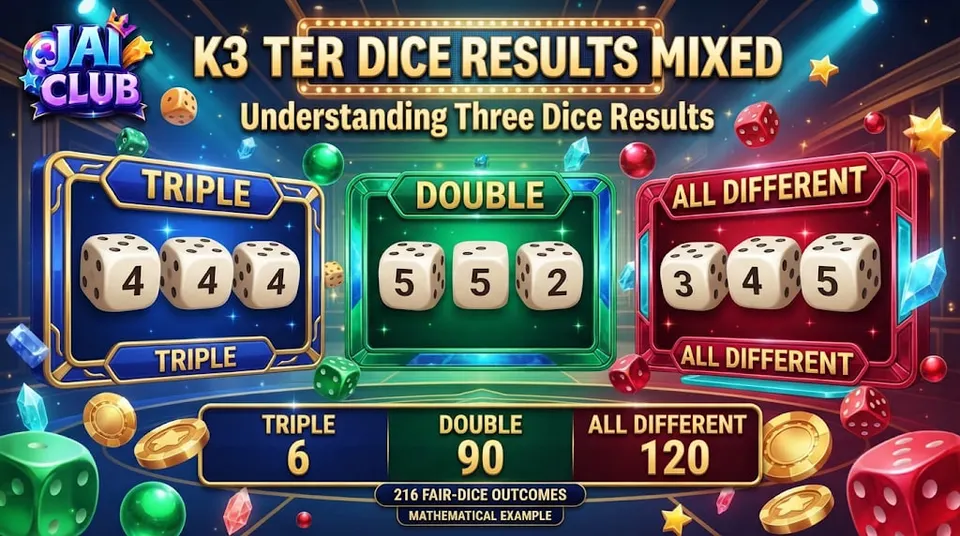
A matching pattern and a dice sum are separate classifications.
For example:
Triple: 4,4,4 gives total 12.
Double: 5,5,2 also gives total 12.
All Different: 3,4,5 also gives total 12.
The three outcomes share the same sum but belong to different matching categories.
This illustrates why a total alone cannot identify the dice pattern.
A complete result needs the values of the individual dice when matching categories matter.
EXAMPLE: Three Results With Total 12
| Dice | Sum | Pattern |
|---|---|---|
| 4, 4, 4 | 12 | Triple |
| 5, 5, 2 | 12 | Exactly one Double |
| 3, 4, 5 | 12 | All Different |
All three examples have total 12.
However, they have different matching structures.
A rule concerning the total is therefore not necessarily the same as a rule concerning Triple or Double.
For more detail on exact positions, read K3 Exact Dice Order vs Total.
K3 Triple Me Odd Even Kaise Work Karta Hai?
A Triple can produce either an Odd or Even sum.
For example:
1 + 1 + 1 = 3, which is Odd.
2 + 2 + 2 = 6, which is Even.
3 + 3 + 3 = 9, which is Odd.
These arithmetic classifications can coexist with the Triple pattern.
However, actual game settlement rules may exclude particular combinations from certain selection categories.
The mathematical parity of a sum and the rules for settling a selection should be distinguished.
Exact Triple vs Any Triple
An exact Triple identifies a specific matching result.
For example, (3,3,3) is one exact ordered outcome.
Any Triple includes all six identical-value outcomes.
Under the fair-dice model:
P(Exact 3,3,3) = 1/216 ≈ 0.463%.
P(Any Triple) = 6/216 ≈ 2.78%.
These are different probabilities because the second category includes more qualifying outcomes.
A game's payout rules may distinguish between them.
Does a Double Always Mean Two Consecutive Positions?
No.
Exactly two matching dice can occupy any two of the three positions.
For example:
(2,2,5)
(2,5,2)
(5,2,2)
All three outcomes contain exactly one matching pair.
They have the same values but different arrangements.
This is why the Double calculation includes a factor of three for the possible position of the different die.
The positions do not need to be adjacent.
Can a Triple Appear Twice in a Row?
Yes.
Under a hypothetical model with independent rounds, consecutive Triple results are possible.
The probability of a Triple in one round is 1/36.
For two specified consecutive rounds both producing any Triple:
(1/36) × (1/36) = 1/1296.
That is approximately 0.0772%.
This probability assumes independent rounds and the same fair-dice model.
A consecutive sequence may be uncommon without being impossible.
It does not automatically establish manipulation or prediction ability.
Does a Recent Triple Change the Next Round?
Not under the independent fair-dice model.
If a Triple appears in one round, the next round still follows the same theoretical distribution.
The probability of another Triple remains 1/36.
Similarly, a long history without a Triple does not make one guaranteed.
Past results do not force the future sequence to balance immediately.
A result-history chart may describe completed patterns, but it does not automatically identify the next outcome.
Can Digital K3 Odds Differ From Fair Dice?
Yes, if the actual mathematical model differs.
A digital implementation may use software to generate results.
Its documented probability model and payout rules are relevant to determining the actual odds.
The counts in this article describe standard independent fair dice.
They should not be presented as verified probabilities for a specific Jai Club game without further technical evidence.
Even with the same theoretical probabilities, different settlement rules can produce different financial outcomes.
Why Payout Rules Are Separate
Probability describes how likely an outcome is.
A payout table describes what happens when a qualifying selection matches an outcome.
For example, a Triple category has a relatively low probability in the fair-dice model.
However, this does not establish its actual payout multiplier.
Similarly, the most frequent matching category is not automatically the most financially favourable.
Expected return depends on both probabilities and settlement values.
The game's paytable must be checked before discussing specific payouts.
Frequently Asked Questions
What is a Triple in K3?
A Triple means all three dice show the same value.
K3 Double Kya Hota Hai?
Exactly two dice match and the third has a different value.
What does Mixed mean in this guide?
Mixed means all three dice have different values. This is an educational label, not necessarily the provider's official terminology.
How many Triple outcomes exist?
Six ordered Triple outcomes exist under the standard three-dice model.
What is the probability of an exact Double pattern?
The probability of exactly two matching dice is 90/216, approximately 41.67%.
How many All-Different outcomes exist?
There are 120 ordered outcomes, approximately 55.56%.
Can Triple and Double have the same total sum?
Yes. Different matching patterns can produce the same total.
Does a previous Triple predict the next result?
No. A previous outcome does not change probabilities under an independent fair-dice model.
Are these verified Jai Club K3 odds?
No. They are exact probabilities for the stated mathematical model.
Conclusion
K3 dice outcomes can be classified into three mathematical matching patterns: Triple, exactly one Double and All Different.
Under a fair independent three-dice model, these categories contain 6, 90 and 120 ordered outcomes respectively.
Understanding the distinction helps readers interpret dice combinations without confusing matching patterns, exact order and total sum.
Editorial method: All calculations use exact counting for three independent fair six-sided dice. The label Mixed is explicitly defined for educational purposes.
Disclaimer: JaiClubGame.online is an independent educational website. Actual K3 game rules, settlement conditions and provider probabilities require verification.