A 5D SUM of 20 Can Come From Thousands of Different Sequences
Understand how a 5D SUM of 20 can be produced by many different five-digit sequences, why number order matters, and how to calculate the total number of possible outcomes.

In this article
- What Does 5D SUM Mean?
- 5D SUM 20 Kaise Banta Hai?
- Five Positions Make Order Important
- EXAMPLE: Different Results With the Same SUM
- How Many Possible 5D Sequences Exist?
- How Many Sequences Produce SUM 20?
- 5D SUM 20 Probability Kitni Hai?
- Why SUM 20 Is Not a Single Result
- Why Middle SUM Values Have More Combinations
- Does SUM 20 Guarantee a Particular Digit?
- Repeated Digits and Different Sequences
- Can a Leading Zero Produce SUM 20?
- Does a Previous SUM Affect the Next Result?
- SUM 20 vs Individual Position Predictions
- Can the Same SUM Appear Several Times?
- Frequently Asked Questions
- How many 5D sequences have SUM 20?
- What is the theoretical probability of 5D SUM 20?
- Is SUM 20 the same as a five-digit result?
- Can a 5D result beginning with zero have SUM 20?
- Does digit order matter in 5D?
- Is SUM 20 equally likely as SUM 0?
- Does SUM 20 appearing recently affect the next round?
- Are these confirmed Jai Club 5D probabilities?
- Conclusion
A Jai Club 5D SUM of 20 can represent many different five-digit results. For example, 4-4-4-4-4 and 9-5-3-2-1 both have a total of 20, even though their individual digits and positions are different.
Under a mathematical model with five independently generated digits from 0 through 9, there are 100,000 possible ordered sequences. Exactly 5,631 of these sequences have a digit sum of 20.
This guide explains why so many combinations exist, how A–E positions affect the outcome, and why a matching sum is not equivalent to a matching five-digit result.
The calculations describe a hypothetical uniform model, not independently verified odds for a particular Jai Club game.
What Does 5D SUM Mean?
In a commonly described 5D format, the result contains five digit positions.
These are often labelled A, B, C, D and E.
Each position contains one digit from 0 through 9.
SUM is the total obtained by adding the five digits.
For example, consider the fictional result:
4 7 2 5 2
Its SUM is:
4 + 7 + 2 + 5 + 2 = 20
The five-position result and the SUM describe different information.
One identifies the ordered digits, while the other gives their combined total.
5D SUM 20 Kaise Banta Hai?
Many different sequences can produce a total of 20.
For example:
4 + 4 + 4 + 4 + 4 = 20
9 + 5 + 3 + 2 + 1 = 20
8 + 6 + 4 + 2 + 0 = 20
7 + 7 + 3 + 2 + 1 = 20
6 + 6 + 6 + 1 + 1 = 20
These examples have different individual digits but the same total.
Some also have different numbers of repeated digits.
This shows why SUM 20 cannot identify one unique five-digit sequence.
Five Positions Make Order Important
The positions A, B, C, D and E distinguish the digits by location.
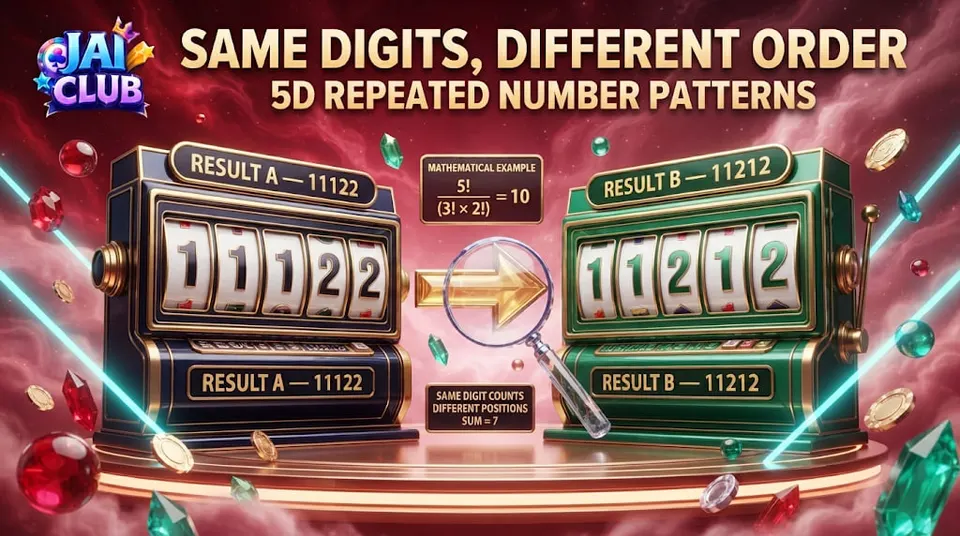
For example, 95321 and 12359 contain the same five digits.
Both produce a SUM of 20.
However, they are different ordered sequences.
If a game evaluates individual positions, those differences matter.
A calculation involving only the SUM ignores the order of the digits.
Therefore, SUM-related and exact-position outcomes should not be treated as equivalent.
EXAMPLE: Different Results With the Same SUM
| Position A–E | Calculation | SUM |
|---|---|---|
| 4 4 4 4 4 | 4+4+4+4+4 | 20 |
| 9 5 3 2 1 | 9+5+3+2+1 | 20 |
| 8 6 4 2 0 | 8+6+4+2+0 | 20 |
| 7 7 3 2 1 | 7+7+3+2+1 | 20 |
| 6 6 6 1 1 | 6+6+6+1+1 | 20 |
| 0 0 9 9 2 | 0+0+9+9+2 | 20 |
EXAMPLE ONLY: These are mathematical examples rather than actual Jai Club 5D results.
The last example also shows why leading zeros matter.
A result displayed as 00992 should be preserved as a five-position sequence rather than converted into the ordinary four-digit number 992.
How Many Possible 5D Sequences Exist?
Under a hypothetical format where each of the five positions independently contains one of ten digits, the total number of ordered outcomes is:
10 × 10 × 10 × 10 × 10 = 100,000.
This count includes sequences beginning with zero.
For example, 00000 and 00001 are both valid five-position sequences under the assumed model.
The count is based on ordered sequences rather than ordinary five-digit integers.
If leading zeros were excluded or the provider used a different digit model, the calculation would change.
How Many Sequences Produce SUM 20?
The exact number is 5,631 under the stated mathematical model.
To derive it, we count solutions to:
A + B + C + D + E = 20
where each digit is an integer between 0 and 9.
If there were no upper limit of 9, the number of non-negative integer solutions would be:
C(24,4) = 10,626.
However, that includes invalid cases where a digit is 10 or more.
Using inclusion-exclusion, subtract the cases where at least one digit exceeds 9, then correct for double counting.
The calculation is:
C(24,4) − 5 × C(14,4) + 10 × C(4,4)
= 10,626 − 5,005 + 10
= 5,631.
This is the exact count of ordered five-digit sequences with SUM 20 under the model.
5D SUM 20 Probability Kitni Hai?
If all 100,000 ordered sequences are equally likely, the probability of SUM 20 is:
5,631 ÷ 100,000 = 0.05631.
Expressed as a percentage:
0.05631 × 100 = 5.631%.
Therefore, the theoretical probability of SUM 20 is 5.631% under this hypothetical independent uniform five-digit model.
This is not a verified probability for an actual Jai Club 5D implementation.
The actual result-generation model would need to be established separately.
Why SUM 20 Is Not a Single Result
An exact five-position result specifies the value at every position.
SUM 20 specifies only the combined total.
For example, the exact sequence 44444 is one possible outcome.
The SUM 20 category contains 5,631 outcomes under the assumed model.
These events have very different theoretical probabilities.
Under the uniform sequence model, a specified exact sequence has probability:
1 ÷ 100,000 = 0.001%.
The broader SUM 20 category has probability 5.631%.
Comparing their likelihoods without recognising the difference in outcome definitions would be misleading.
Why Middle SUM Values Have More Combinations
The minimum possible SUM is 0.
The maximum is:
9 + 9 + 9 + 9 + 9 = 45.
Extreme totals have fewer possible sequences.
For example, SUM 0 requires all five digits to be zero.
SUM 45 requires all five digits to be nine.
Middle totals can be formed through many different combinations.
That is why the distribution of sums is concentrated towards the centre rather than being uniform across all 46 possible totals.
The exact shape follows from the underlying digit model.
Does SUM 20 Guarantee a Particular Digit?
No.
A SUM of 20 does not uniquely identify any one position.
For example, Position A may be zero in one qualifying sequence and nine in another.
The other four digits can compensate to produce the same total.
Therefore, knowing only the SUM is insufficient to reconstruct the exact result.
A complete 5D record should preserve the individual position values when those fields are relevant.
For the basic A–E structure, read Jai Club 5D Positions and SUM.
Repeated Digits and Different Sequences
A five-position result can contain repeated digits.
For example, 44444 contains five copies of the same digit.
Another result might contain five different digits.
Both types can produce SUM 20.
However, the number of unique arrangements of a particular set of digits depends on repetition.
For example, five distinct digits can have 5! = 120 arrangements.
Five identical digits have only one distinct arrangement.
The total of 5,631 includes all valid ordered sequences, accounting for those differences.
Can a Leading Zero Produce SUM 20?
Yes.
Under the assumed five-position format, zero contributes nothing to the total but remains a valid digit.
For example:
0 + 8 + 7 + 3 + 2 = 20.
The ordered result is 08732.
Removing the leading zero would change the representation from five positions to four characters.
It is therefore important to preserve the full sequence when comparing game results or creating spreadsheets.
Zero is not the same as a missing digit.
Does a Previous SUM Affect the Next Result?
Not in an independent uniform model.
Suppose one fictional round produces SUM 20.
That does not mean the next round is less likely or more likely to produce SUM 20.
The probability remains 5.631% under the fixed model's assumptions.
Likewise, a long absence of SUM 20 does not make it mathematically due.
The belief that random outcomes must immediately balance their histories is the gambler's fallacy.
Historical results can be counted without establishing a reliable forecast.
SUM 20 vs Individual Position Predictions
A forecast of SUM 20 is broader than a forecast identifying all five exact digits.
The two tasks should not be compared using the same accuracy baseline.
For example, under the hypothetical uniform model, an exact specified sequence has a probability of 0.001%.
SUM 20 has a probability of 5.631%.
The difference comes from the number of qualifying outcomes.
However, prediction probabilities do not determine payout values.
Actual game settlement depends on rules that must be verified separately.
Can the Same SUM Appear Several Times?
Yes.
Different completed rounds can produce the same SUM.
They may even contain different five-digit sequences.
For example, SUM 20 could appear in one period as 44444 and in another as 95321.
That does not mean the same exact result was repeated.
A result-history analysis should distinguish SUM frequency from exact-sequence frequency.
These measure different things.
Frequently Asked Questions
How many 5D sequences have SUM 20?
Exactly 5,631 under a model with five ordered independent digits from 0 to 9.
What is the theoretical probability of 5D SUM 20?
5.631%, assuming all 100,000 five-digit sequences are equally likely.
Is SUM 20 the same as a five-digit result?
No. Many different ordered sequences can produce the same total.
Can a 5D result beginning with zero have SUM 20?
Yes. For example, 08732 has SUM 20.
Does digit order matter in 5D?
Yes, when interpreting the five individual positions.
Is SUM 20 equally likely as SUM 0?
No. Under the uniform model, SUM 20 has many more qualifying sequences.
Does SUM 20 appearing recently affect the next round?
Not under an independent fixed-probability model.
Are these confirmed Jai Club 5D probabilities?
No. They are exact mathematical calculations for a clearly stated hypothetical model.
Conclusion
A 5D SUM of 20 can be produced by thousands of different ordered five-digit sequences.
Under a uniform model with five independently generated digits from 0 to 9, exactly 5,631 of the 100,000 possible sequences have a total of 20.
Understanding this difference helps readers separate exact position results from broader SUM categories without treating historical numbers as guaranteed predictions.
Editorial method: Combination counts use exact mathematical enumeration through inclusion-exclusion. No actual Jai Club 5D result-generation system was audited.
Disclaimer: JaiClubGame.online is an independent educational website. The figures are theoretical examples, not verified game odds or guaranteed results.