5D Palindrome Numbers: How Many Five-Digit Results Read the Same Backwards?
Understand how palindromic five-digit results work in a 5D game, why their first and last positions match, and how to calculate the exact number of possible palindromes.
In this article
- What Is a Palindrome Number?
- 5D Palindrome Kaise Banta Hai?
- Understanding the A–E Positions
- EXAMPLE: Palindrome and Non-Palindrome Results
- How Many Five-Position Palindromes Exist?
- What About All Possible 5D Outcomes?
- EXAMPLE: Palindrome Probability
- Five-Digit Integer vs Five-Position Sequence
- How Many Ordinary Five-Digit Integers Are Palindromes?
- Why Leading Zeros Matter
- Palindromes and Repeated Digits
- Palindrome vs Exact Matching Positions
- Can a Palindrome Have Any SUM?
- EXAMPLE: Palindrome SUM Calculation
- Is a Palindrome More Likely After Several Non-Palindromes?
- What Does a Palindrome History Chart Show?
- Can a Palindrome Be Used for 5D Prediction?
- Frequently Asked Questions
- What is a 5D palindrome?
- How many palindromes exist in a five-position 0–9 model?
- How many ordinary five-digit palindromic integers exist?
- What is the theoretical probability of a 5D palindrome?
- Is 12321 a palindrome?
- Can a palindrome begin with zero?
- Does Jai Club 5D offer a palindrome payout?
- Does a long absence make a palindrome more likely next?
- Conclusion
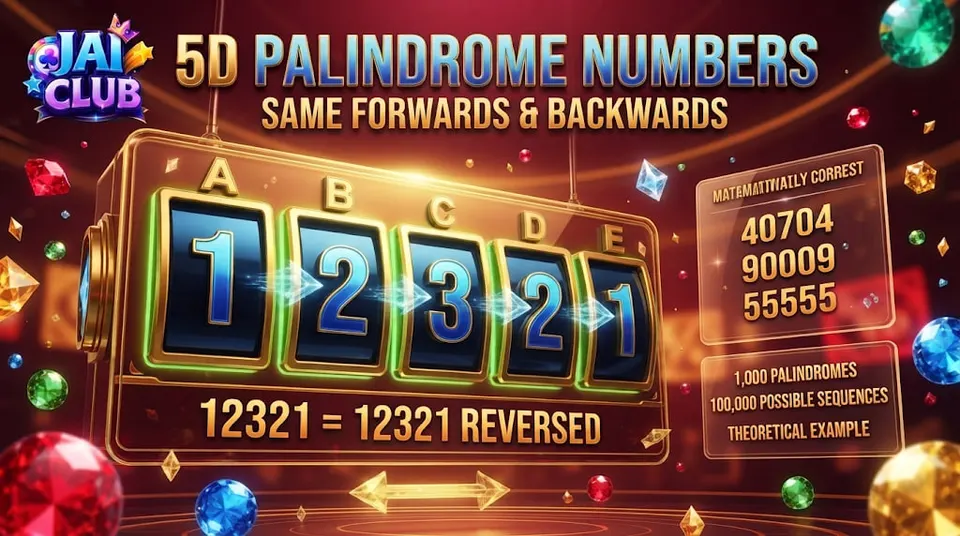
A 5D palindrome is a five-position digit sequence that reads the same from left to right and right to left.
For example, the sequence 12321 is a palindrome because reversing its digits produces the same sequence.
The same is true for 40704 and 99999.
In a mathematical 5D format containing five positions, palindromes follow a simple structure: the first digit matches the fifth, and the second matches the fourth.
This guide explains the structure, counting method and theoretical probability of palindromes under a uniform five-digit model.
It does not claim that palindrome results have special settlement rules in Jai Club.
What Is a Palindrome Number?
A palindrome is a sequence that remains unchanged when its order is reversed.
The idea applies to words, numbers and other ordered symbols.
For example, 121 is a three-digit palindrome.
A five-position example is 12321.
Reversing 12321 still gives 12321.
However, a sequence such as 12345 is not a palindrome because its reverse is 54321.
In a game using five ordered digit positions, the same concept can be applied to the completed result.
5D Palindrome Kaise Banta Hai?
A five-position palindrome follows the pattern:
A B C B A
The first and last positions must contain the same digit.
The second and fourth positions must also match.
The middle digit can be any permitted value.
For example:
4 0 7 0 4
The first and fifth digits are both 4.
The second and fourth digits are both 0.
The centre is 7.
Therefore, 40704 is a palindrome.
Understanding the A–E Positions
A commonly described 5D format uses five positions labelled A, B, C, D and E.
For a palindrome, the required relationships are:
A = E
B = D
C can be any digit.
This means only the first three positions need to be chosen independently.
Once A, B and C are known, D and E are fixed by the palindrome rule.
That structure provides a straightforward way to count every possible result.
EXAMPLE: Palindrome and Non-Palindrome Results
| Five-position result | Reversed result | Palindrome? |
|---|---|---|
| 12321 | 12321 | Yes |
| 40704 | 40704 | Yes |
| 99999 | 99999 | Yes |
| 01210 | 01210 | Yes |
| 12345 | 54321 | No |
| 22112 | 21122 | No |
EXAMPLE ONLY: These are mathematical sequences, not live Jai Club results.
The example 01210 demonstrates why leading zeros need to be preserved in a five-position format.
How Many Five-Position Palindromes Exist?
Assume each of the five positions can contain any digit from 0 through 9.
There are ten choices for Position A.
There are ten choices for Position B.
There are ten choices for Position C.
Positions D and E are then determined.
Therefore:
10 × 10 × 10 = 1,000.
There are exactly 1,000 palindromic five-position sequences under this model.
This count includes sequences beginning with zero.
It is a mathematical result, not an audited Jai Club game statistic.
What About All Possible 5D Outcomes?
If five digits are independently selected from 0 through 9, the number of ordered sequences is:
10 × 10 × 10 × 10 × 10 = 100,000.
This includes results such as 00000, 00001 and 99999.
The palindrome count is 1,000.
Therefore, the share of all possible sequences that are palindromes is:
1,000 ÷ 100,000 = 0.01.
That equals 1%.
Under an independent uniform model, the theoretical probability of a palindromic result is 1%.
EXAMPLE: Palindrome Probability
| Measurement | Value |
|---|---|
| Possible values per position | 10 |
| Number of positions | 5 |
| Total ordered sequences | 100,000 |
| Palindromic sequences | 1,000 |
| Theoretical proportion | 1% |
These values assume all ordered five-position sequences are equally likely.
The actual probability could differ if a game uses another outcome-generation model.
Five-Digit Integer vs Five-Position Sequence
There is an important distinction between an ordinary five-digit integer and a five-position sequence.
An ordinary five-digit integer cannot begin with zero.
Therefore, the integer range 10000 to 99999 contains 90,000 values.
A 5D-style sequence may preserve leading zeros and represent 00000 through 99999 as five-position results.
That produces 100,000 possible sequences.
The distinction changes the palindrome count.
Readers must identify which definition applies before interpreting statistics.
How Many Ordinary Five-Digit Integers Are Palindromes?
For an ordinary five-digit integer, the first digit must be between 1 and 9.
There are nine choices for the first digit.
The second digit has ten choices.
The middle digit also has ten choices.
The final two digits are determined by symmetry.
Therefore:
9 × 10 × 10 = 900.
There are 900 ordinary five-digit palindromic integers.
This differs from the 1,000 five-position palindrome sequences that allow leading zeros.
Both counts are correct under their respective definitions.
Why Leading Zeros Matter
Consider the sequence:
0 1 2 1 0
As a five-position string, it is a palindrome.
If software removes the leading zero, it becomes 1210.
The resulting four-character representation is no longer a palindrome.
This does not mean the original sequence changed.
It means its display format was altered.
When examining 5D records, the five positions should be preserved if the game treats leading zeros as meaningful.
A spreadsheet should import such identifiers and results carefully.
Palindromes and Repeated Digits
A palindrome does not require all five digits to be identical.
For example, 12321 is a palindrome despite containing several different digits.
Likewise, 77777 is a palindrome because it reads identically in both directions.
The important condition is symmetry around the centre.
Repeated digits alone do not guarantee a palindrome.
For example, 11223 contains repeated digits but does not read the same backwards.
The position relationships matter.
Palindrome vs Exact Matching Positions
A palindromic result imposes two matching relationships.
Position A must match E, and B must match D.
A game could theoretically evaluate particular positions or exact combinations separately.
However, the palindrome pattern itself does not establish any official selection category.
A mathematical property of a result is not automatically a recognised payout feature.
Readers should not assume that Jai Club 5D offers a special palindrome award without verified game rules.
Can a Palindrome Have Any SUM?
Not every possible 5D SUM is achievable with a palindrome.
For a sequence A-B-C-B-A, the total is:
2A + 2B + C.
For example, 12321 has SUM:
1 + 2 + 3 + 2 + 1 = 9.
The palindrome 40704 has SUM:
4 + 0 + 7 + 0 + 4 = 15.
This formula helps explain how the symmetry affects the sum.
A palindrome and a SUM classification are different properties, but they can be examined together.
EXAMPLE: Palindrome SUM Calculation
| Palindrome | Calculation | SUM |
|---|---|---|
| 12321 | 1+2+3+2+1 | 9 |
| 40704 | 4+0+7+0+4 | 15 |
| 55555 | 5+5+5+5+5 | 25 |
| 90009 | 9+0+0+0+9 | 18 |
All examples use five digit positions.
The same symmetry rule applies to each result.
Is a Palindrome More Likely After Several Non-Palindromes?
Not under an independent uniform model.
If the theoretical probability remains 1% on every round, previous non-palindrome outcomes do not increase the next round's probability.
For example, a history containing fifty consecutive non-palindromes does not guarantee a palindrome next.
A low-probability event can remain absent for a long period.
The idea that it must appear because it has been missing is the gambler's fallacy.
Historical frequency and future probability are separate questions.
What Does a Palindrome History Chart Show?
A history chart could classify each completed five-position result as palindromic or non-palindromic.
This would describe how often the property occurred within the selected sample.
However, the sample should contain complete and correctly formatted records.
Missing zeros or truncated digits can change the classification.
Duplicate rows can also distort the observed percentage.
A chart based on incomplete data should not be treated as evidence of a reliable future pattern.
Can a Palindrome Be Used for 5D Prediction?
Identifying a palindrome is a mathematical classification.
It does not reveal the next result.
For example, knowing that 12321 belongs to a set of 1,000 possible palindromic sequences does not establish that it will appear.
The probability of one exact specified sequence under the uniform model is 1/100,000.
The broader palindrome category contains 1,000 such sequences.
These are different prediction targets.
A historical palindrome count alone does not establish forecasting ability.
Frequently Asked Questions
What is a 5D palindrome?
It is a five-position result that reads the same forwards and backwards.
How many palindromes exist in a five-position 0–9 model?
Exactly 1,000 when leading zeros are allowed.
How many ordinary five-digit palindromic integers exist?
Exactly 900 because the first digit cannot be zero.
What is the theoretical probability of a 5D palindrome?
1% when all 100,000 ordered five-position sequences are equally likely.
Is 12321 a palindrome?
Yes. Its reverse is also 12321.
Can a palindrome begin with zero?
Yes, when the result is treated as a fixed five-position sequence.
Does Jai Club 5D offer a palindrome payout?
No such special feature is verified in this article.
Does a long absence make a palindrome more likely next?
Not under an independent uniform model.
Conclusion
Five-position palindromes follow a simple symmetrical structure: A-B-C-B-A.
Under a uniform 0–9 digit model, there are 1,000 palindromic sequences among 100,000 possible results.
The count changes to 900 when considering ordinary five-digit integers without leading zeros.
Understanding this distinction helps readers interpret 5D number patterns accurately without treating them as guaranteed predictions.
Editorial method: All counts are derived from exact combinatorics. No Jai Club 5D result-generation system was independently audited.
Disclaimer: JaiClubGame.online is an independent educational website. Mathematical patterns do not guarantee game outcomes.