Repeated Digits in 5D: Why 11122 and 11212 Are Different Results
Learn how repeated digits work in five-position results, why the same digits can form different ordered sequences, and how to calculate exact combinations for pairs, triples and repeated-number patterns.
In this article
- What Is a Repeated-Digit Result?
- 5D Me Position Order Kyu Important Hai?
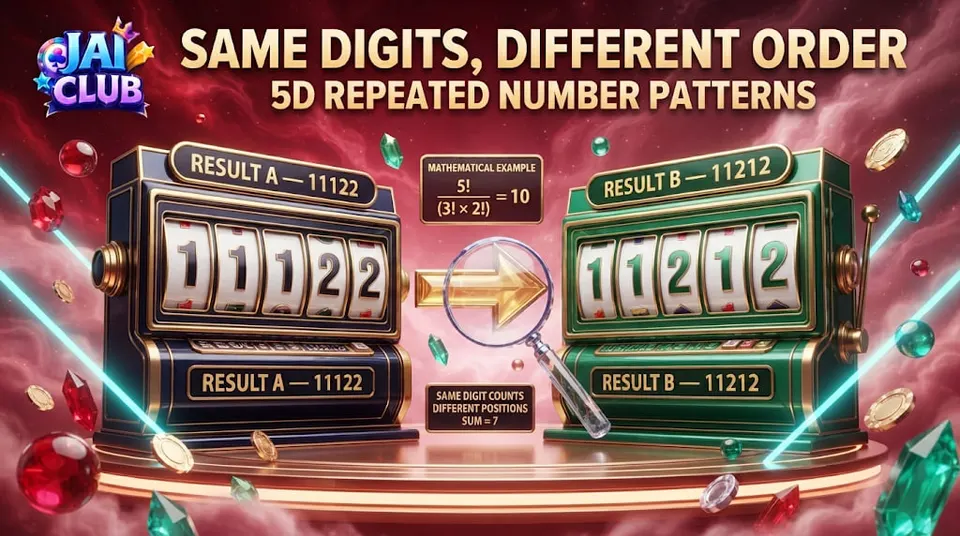
- EXAMPLE: Same Digits, Different Sequences
- Exact Result vs Digit Pattern
- How Many Arrangements Can 11122 Produce?
- All Ten Arrangements of 11122
- How Many 5D Outcomes Exist?
- Probability of Exact 11122
- Probability of Any Three 1s and Two 2s
- EXAMPLE: Exact Result vs Pattern Probability
- What About a Result Like 11234?
- Comparing Repetition Patterns
- Why Two Pairs Have 30 Arrangements
- Does Repetition Change the SUM?
- EXAMPLE: Same SUM, Different Repetition Pattern
- How Many Results Have All Different Digits?
- How Many Results Contain Repeated Digits?
- EXAMPLE: Repetition Categories in the Full Outcome Space
- Can a Result Have Three Zeros?
- Does 00000 Count as a Five-Digit Result?
- Are Repeated Digits More Likely Than All-Different Digits?
- Can Previous Repeated Digits Predict Another Repeat?
- Why Result Position Matters for Verification
- Frequently Asked Questions
- Are 11122 and 11212 the same 5D result?
- How many arrangements does 11122 have?
- What is the probability of exact 11122?
- Can a result begin with zero?
- How many possible 5D sequences exist?
- How many sequences contain at least one repeated digit?
- Does reordering digits change the SUM?
- Does a recent repeat make another repeat guaranteed?
- A Better Way to Read Repeated-Digit Results
Two 5D results can contain exactly the same digits while representing different ordered sequences.
For example, 11122 and 11212 both contain three ones and two twos. However, their digit positions are different.
This matters because a five-position result is not necessarily the same as an unordered collection of digits.
In commonly described 5D formats, the positions may be labelled A, B, C, D and E. Each position contains its own digit.
Understanding repeated digits and position order helps readers distinguish exact results, number patterns and SUM calculations.
This article uses a theoretical model with five independent uniformly selected digits from 0 through 9. It does not claim that every Jai Club 5D game uses the same probability rules or settlement categories.
What Is a Repeated-Digit Result?
A repeated-digit result contains at least one digit more than once.
For example:
11234 contains two ones.
11124 contains three ones.
11122 contains three ones and two twos.
99999 contains five nines.
These are different repetition patterns.
The number of repeated digits does not automatically determine the total sum or exact sequence.
The positions of the digits must also be considered.
5D Me Position Order Kyu Important Hai?
In an ordered five-position result, every digit has a specific location.
For example, consider the sequence:
1 1 1 2 2
Its positions are:
A = 1
B = 1
C = 1
D = 2
E = 2
Now consider:
1 1 2 1 2
The digits are the same, but Position C has changed from 1 to 2.
Position D has changed from 2 to 1.
Therefore, the two sequences are different ordered outcomes.
EXAMPLE: Same Digits, Different Sequences
| Sequence | Number of 1s | Number of 2s | Exact order |
|---|---|---|---|
| 11122 | 3 | 2 | Sequence A |
| 11212 | 3 | 2 | Sequence B |
| 12112 | 3 | 2 | Sequence C |
| 21112 | 3 | 2 | Sequence D |
EXAMPLE ONLY: These are mathematical results, not actual Jai Club history.
Every row contains the same five digits.
However, the positions differ.
The results are equal as unordered digit collections but not as ordered five-position sequences.
Exact Result vs Digit Pattern
An exact result identifies the value at every position.
A digit pattern describes a broader property.
For example, 11122 is one exact sequence.
The pattern "three ones and two twos" includes several possible arrangements.
These are different outcome categories.
A game could theoretically define rules based on exact positions, digit frequency or total sum.
However, the existence of a mathematical category does not establish that a particular game offers a selection or payout for it.
The actual rules must be verified.
How Many Arrangements Can 11122 Produce?
The digits 11122 contain five positions.
If all five digits were different, there would be:
5! = 120
possible arrangements.
However, three ones are identical and two twos are identical.
Swapping identical digits does not create a new sequence.
Therefore, the number of distinct arrangements is:
5! ÷ (3! × 2!)
= 120 ÷ (6 × 2)
= 10.
There are exactly ten distinct ordered sequences containing three ones and two twos.
All Ten Arrangements of 11122
| No. | Ordered result |
|---|---|
| 1 | 11122 |
| 2 | 11212 |
| 3 | 11221 |
| 4 | 12112 |
| 5 | 12121 |
| 6 | 12211 |
| 7 | 21112 |
| 8 | 21121 |
| 9 | 21211 |
| 10 | 22111 |
Each sequence contains three ones and two twos.
Every sequence has a total SUM of 7.
However, each has a different exact positional arrangement.
This is why the same collection of digits can correspond to several distinct results.
How Many 5D Outcomes Exist?
Suppose five positions independently take values from 0 through 9.
Each position has ten possible digits.
The number of ordered outcomes is:
10 × 10 × 10 × 10 × 10
= 100,000.
This includes sequences with leading zeros, such as 00123 and 00000.
The model treats them as five-position strings rather than ordinary integers that omit leading zeros.
Under the uniform assumption, every exact ordered result has probability:
1 ÷ 100,000 = 0.001%.
Probability of Exact 11122
The exact ordered sequence 11122 is one outcome among 100,000 equally likely sequences.
Therefore:
P(11122) = 1/100,000.
That equals 0.001%.
The same applies to the exact sequence 11212 under the hypothetical uniform model.
They are different outcomes with equal theoretical probabilities.
The fact that their digits are the same does not make them one result.
Probability of Any Three 1s and Two 2s
The broader pattern includes ten distinct ordered sequences.
Therefore:
P(Three 1s and two 2s, in any order)
= 10/100,000.
That equals 0.01%.
This is ten times the probability of one specified arrangement.
The difference is important when comparing exact-position results with unordered digit patterns.
However, actual game selection categories and settlement rules must be verified separately.
EXAMPLE: Exact Result vs Pattern Probability
| Event | Matching ordered sequences | Theoretical probability |
|---|---|---|
| Exactly 11122 | 1 | 0.001% |
| Exactly 11212 | 1 | 0.001% |
| Any order of three 1s and two 2s | 10 | 0.01% |
EXAMPLE MODEL: Five independent uniform digits from 0 to 9.
These are exact mathematical values under the stated model.
They are not verified provider odds.
What About a Result Like 11234?
The sequence 11234 contains one pair of ones and three different other digits.
The number of distinct arrangements of those exact five digits is:
5! ÷ 2!
= 120 ÷ 2
= 60.
This is more than the ten arrangements of 11122.
Why?
Because 11234 contains four distinct digit values, while 11122 contains only two distinct values.
There are more ways to arrange the different symbols.
The amount of repetition changes the number of unique permutations.
Comparing Repetition Patterns
| Pattern | Example | Unique arrangements of those digits |
|---|---|---|
| All five different | 12345 | 120 |
| One pair | 11234 | 60 |
| Two pairs | 11223 | 30 |
| One triple | 11123 | 20 |
| Triple and pair | 11122 | 10 |
| Four identical | 11112 | 5 |
| Five identical | 11111 | 1 |
The values count distinct arrangements of the specific digit collection shown.
They do not describe the probabilities of the broader pattern categories across all possible choices of digit values.
That is an important distinction.
Why Two Pairs Have 30 Arrangements
Consider the digit collection 11223.
There are two ones, two twos and one three.
The total unrestricted arrangements would be 5! = 120.
However, swapping the identical ones does not create a new sequence.
The same applies to the twos.
Therefore:
5! ÷ (2! × 2!)
= 120 ÷ 4
= 30.
This is an exact permutation count.
The same formula applies to any five-symbol collection containing two pairs and one different value.
Does Repetition Change the SUM?
Changing only the order of the digits does not change their sum.
For example:
11122 gives:
1 + 1 + 1 + 2 + 2 = 7.
11212 gives:
1 + 1 + 2 + 1 + 2 = 7.
The SUM remains 7 because addition is independent of order.
However, exact positional results differ.
This means a SUM-based classification and an exact-order classification are not interchangeable.
A game may evaluate them differently.
EXAMPLE: Same SUM, Different Repetition Pattern
Consider these five-position outcomes.
| Result | SUM | Pattern |
|---|---|---|
| 11122 | 7 | Triple and pair |
| 00133 | 7 | Two pairs and one other digit |
| 00025 | 7 | Triple and two distinct digits |
| 00016 | 7 | Triple and two distinct digits |
All four have SUM 7.
However, their repeated-digit structures differ.
This demonstrates why a total sum does not fully describe the result.
EXAMPLE ONLY: These outcomes are fictional.
How Many Results Have All Different Digits?
There are ten choices for the first position.
The second must differ from the first, leaving nine choices.
The third must differ from the first two, leaving eight.
The fourth has seven choices.
The fifth has six.
Therefore:
10 × 9 × 8 × 7 × 6 = 30,240.
There are 30,240 ordered five-position sequences with no repeated digit under the 0–9 model.
Their theoretical proportion is:
30,240/100,000 = 30.24%.
This is a property of the model, not a verified Jai Club outcome frequency.
How Many Results Contain Repeated Digits?
Every five-position sequence either has all different digits or contains at least one repeated digit.
There are 100,000 total sequences.
There are 30,240 sequences with all five digits different.
Therefore:
100,000 − 30,240 = 69,760.
So 69,760 sequences contain at least one repeated digit.
Their theoretical proportion is:
69,760/100,000 = 69.76%.
This category includes pairs, triples, four identical digits and five identical digits.
EXAMPLE: Repetition Categories in the Full Outcome Space
| Category | Number of sequences | Probability |
|---|---|---|
| All five digits different | 30,240 | 30.24% |
| At least one repeated digit | 69,760 | 69.76% |
| Total | 100,000 | 100% |
These categories are mutually exclusive and exhaustive.
Unlike the earlier arrangement table, this calculation considers every possible choice of digits in the entire theoretical outcome space.
The distinction between an individual digit collection and a full pattern category matters.
Can a Result Have Three Zeros?
Yes.
For example, 00025 contains three zeros.
A fixed five-position system preserves leading zeros as part of the result.
If software converts 00025 into the ordinary number 25, the original five-position representation is lost.
This can affect repeated-digit analysis.
Therefore, a spreadsheet or database should preserve the exact five-character sequence when leading zeros are meaningful.
A numerical conversion may remove information needed for positional comparisons.
Does 00000 Count as a Five-Digit Result?
Under the five-position sequence model used in this guide, yes.
The result contains five positions, each holding zero.
As an ordinary integer, 00000 is simply zero.
However, a fixed-format game result can preserve all five zeros.
The difference is between a five-character representation and an ordinary integer value.
This distinction also matters for results such as 01210.
The game format must be identified before interpreting them.
Are Repeated Digits More Likely Than All-Different Digits?
Under the independent uniform five-digit model, yes.
A repeated-digit result occurs in 69.76% of the theoretical outcome space.
An all-different result occurs in 30.24%.
However, the broader category "at least one repeated digit" contains many different patterns.
This does not mean one exact result such as 11122 is more likely than one exact result such as 12345.
Both exact ordered sequences have probability 1/100,000 under the stated model.
The broader event probabilities differ because the categories contain different numbers of outcomes.
Can Previous Repeated Digits Predict Another Repeat?
Not under the independent uniform model.
For example, seeing repeated digits in several consecutive 5D results does not force the next outcome to contain all different digits.
Likewise, a long history without 11111 does not make that exact result due.
The probability of a future event depends on the model, not on a belief that short-term histories must balance.
Historical repetition analysis can describe completed results but does not automatically establish forecasting ability.
Why Result Position Matters for Verification
A five-position result should be read in the same order every time.
For example, 11122 and 11212 must not be treated as identical exact records.
However, they may be grouped together when the analysis concerns unordered digit frequency.
This means the definition of equality matters.
A report counting exact results needs positional equality.
A report counting digit collections can use a different comparison rule.
For an introduction to 5D terminology, see the Jai Club Games & Features guide.
Frequently Asked Questions
Are 11122 and 11212 the same 5D result?
No. They contain the same digits but have different position orders.
How many arrangements does 11122 have?
Exactly ten distinct ordered arrangements.
What is the probability of exact 11122?
Under a uniform five-position 0–9 model, it is 1/100,000 or 0.001%.
Can a result begin with zero?
Yes, when the system uses fixed five-position sequences and preserves leading zeros.
How many possible 5D sequences exist?
There are 100,000 under the independent uniform 0–9 model.
How many sequences contain at least one repeated digit?
There are 69,760, representing 69.76% of the theoretical outcome space.
Does reordering digits change the SUM?
No. Reordering the same digits preserves their sum.
Does a recent repeat make another repeat guaranteed?
No. Previous results do not guarantee the next outcome.
A Better Way to Read Repeated-Digit Results
When examining a 5D result, first preserve its exact five positions.
Next, decide whether the question concerns an exact ordered sequence, an unordered collection of digits or the total sum.
Only then apply the relevant calculation.
This avoids treating 11122 and 11212 as the same exact result while still recognising that both share the same digit-frequency pattern and SUM.
Editorial method: Every permutation and probability is derived from the explicitly stated five-position uniform digit model. No real Jai Club 5D game data was accessed or independently audited.
Disclaimer: JaiClubGame.online is an independent educational website. Theoretical combinations do not guarantee future game outcomes.