
Jai Club K3 vs 5D: What's the Difference Between These Games?
Compare Jai Club K3 and 5D game formats, including three-dice results, five-digit positions, number ranges, totals, classifications and result history.
In this article
- Jai Club K3 vs 5D: What's the Difference Between These Games?
- What Is the Jai Club K3 Game?
- What Is the Jai Club 5D Game?
- Jai Club K3 vs 5D: Main Differences
- 1. Three Dice vs Five Number Positions
- 2. How K3 and 5D Totals Are Calculated
- K3 Total
- 5D Total
- 3. Big and Small in K3 vs 5D
- K3 Big and Small
- 5D Big and Small
- 4. Odd and Even Results
- 5. Double and Triple Combinations in K3
- 6. How Many Possible Results Exist?
- K3
- 5D
- 7. Why Are the Result Histories Different?
- 8. Are K3 and 5D the Same as WinGo?
- 9. Can K3 or 5D History Predict Future Results?
- 10. Where to Read More About Jai Club K3 and 5D
- Frequently Asked Questions
- What is the main difference between Jai Club K3 and 5D?
- Is K3 a dice game?
- What does 5D mean in Jai Club Game?
- What is the maximum sum in K3?
- What is the maximum sum in 5D?
- Do K3 and 5D use the same Big and Small rules?
- Are K3 and 5D results predictable?
- Conclusion
Jai Club K3 vs 5D: What's the Difference Between These Games?
Jai Club K3 and 5D are two number-based game formats commonly associated with Jai Club Game. Although both involve numerical results, they use different structures, number ranges and classifications.
K3 is typically based on three dice, while 5D uses five separate digit positions.
Understanding these differences is important because a K3 dice total cannot be interpreted in the same way as a 5D number sequence.
This comparison explains how both game formats work, what their results represent and the main differences between their mathematical structures.
What Is the Jai Club K3 Game?
Jai Club K3 is commonly described as a three-dice game format.
Each die can display a number from 1 to 6. A completed round produces three values, which can be added together.
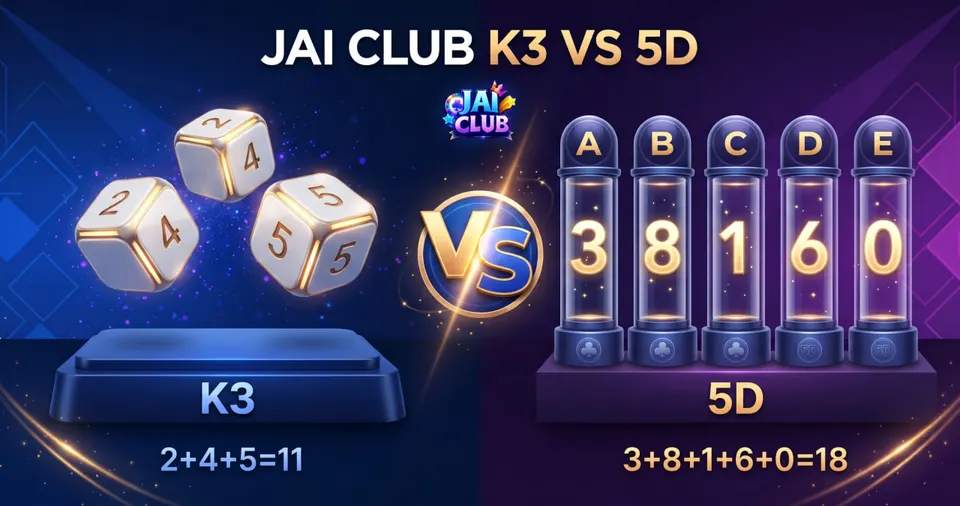
For example, consider this fictional K3 result:
2 + 4 + 5 = 11
The three dice produce a total of 11.
K3 results may also be described using terms such as Odd, Even, Big, Small, Double and Triple.
However, exact classification and eligibility rules may vary between game implementations.
What Is the Jai Club 5D Game?
Jai Club 5D is commonly described as a five-position number format.
Each position can contain a digit from 0 to 9.
The positions are often represented by the letters A, B, C, D and E.
For example:
A = 3, B = 8, C = 1, D = 6, E = 0
The complete sequence is 38160.
Adding all five numbers gives:
3 + 8 + 1 + 6 + 0 = 18
Unlike K3, which uses three dice, 5D uses five digit positions to form a result.
The rules for individual positions and sum classifications depend on the specific game version.
Jai Club K3 vs 5D: Main Differences
The most obvious difference between K3 and 5D is how the results are generated and displayed.
| Feature | Jai Club K3 | Jai Club 5D |
|---|---|---|
| Main format | Three dice | Five number positions |
| Number range | 1–6 per die | 0–9 per position |
| Number of values | 3 | 5 |
| Minimum sum | 3 | 0 |
| Maximum sum | 18 | 45 |
| Common classifications | Dice totals, Odd/Even, doubles, triples | Positions, sums, Odd/Even |
| Result example | 2, 4, 5 | 3, 8, 1, 6, 0 |
| Result identifier | Period number | Period number |
These figures describe the common mathematical formats. They are not confirmation of the rules of every Jai Club-branded game.
1. Three Dice vs Five Number Positions
K3 uses dice values.
A standard six-sided die has six possible outcomes, numbered from 1 to 6.
When three dice are involved, the result can be written as three separate numbers.
For example:
3 – 5 – 2
5D uses five positions, each containing a digit between 0 and 9.
For example:
7 – 1 – 4 – 0 – 8
The result structure is therefore different even before totals and classifications are considered.
A K3 result involves three values from a six-number range, while a 5D result involves five values from a ten-number range.
2. How K3 and 5D Totals Are Calculated
Both formats can have a combined total, but their ranges differ.
K3 Total
The minimum sum of three standard dice is:
1 + 1 + 1 = 3
The maximum sum is:
6 + 6 + 6 = 18
Therefore, K3 totals range from 3 through 18.
5D Total
In a five-position format using digits from 0 to 9, the minimum sum is:
0 + 0 + 0 + 0 + 0 = 0
The maximum sum is:
9 + 9 + 9 + 9 + 9 = 45
Therefore, the mathematical sum ranges from 0 through 45.
Although both formats involve addition, they do not share the same sum distribution.
3. Big and Small in K3 vs 5D
Big and Small are classification terms commonly found in number-based games.
However, their meanings depend on which number or total is being classified.
K3 Big and Small
Some K3 versions divide the three-dice totals into lower and upper ranges.
A commonly described division is:
- Small: totals 3–10
- Big: totals 11–18
Certain implementations may apply special exclusions to triple results.
For this reason, the actual game's rule screen should be consulted before treating the classification as universal.
5D Big and Small
In a common digit-based classification:
- Small: digits 0–4
- Big: digits 5–9
But this classification may apply to individual positions rather than the combined sum.
Rules for the five-digit sum may use different boundaries.
The key difference is that K3 commonly classifies a three-dice total, while 5D can classify individual positions and derived values separately.
4. Odd and Even Results
Odd and Even refer to mathematical parity.
An even number is divisible by two, while an odd number is not.
Consider these fictional examples.
| Game | Result | Total | Parity |
|---|---|---|---|
| K3 | 2, 4, 5 | 11 | Odd |
| K3 | 3, 5, 6 | 14 | Even |
| 5D | 3, 8, 1, 6, 0 | 18 | Even |
| 5D | 4, 7, 2, 5, 9 | 27 | Odd |
This table illustrates ordinary mathematical parity.
It does not establish whether every version uses exactly the same settlement rules.
5. Double and Triple Combinations in K3
One distinctive characteristic of K3 is its use of dice-matching terminology.
A matching pair occurs when two dice show the same value.
For example:
2 – 2 – 5
A triple occurs when all three dice show the same value.
For example:
4 – 4 – 4
These classifications describe patterns among the three dice.
The standard five-position 5D format is organised differently and should not automatically be evaluated using K3 double and triple rules.
6. How Many Possible Results Exist?
The mathematical number of possible ordered results differs significantly.
K3
If three fair and independent dice are used:
6 × 6 × 6 = 216
There are 216 ordered outcomes.
5D
If five positions independently contain one of ten digits:
10 × 10 × 10 × 10 × 10 = 100,000
There are 100,000 possible five-digit sequences.
These calculations describe theoretical models.
They do not prove that a particular online game uses independently generated or uniformly distributed results.
7. Why Are the Result Histories Different?
Jai Club K3 and 5D history tables may contain different information because their underlying result structures are different.
A K3 result history may show three dice, a combined total and related classifications.
A 5D history may display five digits, individual positions and a calculated sum.
For example:
| Game | Fictional Result | Displayed Total |
|---|---|---|
| K3 | 2-4-5 | 11 |
| 5D | 3-8-1-6-0 | 18 |
The examples are fictional and do not represent live Jai Club game records.
A period identifier helps distinguish one round from another, but the identifier itself is not the game result.
8. Are K3 and 5D the Same as WinGo?
No.
WinGo is commonly associated with a single result digit from 0 to 9, accompanied by colour and size classifications.
K3 uses three dice values.
5D uses five digit positions.
Each format should be interpreted using its own mathematical structure and game-specific rules.
Readers can explore more about these formats in the WinGo category and K3 & 5D category.
9. Can K3 or 5D History Predict Future Results?
Past results alone do not establish the next outcome in a properly functioning independent random game.
For example, several consecutive low K3 totals do not mean a high total must appear next.
Likewise, a sequence of 5D results containing repeated digits does not establish that a particular digit is due to appear.
Historical records describe completed rounds.
They should not be treated as guaranteed prediction tools.
10. Where to Read More About Jai Club K3 and 5D
JaiClubGame.online publishes separate explanations of these number-based game formats.
For additional information, read:
- Jai Club K3 Game: Three Dice, Total Numbers & Results
- Jai Club 5D Game: Five-Digit Results, Positions & Sum
You can also visit the Game Comparisons category for other discussions about game mechanics and differences.
Frequently Asked Questions
What is the main difference between Jai Club K3 and 5D?
K3 uses three dice, while 5D uses five number positions. Their possible values, result structures and total ranges are different.
Is K3 a dice game?
K3 is commonly described as a three-dice game format.
What does 5D mean in Jai Club Game?
5D commonly refers to a number-based format involving five positions, often labelled A through E.
What is the maximum sum in K3?
The mathematical maximum is 18 when all three dice show 6.
What is the maximum sum in 5D?
The mathematical maximum is 45 when all five positions contain the digit 9.
Do K3 and 5D use the same Big and Small rules?
Not necessarily. Their number structures differ, and classification rules may vary between implementations.
Are K3 and 5D results predictable?
Previous outcomes cannot reliably predict future results in an independent random system.
Conclusion
Jai Club K3 and 5D are different number-based game formats.
K3 is built around three-dice results, including totals and matching dice patterns. 5D uses five separate number positions that can be interpreted individually or through their combined sum.
Understanding their differences can help readers interpret the game information without confusing one format with the other.
The precise rules and interface details should always be verified for the individual game version.
Disclaimer: JaiClubGame.online is an independent educational website and is not officially affiliated with Jai Club. This article does not provide betting strategies, guaranteed predictions or financial advice. Real-money gaming involves financial risk and may be restricted or prohibited by applicable laws.