Odd or Even? Understanding Jai Club Lottery Rules Across WinGo, K3 & 5D
Understand how Odd and Even results differ across Jai Club Lottery formats, including WinGo digits, K3 dice totals and 5D number positions and SUM.
In this article
- What Does Odd and Even Mean in Jai Club Lottery?
- How Odd and Even Work in WinGo
- WinGo Odd Even Number Chart
- Is Odd Even the Same as Red and Green?
- How Odd Even Works in K3 Lottery
- K3 Odd Even Examples
- Why Triple Dice Can Cause Confusion
- How Odd and Even Work in 5D Lottery
- 5D Position Parity vs SUM Parity
- An Interesting 5D Parity Rule
- Jai Club Lottery Odd Even: WinGo vs K3 vs 5D
- Are Odd and Even Outcomes Equally Likely?
- Why 50% Probability Does Not Mean Guaranteed Alternation
- Can Odd Even Result History Be Misleading?
- Mathematical Parity vs Game Eligibility
- How to Identify the Correct Odd Even Field
- Does Moto Racing Use the Same Odd Even Rules?
- Can Jai Club Lottery Odd Even Be Predicted?
- Frequently Asked Questions
- What does Odd Even mean in Jai Club Lottery?
- Is 0 Odd or Even in WinGo?
- Does K3 Odd Even use individual dice or the total?
- Can a K3 Triple be Even?
- Can a 5D result contain both Odd and Even digits?
- How do I know whether a 5D SUM is Odd or Even?
- Can all five 5D positions be Odd while SUM is Even?
- Are Odd and Even equally likely in every Jai Club Lottery game?
- Does an Odd streak mean Even will appear next?
- Are WinGo, K3 and 5D Odd Even rules identical?
- Conclusion
Jai Club Lottery Odd Even is a topic that requires more explanation than simply dividing numbers into two groups. Although Odd and Even are familiar mathematical classifications, their meaning within a lottery-style game depends on what number is being evaluated. A single WinGo digit, a K3 dice total and a 5D result containing five positions are not equivalent, even when their interfaces display similar labels.
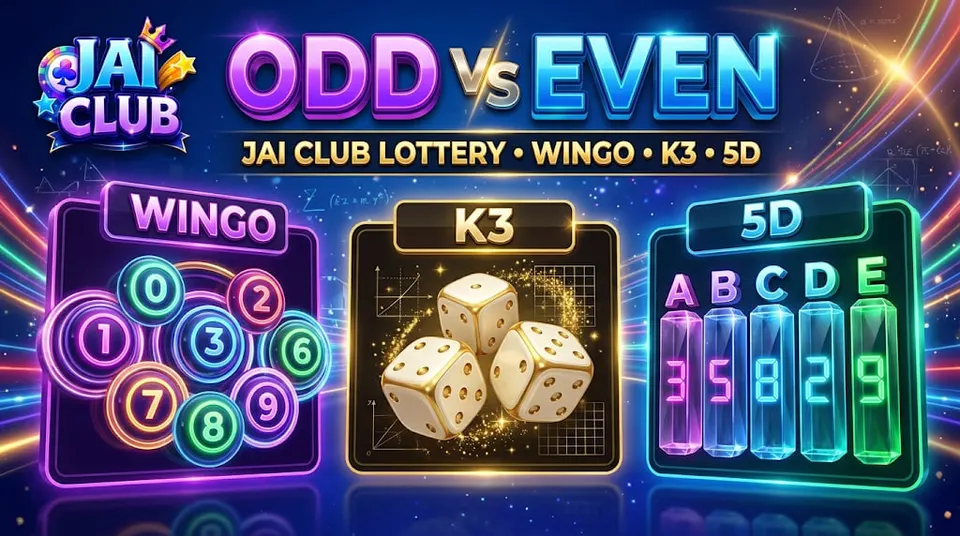
This distinction becomes important when readers move between different Jai Club Lottery formats. In WinGo, a completed round commonly produces one digit from 0 to 9. In K3, three dice produce individual face values and a combined sum. In 5D, five separate positions may each contain a digit, while another field displays the total of all five. The correct Odd or Even classification depends on which of these values the game is referring to.
This guide explains how parity works across these formats, why different numerical structures can produce different classifications, and how to recognise common misunderstandings in result tables. It focuses on game mechanics and mathematical interpretation rather than predictions or betting strategies.
What Does Odd and Even Mean in Jai Club Lottery?
Odd and Even refer to the mathematical property known as parity. An even integer can be divided by two without leaving a remainder, while an odd integer leaves a remainder of one when divided by two.
For example, the numbers 0, 2, 4, 6 and 8 are even, while 1, 3, 5, 7 and 9 are odd. Zero is even because it is exactly divisible by two. This rule remains the same whether a number appears in WinGo, K3 or 5D.
However, the mathematical definition does not tell readers which result field a particular game evaluates. A game might classify one individual digit, while another uses the total of several digits or dice. A number can therefore be mathematically even without necessarily satisfying every game-specific selection rule.
The key is to identify the underlying value before interpreting the label.
For a broader introduction to the different formats, read our Jai Club Lottery overview, which explains WinGo, K3, 5D and Moto Racing as separate number-based games.
How Odd and Even Work in WinGo
In a commonly discussed WinGo format, each completed round produces one result digit between 0 and 9. This means the Odd or Even classification can be determined directly from the single digit without adding other values together.
Under ordinary mathematical rules, digits 0, 2, 4, 6 and 8 are even, while 1, 3, 5, 7 and 9 are odd. For example, a fictional WinGo result of 6 would be Even, whereas a result of 7 would be Odd.
Some WinGo interfaces also display Red, Green, Violet, Big and Small labels. These classifications are separate from parity, even though they may all be derived from the same numerical result. A digit can therefore have a colour classification, a size classification and an Odd/Even classification without representing three independent outcomes.
The distinction is particularly useful when a result-history screen displays several coloured labels next to one number. Those labels should be understood as descriptions of the same completed result according to the particular game's rules.
WinGo Odd Even Number Chart
The following table illustrates the mathematical parity of the ten digits commonly associated with WinGo-style formats.
| Result digit | Mathematical parity |
|---|---|
| 0 | Even |
| 1 | Odd |
| 2 | Even |
| 3 | Odd |
| 4 | Even |
| 5 | Odd |
| 6 | Even |
| 7 | Odd |
| 8 | Even |
| 9 | Odd |
This table explains ordinary mathematics. It does not confirm that a particular WinGo version offers a separate Odd/Even selection, or that every result is eligible under identical settlement conditions.
Some interfaces may present only number, colour and Big/Small selections. Readers should therefore distinguish a number's mathematical parity from a feature that is actually available within a specific game.
Is Odd Even the Same as Red and Green?
No. Colour labels and mathematical parity are different classifications, even when a particular colour mapping appears to correspond to certain groups of numbers.
In one commonly discussed colour system, regular odd digits such as 1, 3, 7 and 9 are associated with Green, while digits 2, 4, 6 and 8 are associated with Red. However, the special treatment of 0 and 5 can complicate this apparent relationship because those digits may also involve Violet classifications.
For this reason, it is misleading to describe Red as universally equivalent to Even or Green as universally equivalent to Odd. A game's colour mapping and its settlement rules may contain exceptions that do not arise in ordinary mathematics.
The correct approach is to treat parity as a property of the numerical result and colour as a separate label defined by the game provider.
How Odd Even Works in K3 Lottery
K3 is commonly described as a three-dice game. Each die contains six possible face values, and the total is calculated by adding the three values together. In a standard K3 model, the combined sum ranges from 3 to 18.
Unlike WinGo, which commonly uses one digit as its result, K3 can contain both individual dice and a combined total. When Odd or Even is applied to the total, the classification depends on the sum rather than the parity of any one die.
Consider a fictional K3 result containing dice values of 2, 4 and 5. Their total is 11, which is Odd. Although two of the dice display even numbers, the combined total is odd because the sum of 2, 4 and 5 equals 11.
Another result containing 1, 3 and 6 produces a total of 10, which is Even. The presence of two odd dice does not make the final total odd.
This shows why K3 classifications must be calculated from the correct result field.
Our Jai Club K3 Game guide explains the relationship between the three dice, their totals and commonly discussed result labels.
K3 Odd Even Examples
The following fictional examples show how the mathematical parity of a K3 total is calculated.
| Die 1 | Die 2 | Die 3 | Total | Parity |
|---|---|---|---|---|
| 2 | 4 | 5 | 11 | Odd |
| 1 | 3 | 6 | 10 | Even |
| 4 | 4 | 4 | 12 | Even |
| 3 | 3 | 5 | 11 | Odd |
| 6 | 6 | 6 | 18 | Even |
| 1 | 1 | 1 | 3 | Odd |
These examples demonstrate mathematical parity rather than guaranteed classifications for every possible game selection. Some K3 implementations treat particular Triple combinations separately when evaluating certain result categories.
A Triple such as 6-6-6 still has an even mathematical total of 18. Whether that result qualifies for a particular Odd/Even selection must be determined from the actual provider's rules. The mathematical classification and the conditions of a game feature should never be assumed to be identical.
Why Triple Dice Can Cause Confusion
Triples occur when all three dice show the same number. They are visually distinctive and may be assigned special treatment by some K3 game designs.
For example, 3-3-3 produces a total of 9, which is mathematically Odd. Similarly, 4-4-4 produces a total of 12, which is Even. Those classifications follow ordinary arithmetic regardless of the matching pattern.
However, an individual game may define separate conditions for Triple outcomes. This means a mathematical result can belong to a parity group while being handled differently by a particular game category.
Readers should therefore check both the total and the matching pattern rather than assuming that every Odd or Even result follows the same settlement rule.
For a deeper mathematical explanation, our K3 Dice Total Chart covers possible sums from 3 to 18 and their theoretical combination counts.
How Odd and Even Work in 5D Lottery
A commonly discussed 5D format uses five positions labelled A, B, C, D and E. Each position contains a digit from 0 to 9, allowing a completed result to be represented as an ordered sequence of five numbers.
Unlike WinGo, which generally focuses on one digit, 5D can contain several different values that may be classified independently. A particular position may be Odd or Even, while the combined SUM can have a separate parity.
For example, consider the fictional five-digit result 4-7-2-9-1. Position A contains 4, which is Even. Position B contains 7, which is Odd. Position C contains 2, which is Even. Position D contains 9, which is Odd, and Position E contains 1, which is Odd.
The combined SUM is 23, which is Odd. This does not mean all five positions are odd. It means the total obtained by adding them together is odd.
Understanding the distinction between individual positions and their total is essential when reading a 5D result screen.
5D Position Parity vs SUM Parity
The difference between position parity and total parity can be illustrated using a fictional result.
| Position | Digit | Parity |
|---|---|---|
| A | 4 | Even |
| B | 7 | Odd |
| C | 2 | Even |
| D | 9 | Odd |
| E | 1 | Odd |
| SUM | 23 | Odd |
The SUM is calculated as 4 + 7 + 2 + 9 + 1 = 23.
A position-specific classification evaluates the digit in that position. SUM parity evaluates the combined total. These are related mathematical properties but are not interchangeable.
A result could therefore contain an Even digit in Position A while its total SUM is Odd. There is no contradiction because the classifications apply to different numerical values.
Our Jai Club 5D Game guide explains the five positions and the mathematical relationship between individual digits and their total.
An Interesting 5D Parity Rule
There is a useful mathematical rule connecting the parity of individual digits with the parity of their combined SUM.
The sum of several integers is Odd when an odd number of the components are odd. The sum is Even when an even number of the components are odd, including zero.
For example, the five digits 4, 7, 2, 9 and 1 contain three odd digits: 7, 9 and 1. Since three is odd, their combined SUM of 23 is also odd.
Now consider the fictional result 2, 5, 4, 7 and 8. It contains two odd digits, 5 and 7. The total is 26, which is Even.
This relationship is a mathematical identity, not a prediction method. It allows the parity of a completed sum to be checked from the component digits, but it does not reveal what those digits will be in a future round.
Jai Club Lottery Odd Even: WinGo vs K3 vs 5D
Although all three formats can involve Odd and Even numbers, the underlying value is different.
| Format | Value being classified | Example | Parity |
|---|---|---|---|
| WinGo | One result digit | 7 | Odd |
| K3 | Sum of three dice | 2 + 4 + 5 = 11 | Odd |
| 5D position | One selected digit | Position A = 4 | Even |
| 5D SUM | Total of five digits | 4 + 7 + 2 + 9 + 1 = 23 | Odd |
This comparison explains why the same Odd or Even label can appear in different lottery-style games while referring to different types of results.
A WinGo digit of 7 is not equivalent to a K3 total of 7 simply because both are Odd. They belong to different number systems, have different possible outcomes and may be evaluated under different game rules.
Likewise, an Odd classification in 5D does not identify which individual position was odd unless the record specifies the relevant field.
Are Odd and Even Outcomes Equally Likely?
The answer depends on the assumed mathematical model and the actual rules of the game.
If a WinGo-style system generates each digit from 0 through 9 independently and with equal probability, five digits are Even and five are Odd. Under that hypothetical model, the probability of each parity category would be 50%.
A similar mathematical balance occurs with the total of three independent fair six-sided dice. Because each die has three odd faces and three even faces, the combined sum is Odd in half of the 216 ordered outcomes and Even in the other half.
For a standard 5D mathematical model with five independent uniformly distributed digits, each individual position has five odd and five even possibilities. The combined SUM also has an equal theoretical chance of being Odd or Even.
However, these mathematical observations do not establish the actual probabilities used by an online service. Provider-specific algorithms, settlement exclusions or other conditions may affect how a result category is evaluated.
An equal theoretical probability also does not guarantee a positive financial return.
Why 50% Probability Does Not Mean Guaranteed Alternation
One common misunderstanding is that Odd and Even outcomes must alternate because each category appears equally likely in a balanced mathematical model.
Suppose a fictional history shows Even, Even, Odd, Even and Even. It may feel as though Odd should appear more frequently in the next few rounds to restore balance. However, independently generated outcomes do not have an obligation to correct short historical sequences.
A genuinely random system can produce several consecutive results with the same parity. Long streaks can occur even when the two classifications are equally likely before each independent round.
The difference between a long-term mathematical distribution and a short observed sequence is important. Probability describes uncertainty across possible outcomes, not a fixed schedule of alternation.
Can Odd Even Result History Be Misleading?
Result-history tables can be useful for understanding completed rounds, but they may contain several numerical fields. A reader who looks only at a label without identifying its underlying value can misinterpret the record.
In WinGo, the label may describe one result digit. In K3, it may describe the total of three dice. In 5D, it could describe a selected position or the combined SUM.
If a history table shows an Odd label beside an Even-looking digit, the first question should be whether the label belongs to that digit or to another numerical field in the same record.
Period identifiers are another source of confusion. A period number identifies a particular round and should not be interpreted as the numerical result itself.
The WinGo Game Records guide explains the importance of matching a result with its correct period.
Mathematical Parity vs Game Eligibility
One of the most important distinctions in lottery-style games is the difference between a number's mathematical property and whether a particular result qualifies under the provider's rules.
For example, any integer divisible by two is Even. This definition does not change because a game uses different colours, bonus classifications or special combinations.
However, a game may define a particular category with additional restrictions. Certain K3 implementations, for instance, may treat Triple outcomes separately for some selections. The total remains mathematically Odd or Even, but the applicable settlement category may have additional conditions.
Similarly, a 5D interface could present Odd/Even classifications for individual positions and the combined SUM under separate headings.
The correct interpretation must follow the precise rule associated with the selected field. General mathematical knowledge is useful for checking arithmetic, but it cannot replace the provider's published conditions.
How to Identify the Correct Odd Even Field
When examining a lottery-style game screen, first identify which format is being displayed. A WinGo number, K3 total and 5D position should not be analysed as though they refer to the same type of outcome.
Next, identify the completed period and the numerical value associated with the Odd or Even label. In 5D, check whether the interface is referring to one of the positions A–E or the combined SUM. In K3, verify whether the label describes the full dice total rather than a single die.
Finally, compare the classification with the game-specific rules. If the visible number is mathematically Even but a particular selection is treated differently, there may be an additional condition that is not apparent from the number alone.
A clear reading of the actual result is more useful than assuming every game uses identical classifications.
Does Moto Racing Use the Same Odd Even Rules?
Moto Racing is generally discussed as a numbered racing format involving participants and finishing positions. Although the motorcycle numbers themselves can be mathematically Odd or Even, this does not establish that the game offers an Odd/Even result category.
A numbered motorcycle finishing first is a ranking outcome, not necessarily the same type of numerical draw as WinGo, K3 or 5D.
Readers should therefore avoid applying the Odd/Even terminology of a number game to Moto Racing unless the relevant provider explicitly documents such a feature.
This distinction demonstrates why different formats may appear under a broad Lottery heading without sharing every result classification.
Can Jai Club Lottery Odd Even Be Predicted?
A mathematical classification does not create a reliable forecasting method. Knowing that a completed K3 total is Odd or that a 5D SUM is Even does not reveal the next result.
If rounds are generated independently, previous parity labels do not determine future outcomes. A sequence of several Odd results does not make an Even result certain, and the same limitation applies in reverse.
A number chart can describe mathematical possibilities, while a history table records completed outcomes. Neither is evidence of guaranteed future results.
Readers should be cautious of claims about fixed Odd/Even patterns, secret prediction formulas or automatic signals that promise certainty without verifiable information about the actual result-generation system.
Frequently Asked Questions
What does Odd Even mean in Jai Club Lottery?
Odd and Even describe the parity of a numerical result. The number being classified depends on the game format and its rules.
Is 0 Odd or Even in WinGo?
Zero is mathematically Even because it is divisible by two without a remainder. Game-specific selection eligibility must still be verified.
Does K3 Odd Even use individual dice or the total?
In the commonly described K3 format, Odd and Even generally refer to the combined total of three dice.
Can a K3 Triple be Even?
Yes. For example, 4-4-4 totals 12, which is mathematically Even. The game's settlement rules may treat Triples separately.
Can a 5D result contain both Odd and Even digits?
Yes. Each of the five positions can have a different parity, while the combined SUM has its own classification.
How do I know whether a 5D SUM is Odd or Even?
Add the five digits. If the total is divisible by two, it is Even; otherwise, it is Odd.
Can all five 5D positions be Odd while SUM is Even?
No. The sum of five odd integers is always Odd because there are an odd number of odd components.
Are Odd and Even equally likely in every Jai Club Lottery game?
Not necessarily. Equal probability can be demonstrated in certain fair mathematical models, but actual platform probabilities and eligibility conditions require verification.
Does an Odd streak mean Even will appear next?
No. Previous independent outcomes do not guarantee the classification of the next result.
Are WinGo, K3 and 5D Odd Even rules identical?
They share the same mathematical definition of parity, but the numerical fields and game-specific conditions can differ.
Conclusion
Understanding Jai Club Lottery Odd Even requires identifying which number is being classified. WinGo commonly uses a single result digit, K3 evaluates three dice and their combined total, and 5D can display parity for individual positions as well as the total SUM.
The mathematical distinction between Odd and Even remains consistent, but the relevant game fields and settlement conditions are not necessarily identical. Recognising these differences helps readers interpret completed records accurately without confusing one game format with another.
Odd and Even charts provide useful mathematical explanations, but they do not guarantee future outcomes or establish a financial advantage. The rules of the actual game version remain essential when interpreting any provider-specific result.
Disclaimer: JaiClubGame.online is an independent informational website and is not officially affiliated with Jai Club. The examples and probability calculations in this guide describe general mathematical models rather than verified rules of every Jai Club service. This article does not provide betting advice or guaranteed predictions. Real-money gaming involves financial risk and may be restricted or prohibited under applicable laws.