Fishing Games on Jai Club: Fish Types, Cannons & Arcade Features
Discover how fishing-style arcade games associated with Jai Club work, including fish targets, cannons, shooting costs, special weapons and differences from slots.
In this article
- What Are Fishing Games on Jai Club?
- Popular Fishing Game Names Worth Knowing
- How Does a Fishing Game Cannon Work?
- Small Fish, Large Fish and Special Targets
- How Do Fishing Game Multipliers Work?
- Special Weapons and Arcade Features
- Fishing Games vs Slot Games on Jai Club
- Fishing Games vs Mini Games
- Are Fishing Game Outcomes Random?
- Does a Higher Cannon Level Guarantee Better Results?
- Can Fish Movement Predict a Successful Catch?
- How to Identify the Rules of a Fishing Game
- Explore More Jai Club Game Formats
- Frequently Asked Questions
- What are Jai Club fishing games?
- Which fishing titles are associated with Jai Club?
- How do fishing-game cannons work?
- Do larger fish always have higher multipliers?
- Are fishing games the same as slot games?
- What are special weapons in fishing games?
- Does a higher cannon value guarantee a catch?
- Can fish movements predict future outcomes?
- Are all fishing games available on mobile?
- Conclusion
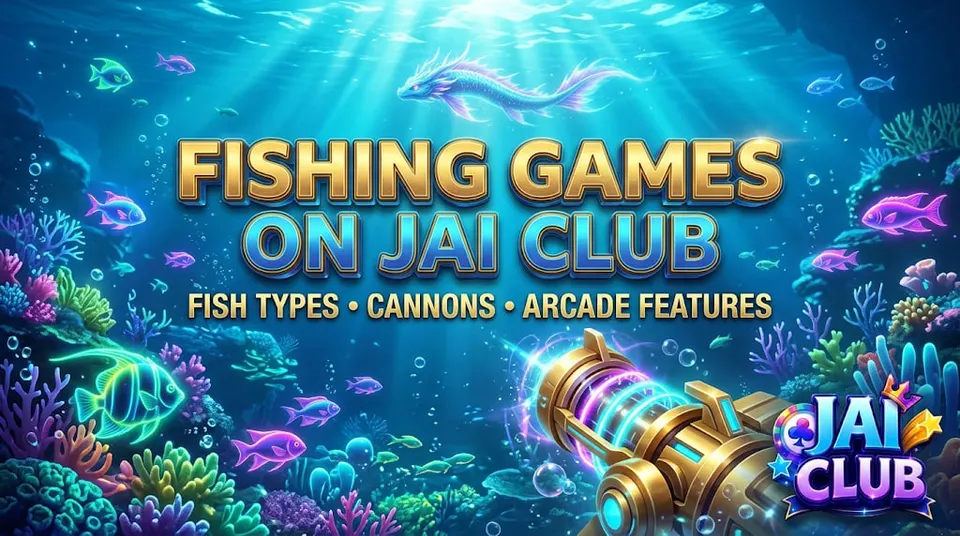
Jai Club fishing games is a search topic associated with arcade-style fish-shooting games, where colourful underwater creatures move across the screen while players use virtual cannons to target them. Unlike traditional slot games, which rely on reels and symbols, fishing-style games present their outcomes through moving targets, shooting animations and game-specific reward systems.
Several publicly accessible Jai Club-related catalogues mention fishing titles such as Jackpot Fishing, Royal Fishing, Mega Fishing and Dragon Master. However, the availability of these games may differ between services and providers. A title appearing on a third-party website does not guarantee that it is currently active on every platform using the Jai Club name.
This article explains the general mechanics of arcade fishing games, the role of cannons and target types, how multipliers are commonly displayed, and what makes fish-shooting formats different from slots, crash games and other mini games.
What Are Fishing Games on Jai Club?
Fishing games are a category of digital arcade games built around an underwater shooting interface. A typical game displays fish and other sea creatures moving across a shared screen, with a virtual cannon positioned near the edge. The player aims at a target, and the game evaluates the shot according to its defined rules.
The visual presentation is more interactive than a conventional slot machine. Instead of spinning reels and waiting for symbol combinations, a fishing game uses moving creatures, cannon animations and effects associated with successful catches. Some versions include additional targets, special weapons, larger creatures and visually elaborate boss encounters.
Despite their arcade appearance, real-money fish-shooting games may charge a defined amount for each shot or projectile. The visual act of aiming does not automatically establish the probability of catching a particular target, which depends on the game's actual mathematical implementation.
Readers looking for a general overview of other game formats can visit the Jai Club Game homepage, which introduces the different categories covered by this website.
Popular Fishing Game Names Worth Knowing
Several recognisable fishing titles appear in gaming catalogues and discussions associated with Jai Club-related platforms. These include Jackpot Fishing, Mega Fishing, Royal Fishing and Dragon Master, alongside other fish-shooting titles published by different studios.
The titles may use different visual themes, creature designs, cannon systems and special effects. For example, one game may feature traditional underwater environments with schools of fish, while another introduces fantasy creatures, dragons or elaborate bonus animations.
A shared fishing theme does not mean that two games use identical rules. The number of available cannon levels, target types, multipliers and special features may differ considerably between versions.
| Game title | Common visual theme | Information to check |
|---|---|---|
| Jackpot Fishing | Underwater arcade targets | Cannon values and catch rules |
| Mega Fishing | Fish-shooting arcade | Available targets and features |
| Royal Fishing | Fantasy-style fishing | Provider and multiplier rules |
| Dragon Master | Dragon-themed fish shooting | Special targets and weapon mechanics |
This table describes titles found in broader gaming catalogues. It is not a verified inventory of games currently active on Jai Club.
How Does a Fishing Game Cannon Work?
The cannon is the main visual tool used to fire projectiles towards targets. In many fish-shooting games, the cannon has a configurable value that affects the amount associated with each shot. Some versions provide several cannon levels, while others use different weapon types or additional mechanics.
A higher cannon value may correspond to a higher cost per shot and different potential payout amounts. However, it should not be assumed that increasing the cannon value guarantees a catch or improves the underlying expected return.
For example, a hypothetical game might use a reference value of five credits per projectile. Firing twenty shots would then represent a total expenditure of one hundred credits before any qualifying payouts are considered. The actual costs, limits and rules depend on the game provider.
This distinction is important because a colourful arcade interface can make repeated shooting appear less consequential than traditional reel-based wagering. The number of projectiles used may matter as much as the displayed multiplier.
Small Fish, Large Fish and Special Targets
Fishing games commonly include several categories of targets. Small fish may be represented by ordinary sea creatures that move across the screen, while larger fish or fantasy creatures may have more elaborate designs and animations.
Some games also feature special targets or boss creatures. These can be associated with distinctive effects or higher displayed payout values, depending on the rules. However, a larger or more colourful target does not automatically mean it is easier to catch or financially favourable.
The relationship between target appearance and outcome probability is game-specific. Without verified documentation, the size, colour or movement pattern of a fish should not be treated as evidence of its actual catch probability.
Special animations can make a successful catch feel dramatic, but they are visual representations of a result governed by the game's underlying system.
How Do Fishing Game Multipliers Work?
Multipliers are numerical factors used in certain fishing-game payout calculations. A target may display an associated multiplier, which is applied according to the provider's rules when the required conditions are satisfied.
For example, if a hypothetical game uses a qualifying reference amount of ten credits and a target carries a 5x multiplier, the corresponding calculation would produce fifty credits. This is a mathematical example rather than a verified Jai Club payout.
The exact meaning of a multiplier may vary. Some providers associate it directly with the value of a successful catch, while others use special rules for bonus targets or weapons.
A high multiplier should not be interpreted as evidence that the target is likely to be caught. Potential payout and probability are different concepts, and both are necessary for understanding a game's mathematical design.
Special Weapons and Arcade Features
Some fishing games introduce features beyond standard cannon shooting. Depending on the developer, these may include special projectiles, area effects, automatic firing systems, target-locking functions or temporary visual events.
These features can change the appearance and pace of the game. However, an automatic shooting function does not remove the cost associated with repeated projectiles when the game uses per-shot charges. Similarly, a weapon capable of targeting multiple creatures does not guarantee that every visible target will produce a qualifying result.
The exact effect of a special weapon should be explained in the relevant game rules. A visual animation showing several targets being struck does not necessarily mean every target awards an identical payout.
Understanding the distinction between visual effects and actual result conditions is particularly important when comparing games from different studios.
Fishing Games vs Slot Games on Jai Club
Fishing games and traditional slots can both use multipliers, but their interfaces and result evaluation methods are different. Slot games generally use reels containing symbols, which are evaluated through paylines, ways-to-win systems or other predefined combinations.
Fishing games instead present moving targets and cannon-based actions. Their outcomes may depend on the interaction between projectile values, selected targets and game-specific probability systems.
| Feature | Fishing Games | Slot Games |
|---|---|---|
| Main visual | Underwater arcade scene | Spinning reels |
| Typical action | Cannon shooting | Spin |
| Main objects | Fish and other targets | Reel symbols |
| Multipliers | May relate to catches | May relate to symbol wins |
| Special features | Weapons and special targets | Wilds, Scatters and bonuses |
| Result presentation | Catch or shooting outcome | Symbol combination |
Readers interested in reel-based games can explore What Slot Games Are Available on Jai Club?, which discusses symbols, paylines and bonus features.
Fishing Games vs Mini Games
Mini Games is a broad category that can include formats such as Mines, Plinko and Limbo. These games generally focus on particular mechanics, including hidden tile reveals, ball landing positions or target multiplier comparisons.
Fishing games may also be grouped under arcade or mini-game headings by some services, but their defining characteristic is the moving-target shooting interface.
A Mines grid does not require the player to aim at creatures, and a Plinko board does not use a cannon. Similarly, Limbo focuses on comparing multiplier values rather than displaying fish moving across an underwater environment.
For more information about these differences, read our Jai Club Mini Games List, which explains the general mechanics of several compact game formats.
Are Fishing Game Outcomes Random?
Digital fishing games can use probabilistic systems to determine whether a target is successfully caught. However, the precise method depends on the actual game provider, and a visual shooting animation cannot independently establish how the outcome was generated.
A player may see several projectiles apparently strike the same creature without a successful catch. That visual behaviour does not necessarily reveal how close the game is to producing a qualifying outcome.
Similarly, the presence of a large target does not establish that its corresponding multiplier will be awarded after a particular number of shots.
Claims that a target can be guaranteed by a fixed shooting sequence require reliable evidence about the underlying system.
Does a Higher Cannon Level Guarantee Better Results?
Not necessarily. In games where cannon values affect the cost associated with each projectile, increasing the setting can increase the amount spent per shot. That does not automatically establish a higher probability of catching a target or an improved expected return.
For example, two cannon levels might produce different possible payout amounts while retaining similar underlying expected-return characteristics. Without the provider's rules and mathematical documentation, the relationship cannot be assessed accurately.
The key distinction is between the size of a potential payout, the cost of each attempt and the probability of a successful outcome. All three affect the financial implications of a real-money fishing game.
Can Fish Movement Predict a Successful Catch?
The movement of fish across a digital screen is primarily part of the game's visual presentation. A creature moving slowly, changing direction or appearing near the edge of the screen does not independently establish that it is more likely to produce a payout.
Some games may use software-generated outcomes that are represented through shooting and catching animations. Others may include different interaction systems, making provider-specific documentation important.
Past successful catches also do not establish that a similar target will be caught during the next attempt. Short sequences of outcomes can vary considerably, especially when probability-based systems are involved.
Readers should be cautious of claims about guaranteed target patterns or automatic fishing prediction tools.
How to Identify the Rules of a Fishing Game
Before interpreting a specific fishing-game interface, useful information includes the actual provider, the value assigned to a cannon shot, target multiplier rules and any special weapon conditions.
It is also important to understand whether the game offers an information panel explaining its theoretical return, probability system or verification process. Not every game publishes the same level of detail.
When similar titles appear on different websites, the game provider and version should be checked before assuming that their mechanics are identical. A shared name or visual theme does not prove that all rules are the same.
Explore More Jai Club Game Formats
JaiClubGame.online provides educational explanations of several gaming categories, including slots, WinGo, K3, 5D and crash-style games. These formats use different interfaces and should not be evaluated using one set of rules.
Readers exploring multiplier-based games can visit our Jai Club Aviator explanation, while those interested in game features can read the Jai Club Games & Features overview. Both resources help distinguish different types of digital gaming mechanics.
Although fishing games share some numerical terminology with these formats, their cannon-based presentation makes them a separate topic worth understanding.
Frequently Asked Questions
What are Jai Club fishing games?
The term refers to arcade-style fishing games discussed in Jai Club-related catalogues, commonly involving moving fish, virtual cannons and game-specific reward systems.
Which fishing titles are associated with Jai Club?
Some third-party catalogues mention Jackpot Fishing, Royal Fishing, Mega Fishing and Dragon Master. Current availability should be verified for the relevant service.
How do fishing-game cannons work?
A cannon fires virtual projectiles at targets. Some games associate a defined cost with each shot or cannon level.
Do larger fish always have higher multipliers?
Not necessarily. Target values and payout conditions depend on the actual game rules.
Are fishing games the same as slot games?
No. Fishing games commonly use a shooting interface, while slots are generally based on reels and symbol combinations.
What are special weapons in fishing games?
Depending on the provider, some games include additional projectile types, automatic firing or special targeting effects.
Does a higher cannon value guarantee a catch?
No. A higher cost or reference amount does not independently establish a guaranteed result.
Can fish movements predict future outcomes?
Visual patterns alone do not provide reliable evidence of future independently generated outcomes.
Are all fishing games available on mobile?
Availability depends on the provider, game version and supported browser or application.
Conclusion
Jai Club fishing games represent a different style of digital gaming from the number-based, slot and crash formats more commonly discussed on Jai Club-related websites. Their distinctive features include moving underwater targets, virtual cannons, special weapons and multiplier-based results.
Understanding the cost associated with individual shots, the function of different target types and the limits of visual animations is more informative than relying on promotional claims about easy catches or guaranteed rewards.
Disclaimer: JaiClubGame.online is an independent educational website and is not officially affiliated with Jai Club. The games and mechanics discussed here are based on general fishing-game formats and third-party catalogues; current availability and specific rules have not been independently verified for every Jai Club service. Real-money gaming involves financial risk and may be restricted or prohibited under applicable laws.