Jai Club Moto Racing Game: Numbers, Rankings & Results Explained
Understand Jai Club Moto Racing Game, numbered motorcycles, finishing positions, rankings, Big Small classifications, result history and differences from WinGo.

In this article
- Jai Club Moto Racing Game: Numbers, Rankings & Results Explained
- What Is Jai Club Moto Racing Game?
- How Do Numbered Motorcycles Work?
- What Is a Finishing Position?
- What Does First Position Mean in Jai Club Moto Racing?
- First, Second and Third Positions Explained
- How Does Big and Small Work in Moto Racing?
- Odd and Even Numbers in Moto Racing
- Jai Club Moto Racing Results vs WinGo Results
- Jai Club Moto Racing vs K3
- What Is Moto Racing Result History?
- Fictional Moto Racing History Example
- What Is the Difference Between a Round Number and a Motorcycle Number?
- How Are Moto Racing Results Generated?
- Are All Motorcycle Numbers Equally Likely to Finish First?
- Can Moto Racing Results Be Predicted?
- Why Might Moto Racing Results Look Different Across Websites?
- What Should You Check About Jai Club Moto Racing?
- Related Jai Club Game Articles
- Frequently Asked Questions
- What is Jai Club Moto Racing Game?
- How many numbers are used in Moto Racing?
- What does first position mean?
- Is number 7 the same as seventh place?
- Does Moto Racing have Big and Small?
- What does Moto Racing history show?
- Is Moto Racing the same as WinGo?
- Can previous race results predict the next winner?
- Conclusion
Jai Club Moto Racing Game: Numbers, Rankings & Results Explained
Jai Club Moto Racing Game is a racing-themed number game mentioned in several Jai Club-related game listings. Unlike WinGo, where a round usually ends with a single digit from 0 to 9, Moto Racing is commonly described through numbered motorcycles and their finishing positions.
This creates a different type of result display. Instead of focusing only on one number, a racing result may show which motorcycle finishes first, second, third and in the remaining positions.
However, the appearance of a racing animation does not establish how results are generated or whether each motorcycle has an equal chance of finishing first.
This article explains the commonly described Moto Racing format, how rankings and result numbers differ, and what readers should check when interpreting a racing-game history table.
Verification note: Moto Racing appears in third-party Jai Club game listings, but the exact rules, probabilities and current platform configuration have not been independently verified.
What Is Jai Club Moto Racing Game?
Jai Club Moto Racing is commonly described as a number-based racing game.
The familiar format involves ten numbered motorcycles, typically identified using numbers 1 through 10.
After a round is completed, the game displays a finishing order.
For example, a fictional racing result could begin:
First place: Number 7
Second place: Number 2
Third place: Number 9
These three numbers describe positions in one race. They are not three independent WinGo results.
The complete race ranking may contain all ten numbered motorcycles, arranged from first to last.
How Do Numbered Motorcycles Work?
In the commonly described Moto Racing format, each motorcycle has an assigned number.
These numbers act as identifiers.
A number does not necessarily describe the motorcycle's speed, performance, or probability of finishing in a particular position.
For example, motorcycle number 10 does not automatically move faster than motorcycle number 2.
The displayed ranking is what establishes the recorded finishing position.
Readers should distinguish the motorcycle's identifying number from its position in the result.
What Is a Finishing Position?
A finishing position describes where a motorcycle ranks at the end of the race.
First place is the leading result, followed by second, third and subsequent positions.
Consider this fictional completed race:
| Position | Motorcycle Number |
|---|---|
| 1st | 7 |
| 2nd | 2 |
| 3rd | 9 |
| 4th | 1 |
| 5th | 5 |
| 6th | 10 |
| 7th | 4 |
| 8th | 8 |
| 9th | 3 |
| 10th | 6 |
Here, motorcycle number 7 finishes first. Motorcycle number 2 finishes second.
The result digit 7 is not the same thing as seventh place.
This difference is especially important in ranking-based games.
What Does First Position Mean in Jai Club Moto Racing?
The first position identifies the motorcycle recorded as finishing first.
Some Moto Racing descriptions focus on the winning motorcycle number, while others discuss separate finishing positions.
The applicable outcome depends on the specific rule or result category being displayed.
For instance, a page might show the first three positions individually.
Another interface could display the full ranking.
Without the actual rules, readers should not assume that every position has the same classification or payout structure.
First, Second and Third Positions Explained
Moto Racing results may use several ranking labels.
First position refers to the leading motorcycle.
Second position refers to the next motorcycle in the ranking.
Third position refers to the third-ranked motorcycle.
These rankings describe different positions within the same race.
A result listed under the first-position column should not be compared to a number from another column without checking the heading.
For example, if motorcycle number 9 finishes third, it does not mean number 9 won the entire race.
How Does Big and Small Work in Moto Racing?
Some descriptions of the ten-number racing format divide motorcycle numbers into two groups:
- Small: 1, 2, 3, 4 and 5
- Big: 6, 7, 8, 9 and 10
Under this example mapping, motorcycle number 7 belongs to the Big group, while number 2 belongs to Small.
However, the classification refers to the motorcycle number, not necessarily its finishing position.
A motorcycle with a Small number can finish first.
Likewise, a motorcycle with a Big number can finish last.
The exact category rules must be confirmed for the relevant game.
Odd and Even Numbers in Moto Racing
Odd and Even can also describe motorcycle identifiers.
For the numbers 1 through 10:
Odd: 1, 3, 5, 7, 9
Even: 2, 4, 6, 8, 10
If motorcycle number 7 finishes first, its identifying number is Odd.
If motorcycle number 8 finishes first, its identifying number is Even.
These classifications follow ordinary mathematics.
However, the availability of Odd/Even result categories depends on the game implementation.
Jai Club Moto Racing Results vs WinGo Results
Moto Racing and WinGo may both display numbers, but their formats differ.
| Feature | Moto Racing | WinGo |
|---|---|---|
| Common number identifiers | 1–10 | 0–9 |
| Main result format | Motorcycle rankings | One outcome digit |
| First/second/third places | Central concept | Not generally used |
| Colour classifications | Not a defining feature | Commonly displayed |
| Big/Small | May classify racing numbers | Commonly classifies result digit |
| Result history | Racing order | Period and digit history |
For more information about number-and-colour results, explore the WinGo category.
Jai Club Moto Racing vs K3
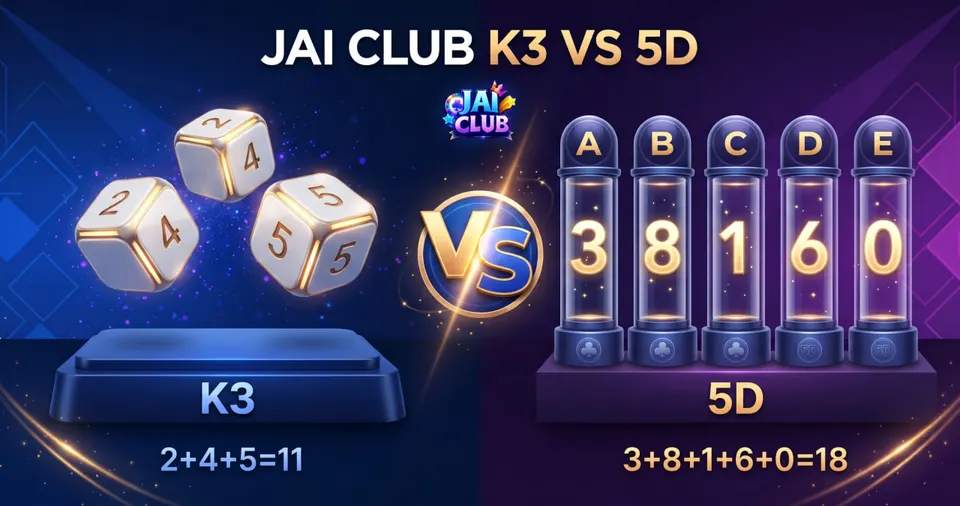
K3 is commonly described as a three-dice format.
A standard K3 result might show 2, 4 and 6, with a combined total of 12.
Moto Racing instead concerns numbered participants and their finishing order.
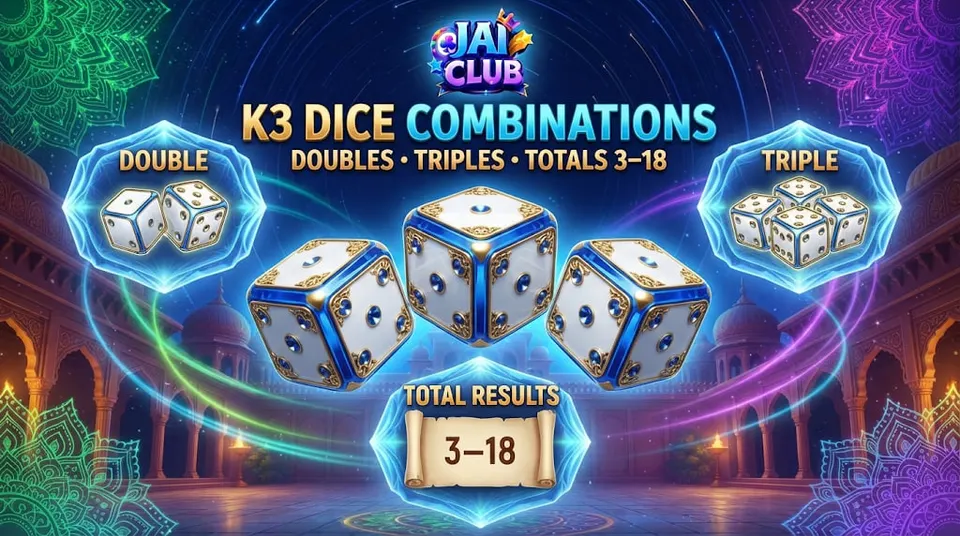
K3 matching dice, Doubles and Triples should not be used to interpret Moto Racing rankings.
Read Jai Club K3 Dice Combinations for a separate explanation of dice patterns.
What Is Moto Racing Result History?
A result-history table can record previously completed racing rounds.
Depending on the interface, it may display:
- A period or round identifier
- The completed race ranking
- The first-place motorcycle number
- Additional finishing positions
- Relevant classification labels
These details allow readers to understand what happened in earlier rounds.
They do not establish future results.
Fictional Moto Racing History Example
| Demo Period | First Place | Second Place | Third Place |
|---|---|---|---|
| DEMO-101 | 7 | 2 | 9 |
| DEMO-102 | 4 | 10 | 1 |
| DEMO-103 | 8 | 5 | 3 |
| DEMO-104 | 1 | 6 | 7 |
All rows are fictional examples, not actual Jai Club history.
The purpose is to show how result columns may be organised.
What Is the Difference Between a Round Number and a Motorcycle Number?
A round number identifies when a particular race took place.
A motorcycle number identifies a participant within that race.
They serve different purposes.
For example:
Round: DEMO-105
First place: Motorcycle 6
The round identifier is not itself a motorcycle result.
This distinction also appears in number games such as WinGo and 5D, where period identifiers are separate from outcome digits.
How Are Moto Racing Results Generated?
A visual racing animation does not provide sufficient evidence about the system that determines the outcome.
An online racing game may use a software-based result-generation system, with animation used to present the final ranking.
However, the exact system cannot be confirmed without technical documentation.
The game provider should explain how outcomes are determined, whether they are random, and what verification information is available.
Readers should be cautious of claims that a motorcycle's apparent animation speed can reliably reveal the final result before the round settles.
Are All Motorcycle Numbers Equally Likely to Finish First?
If a hypothetical system generated a uniformly random ranking of ten motorcycles, each number would have a 1-in-10 probability of finishing first.
That would be 10% for each motorcycle.
However, this mathematical illustration does not prove that any particular Jai Club Moto Racing implementation uses uniform random rankings.
The actual probability distribution requires reliable evidence about the game design.
Published prize multipliers cannot by themselves establish fairness.
Can Moto Racing Results Be Predicted?
If a game uses independent random rankings, previous completed races do not reliably predict the next finishing order.
For example, motorcycle number 3 failing to finish first in several recent rounds does not mean it must win the next race.
Likewise, a repeated first-place number is not proof of a predictable cycle.
Historical frequencies can describe past results, but they do not guarantee future outcomes.
Third-party prediction tools should be assessed cautiously, especially when they advertise certainty without verifiable testing.
Why Might Moto Racing Results Look Different Across Websites?
Several factors can explain differences.
A site may present only the first three places, while another displays all ten.
Some interfaces may use different visual themes.
Different services using the Moto Racing name may also implement different rules.
For these reasons, readers should check the actual game provider and rule description rather than assuming all similarly named games are identical.
What Should You Check About Jai Club Moto Racing?
When examining a specific game version, useful information includes its provider, number range, ranking format, period identifiers, outcome-generation explanation and available historical records.
Do not rely solely on screenshots or promotional graphics to establish probability or payout rules.
If the service does not clearly explain a particular feature, it is better to acknowledge that uncertainty than invent a definitive rule.
Related Jai Club Game Articles
Explore other number-based formats on JaiClubGame.online:
- Jai Club K3 vs 5D: Key Differences
- Jai Club K3 Dice Combinations
- WinGo Game Records Explained
- Game Comparisons Category
- Jai Club Games & Features
These resources explain game formats rather than offering predictions.
Frequently Asked Questions
What is Jai Club Moto Racing Game?
It is a racing-themed number game mentioned in Jai Club-related listings, commonly described using ten numbered motorcycles and finishing positions.
How many numbers are used in Moto Racing?
A commonly described version uses numbers 1 through 10, although the actual game rules should be checked.
What does first position mean?
It identifies the motorcycle recorded as finishing first in the relevant race.
Is number 7 the same as seventh place?
No. Number 7 identifies a motorcycle, while seventh place describes a finishing position.
Does Moto Racing have Big and Small?
Some versions describe Small as 1–5 and Big as 6–10, but availability and settlement rules depend on the provider.
What does Moto Racing history show?
It may show completed periods, motorcycle rankings and individual finishing positions.
Is Moto Racing the same as WinGo?
No. Moto Racing uses racing rankings, while WinGo commonly displays a digit and associated colour classifications.
Can previous race results predict the next winner?
Previous independent outcomes do not reliably establish future finishing positions.
Conclusion
Jai Club Moto Racing Game is commonly described through numbered motorcycles and finishing rankings.
The most important distinction is between a motorcycle's identifying number and the position it occupies at the end of a round.
Understanding first, second and third positions, result history and numerical classifications helps readers interpret the format without relying on unsupported prediction claims.
Disclaimer: JaiClubGame.online is an independent information website and is not officially affiliated with Jai Club. This article describes publicly discussed Moto Racing mechanics, not a verified live platform configuration. No outcome or reward is guaranteed. Real-money gaming involves financial risk and may be restricted or prohibited by applicable laws.