K3 Dice Combinations: Doubles, Triples & Total Results Explained
Explore Jai Club K3 dice combinations, doubles, triples, three-dice totals from 3 to 18, possible outcomes and mathematical probability tables.

In this article
- K3 Dice Combinations: Doubles, Triples & Total Results Explained
- What Are K3 Dice Combinations?
- How Many Possible K3 Dice Results Are There?
- What Is a Double in K3?
- Examples of K3 Double Combinations
- What Is a Triple in K3?
- Double vs Triple: What's the Difference?
- What If All Three Dice Are Different?
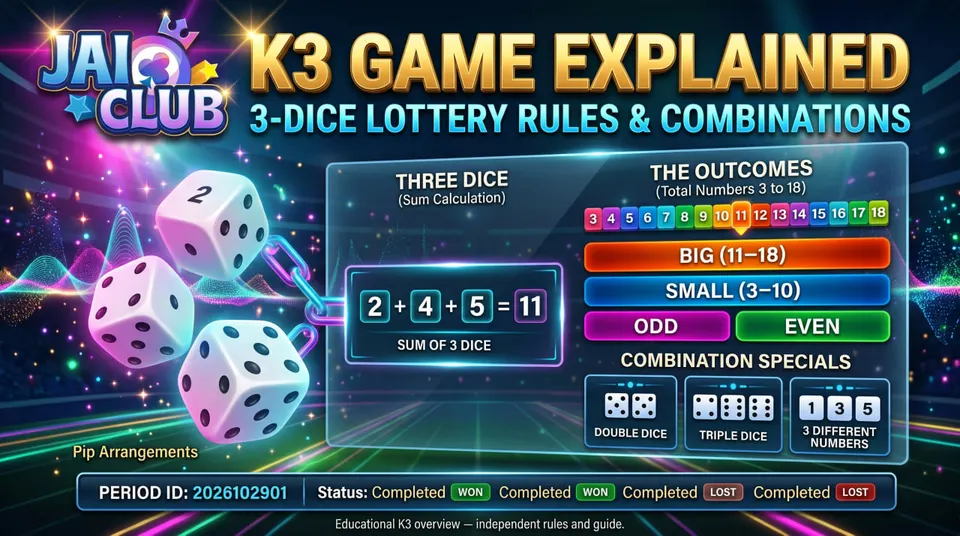
- K3 Dice Total Numbers From 3 to 18
- Complete K3 Dice Total Probability Chart
- Why Are K3 Totals 10 and 11 More Common?
- How Are K3 Big and Small Results Classified?
- K3 Odd and Even Results Explained
- Are All Three-Dice Combinations Equally Likely?
- Can K3 History Predict the Next Dice Combination?
- K3 Dice Combinations vs 5D Number Results
- More Jai Club K3 Game Information
- Frequently Asked Questions
- What are Jai Club K3 dice combinations?
- How many combinations are possible in K3?
- What is a Double in K3?
- What is a Triple in K3?
- How many Triple combinations exist?
- What is the maximum K3 dice total?
- What is the minimum K3 dice total?
- Which K3 totals have the most combinations?
- Is a K3 Triple more likely after several non-Triple results?
- Can K3 combinations predict results?
- Conclusion
K3 Dice Combinations: Doubles, Triples & Total Results Explained
Jai Club K3 dice combinations are an important part of understanding three-dice number games. While the basic K3 format uses three dice, the final result can be described in several different ways, including the total number, matching dice, Double combinations, Triple combinations, and Odd or Even classifications.
A result such as 2-2-5 is different from 2-3-4, even though both produce a total of 9.
That difference matters because K3 uses both the individual dice values and the combined result.
This article explores how three-dice combinations work, what Double and Triple mean, and how the mathematical probability of each total is calculated.
The examples use three fair, independent six-sided dice. They explain the mathematical model, not the verified outcome-generation system of any particular Jai Club game.
What Are K3 Dice Combinations?
A K3 dice combination consists of three values, with each die showing a number between 1 and 6.
For example:
Die 1 = 2, Die 2 = 4, Die 3 = 6
The combined total is:
2 + 4 + 6 = 12
The three values form a combination, while 12 represents the sum.
Different combinations can produce the same total.
For example:
- 1 + 5 + 6 = 12
- 2 + 4 + 6 = 12
- 3 + 3 + 6 = 12
- 4 + 4 + 4 = 12
All four examples produce 12, but their matching-dice patterns differ.
This distinction is essential when understanding K3 Doubles, Triples and total-number classifications.
How Many Possible K3 Dice Results Are There?
Each standard six-sided die has six possible faces.
When three independent dice are rolled, the number of possible ordered outcomes is:
6 × 6 × 6 = 216
This means there are 216 possible ordered dice results.
For example, 1-2-3 and 3-2-1 are different ordered outcomes, even though they contain the same three values.
If the order of the dice is ignored, there are 56 distinct combinations.
The difference between ordered and unordered combinations helps explain why probability calculations must specify what is being counted.
What Is a Double in K3?
A Double occurs when at least two dice show the same number.
For example:
2 – 2 – 5
Two dice display 2.
Another example is:
4 – 6 – 4
Two dice display 4.
These examples contain exactly one matching pair.
In mathematical discussions, it is useful to distinguish an exact pair from a Triple.
A Triple contains three matching dice, not merely two.
Some game interfaces may classify these patterns differently, so the actual K3 rule screen should be checked before interpreting any game-specific category.
Examples of K3 Double Combinations
| Dice Result | Matching Number | Total |
|---|---|---|
| 1-1-4 | 1 | 6 |
| 2-2-5 | 2 | 9 |
| 3-3-6 | 3 | 12 |
| 4-4-1 | 4 | 9 |
| 5-5-2 | 5 | 12 |
| 6-6-3 | 6 | 15 |
These examples demonstrate exact pairs rather than all possible Double outcomes.
What Is a Triple in K3?
A Triple occurs when all three dice show the same number.
Examples include:
1 – 1 – 1
3 – 3 – 3
6 – 6 – 6
There are six possible exact Triple outcomes.
| Triple | Total |
|---|---|
| 1-1-1 | 3 |
| 2-2-2 | 6 |
| 3-3-3 | 9 |
| 4-4-4 | 12 |
| 5-5-5 | 15 |
| 6-6-6 | 18 |
Triples are mathematically distinct from results containing exactly one matching pair.
For a model using three fair, independent dice, each particular Triple has one ordered outcome among the 216 possibilities.
Double vs Triple: What's the Difference?
The difference is straightforward.
A Double has a matching pair.
A Triple has all three values matching.
| Feature | Exact Double | Triple |
|---|---|---|
| Matching dice | Exactly two | All three |
| Example | 2-2-5 | 2-2-2 |
| Third die | Different | Same |
| Number of ordered outcomes | 90 | 6 |
| Model probability | 41.67% | 2.78% |
These probabilities refer to the entire categories, not to one specific matching pair or one exact Triple.
There are 90 ordered outcomes containing exactly one pair and six ordered Triple outcomes.
The exact categories are mutually exclusive under this mathematical classification.
What If All Three Dice Are Different?
Not every K3 result contains matching numbers.
For example:
1 – 3 – 6
All three dice are different.
Under the fair three-dice model, the three structural categories are:
| Dice Pattern | Ordered Outcomes | Approximate Probability |
|---|---|---|
| All different | 120 | 55.56% |
| Exactly one pair | 90 | 41.67% |
| Triple | 6 | 2.78% |
| Total | 216 | 100% |
These three groups cover every possible ordered result.
They are useful for understanding the mathematics of dice combinations, although game-specific settlement rules may classify them differently.
K3 Dice Total Numbers From 3 to 18
The minimum possible total occurs when all three dice show 1.
1 + 1 + 1 = 3
The maximum occurs when all three show 6.
6 + 6 + 6 = 18
Therefore, K3 totals range from 3 to 18.
However, not every total has the same number of possible combinations.
Complete K3 Dice Total Probability Chart
| Total | Ordered Outcomes | Approx. Probability |
|---|---|---|
| 3 | 1 | 0.46% |
| 4 | 3 | 1.39% |
| 5 | 6 | 2.78% |
| 6 | 10 | 4.63% |
| 7 | 15 | 6.94% |
| 8 | 21 | 9.72% |
| 9 | 25 | 11.57% |
| 10 | 27 | 12.50% |
| 11 | 27 | 12.50% |
| 12 | 25 | 11.57% |
| 13 | 21 | 9.72% |
| 14 | 15 | 6.94% |
| 15 | 10 | 4.63% |
| 16 | 6 | 2.78% |
| 17 | 3 | 1.39% |
| 18 | 1 | 0.46% |
| Total | 216 | 100% (approximately) |
The percentages are rounded.
This table describes three fair, independent six-sided dice. It should not be presented as a verified probability chart for an unexamined online game.
Why Are K3 Totals 10 and 11 More Common?
Totals of 10 and 11 can each be formed by 27 ordered outcomes.
By comparison, a total of 3 has only one possible result:
1 – 1 – 1
A total of 18 also has only one possible result:
6 – 6 – 6
Middle totals can be formed by more combinations of dice values, making them more common in the fair-dice model.
For example, the total 10 can be formed from several patterns, including:
- 1-3-6
- 1-4-5
- 2-2-6
- 2-3-5
- 2-4-4
- 3-3-4
Each pattern with different dice values can have multiple ordered arrangements.
The total probability includes those arrangements.
This explains why the distribution of K3 totals is not uniform.
How Are K3 Big and Small Results Classified?
Big and Small are common classification terms in K3-style games.
One frequently described convention separates totals as follows:
- Small: 3 to 10
- Big: 11 to 18
For example:
2 + 3 + 4 = 9, which is Small under this convention.
4 + 5 + 6 = 15, which is Big under this convention.
Some implementations treat Triple outcomes as special cases or apply additional restrictions.
Because of these possible differences, the classifications should not be assumed to determine every platform's settlement rules.
An interesting mathematical feature is that the fair-dice distribution is symmetrical around 10.5.
Consequently, totals 3–10 and 11–18 each account for 108 ordered outcomes before any game-specific exclusions.
K3 Odd and Even Results Explained
Odd and Even refer to whether the combined total is divisible by two.
An Even total is divisible by 2 without a remainder.
An Odd total is not.
For example:
1 + 3 + 4 = 8 — Even
2 + 4 + 5 = 11 — Odd
A result can have several descriptive properties simultaneously.
For example, 2-2-5 contains an exact pair and has an Odd total of 9.
This is another reason not to confuse a dice pattern with its combined total.
Are All Three-Dice Combinations Equally Likely?
Under the mathematical assumption of three fair, independent dice, each ordered result has equal probability.
However, the combined totals are not equally likely.
That distinction is important.
For example:
1-1-1 has a model probability of 1 out of 216.
1-2-3 also has a model probability of 1 out of 216 as an exact ordered result.
But the total of 6 can be produced by ten different ordered outcomes.
Therefore, the probability of obtaining a total of 6 is 10 out of 216.
A specific outcome and a total-number category describe different events.
Can K3 History Predict the Next Dice Combination?
In a properly functioning system with independent random outcomes, previous results do not change the probability distribution of the next round.
For example, observing several recent Doubles does not mean a Triple must appear next.
Likewise, a long period without a particular total does not mean that total is guaranteed to occur soon.
The 216-outcome mathematical model explains the probabilities of a fair independent dice process.
It does not provide a reliable prediction of the next individual result.
If an online platform uses an undisclosed or non-random mechanism, its true probabilities cannot be verified using a theoretical dice table alone.
K3 Dice Combinations vs 5D Number Results
K3 and 5D use different number structures.
K3 has three values, each ranging from 1 to 6.
A typical five-position 5D format has five values, each ranging from 0 to 9.
Their total ranges also differ.
| Feature | K3 | 5D |
|---|---|---|
| Number positions | 3 | 5 |
| Values per position | 1–6 | 0–9 |
| Minimum sum | 3 | 0 |
| Maximum sum | 18 | 45 |
| Common patterns | Doubles, Triples, dice totals | Individual digits, positions and sums |
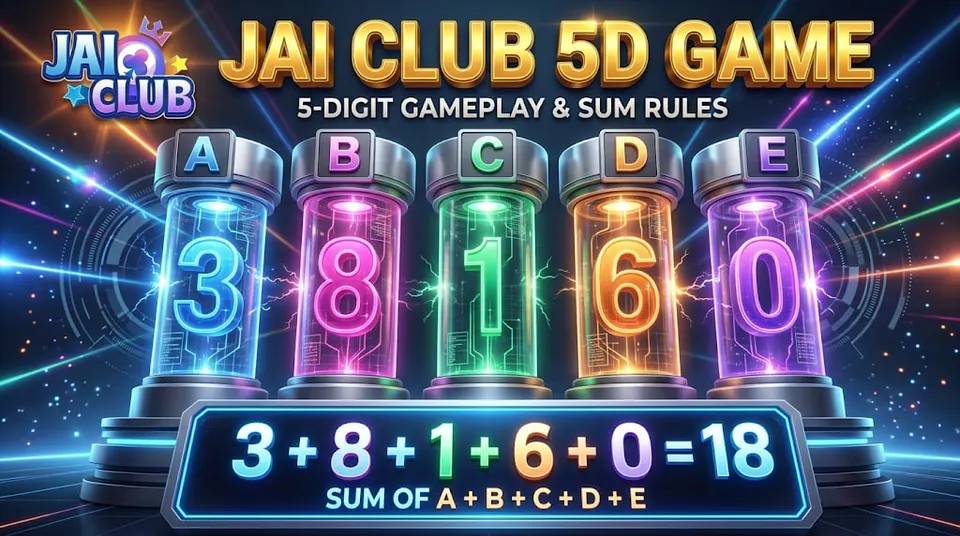
Read Jai Club K3 vs 5D: Key Differences for a more detailed comparison.
More Jai Club K3 Game Information
JaiClubGame.online publishes educational explanations of K3 and related number-based game formats.
Explore these related resources:
- Jai Club K3 Game: Three Dice, Total Numbers & Results
- Jai Club K3 vs 5D: Game Rules and Differences
- Jai Club 5D Game: Five-Digit Results and Positions
- K3 & 5D Articles
These articles are intended to help readers interpret game mechanics and mathematical terminology.
Frequently Asked Questions
What are Jai Club K3 dice combinations?
They are arrangements of three dice values, each typically between 1 and 6, which can be classified by total, matching numbers and other patterns.
How many combinations are possible in K3?
Three fair six-sided dice produce 216 ordered outcomes or 56 distinct combinations when order is ignored.
What is a Double in K3?
An exact Double occurs when two dice show the same value and the third displays a different value.
What is a Triple in K3?
A Triple occurs when all three dice display the same number.
How many Triple combinations exist?
There are six exact Triple outcomes, from 1-1-1 through 6-6-6.
What is the maximum K3 dice total?
The maximum possible total is 18, obtained from 6-6-6.
What is the minimum K3 dice total?
The minimum possible total is 3, obtained from 1-1-1.
Which K3 totals have the most combinations?
In the fair three-dice mathematical model, totals 10 and 11 each have 27 ordered outcomes.
Is a K3 Triple more likely after several non-Triple results?
No. Previous independent outcomes do not make the next Triple more likely.
Can K3 combinations predict results?
The mathematical model describes possible outcomes and probabilities but cannot guarantee future results.
Conclusion
Jai Club K3 dice combinations can be understood through three important elements: individual dice values, matching-dice patterns and combined totals.
Doubles contain a matching pair, Triples contain three identical values, and the sum of the dice ranges from 3 to 18.
In a fair independent three-dice model, there are 216 ordered outcomes, with totals 10 and 11 having the greatest number of possible arrangements.
These mathematical facts help explain the structure of K3-style games, but they should not be interpreted as proof of a particular online game's fairness or as a method for predicting future results.
Disclaimer: JaiClubGame.online is an independent informational website and is not officially affiliated with Jai Club. The probability calculations in this article assume fair, independent six-sided dice and may not describe the actual operating mechanism of a particular online game. This article does not provide betting strategies, guaranteed predictions or financial advice. Real-money gaming involves financial risk and may be restricted or prohibited by applicable laws.