What Do WinGo Game Records Actually Show?
Understand the information shown in WinGo game records, including period identifiers, result numbers, colours, status labels and historical data.
In this article
- What Do WinGo Game Records Actually Show?
- What Are WinGo Game Records?
- 1. Period Identifier
- 2. Result Number
- 3. Big and Small Labels
- 4. Colour Labels
- 5. Pending and Completed Results
- Why Status Matters
- 6. Example of a WinGo Result Table
- 7. What Does Result History Tell You?
- 8. Are Result Streaks Meaningful?
- 9. Why Might Records Appear in Different Orders?
- 10. How to Interpret WinGo Information Responsibly
- Frequently Asked Questions
- What is a WinGo period number?
- What does Small mean in WinGo?
- What does a pending WinGo result mean?
- Can result history predict future numbers?
- Are WinGo result tables identical on every platform?
- Conclusion
What Do WinGo Game Records Actually Show?
WinGo interfaces commonly display more than a countdown and a final number. They may also include period identifiers, colour labels, historical results and status information.
For someone unfamiliar with the interface, these records can be confusing.
What does a period number identify? How does a result become final? And what can previous results actually tell you?
Understanding these fields is useful for interpreting WinGo information accurately.
What Are WinGo Game Records?
WinGo game records are entries containing information about individual game rounds.
A record may include a period identifier, a final digit, its associated colour, a Big or Small classification and other details.
The purpose of a result record is to document what occurred in a particular round.
It does not provide a verified forecast of what will happen in a future round.
The precise fields depend on the platform and its version of WinGo.
1. Period Identifier
A period identifier distinguishes one game round from another.
For example, a result table may contain a long numeric identifier beside each completed result.
The identifier allows a particular result to be associated with the relevant round.
Some systems may incorporate dates, time information or sequential counters into their identifiers.
However, there is no reason to assume every WinGo implementation uses the same identifier format.
When interpreting a record, treat the period number as an identifier rather than a prediction.
2. Result Number
Many WinGo-style games use a result digit between 0 and 9.
This digit is often the foundation for other displayed information, including colour and Big or Small labels.
For example, a result of 7 may be classified as Big in implementations using the common 0–4 and 5–9 grouping.
The result number records the outcome of a completed period.
It does not indicate which number must appear next.
3. Big and Small Labels
In a commonly documented WinGo format, the numbers are divided into two groups.
| Number | Classification |
|---|---|
| 0 | Small |
| 1 | Small |
| 2 | Small |
| 3 | Small |
| 4 | Small |
| 5 | Big |
| 6 | Big |
| 7 | Big |
| 8 | Big |
| 9 | Big |
This classification is derived from the result digit.
For example, 4 is Small and 5 is Big.
The exact boundaries should be checked against the specific game's official rules before using the table for a particular platform.
4. Colour Labels
Some WinGo games associate result numbers with red, green or violet symbols.
A commonly described scheme uses red and green for different digit groups, while certain numbers have a special violet association.
However, colour displays can differ between implementations.
A colour label should therefore be read using the rules of the relevant game rather than treating every internet chart as universally authoritative.
For an educational result table, clearly identify whether the colours come from verified game rules or an illustrative example.
5. Pending and Completed Results
A result may not be available while the associated round is still running.
In some interfaces, this condition appears as a pending, ongoing or unsettled status.
After the round finishes and the system provides its outcome, the record may be marked as completed or settled.
These terms describe the status of the record.
They do not establish whether the next outcome is likely to be red, green, Big or Small.
Why Status Matters
A pending record and a completed record represent different stages.
An empty result field may simply indicate that the outcome has not yet been posted.
It should not be interpreted as a zero, a failed result or a hidden prediction.
6. Example of a WinGo Result Table
The following data is fictional and provided only to illustrate how game records can be organised.
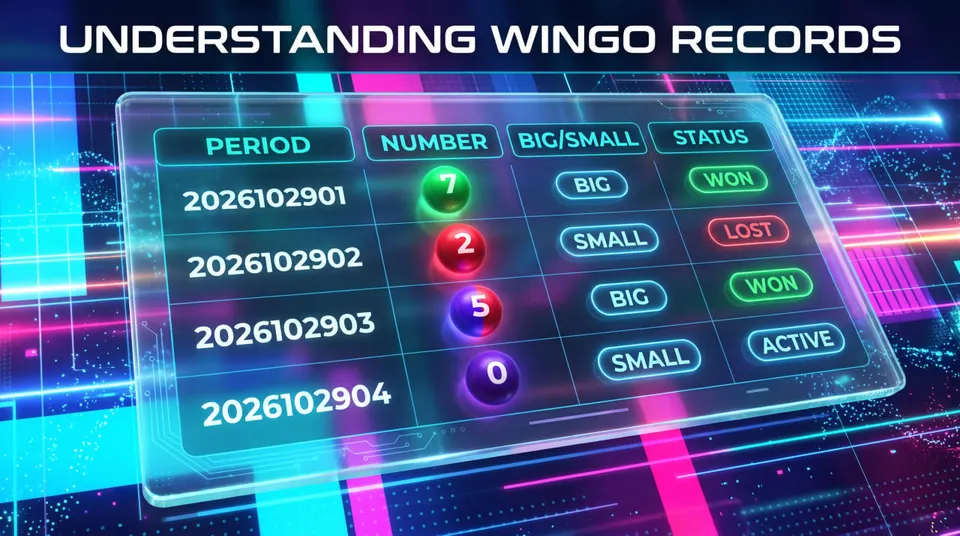
| Period | Result | Big/Small | Status |
|---|---|---|---|
| Demo-105 | 7 | Big | Completed |
| Demo-104 | 2 | Small | Completed |
| Demo-103 | 5 | Big | Completed |
| Demo-102 | 0 | Small | Completed |
| Demo-101 | 8 | Big | Completed |
The period labels are deliberately fictional and are not intended to reproduce any live platform format.
This example shows how a result digit may be displayed alongside its classification.
7. What Does Result History Tell You?
Result history provides a record of previous outcomes.
It can be useful for checking which digit appeared in a particular completed period or understanding how the interface classifies results.
However, historical information has important limitations.
In a game where future outcomes are generated independently, a sequence of previous numbers does not determine the next number.
For example, several consecutive Small results do not prove that the next result must be Big.
This mistaken assumption is often called the gambler's fallacy.
8. Are Result Streaks Meaningful?
A streak is a sequence in which the same label appears repeatedly.
For example, an illustrative result sequence might contain four consecutive Big classifications.
That sequence describes what happened in those four periods.
It does not establish that the next outcome is more likely to be Small.
Without verified information about the game's underlying probability model, streaks should not be treated as evidence of a predictable cycle.
9. Why Might Records Appear in Different Orders?
Game interfaces may display historical information in different ways.
Some tables put the newest completed period at the top.
Others may allow users to filter, sort or select a particular round duration.
A result table should therefore be interpreted together with its headings and selected game mode.
If two screens display different period sequences, first establish whether they refer to the same game mode and time range.
10. How to Interpret WinGo Information Responsibly
A useful approach is to distinguish three separate concepts.
Game timing explains when periods begin and end.
Result records explain what the system reports for completed periods.
Outcome probability concerns how future results are generated.
These concepts are connected to the same game but do not mean the same thing.
Knowing the period duration does not establish the next result.
Knowing past results does not reveal the underlying random process.
And seeing a colour label does not establish that future results will follow a predictable pattern.
For additional WinGo information, browse the WinGo category.
Frequently Asked Questions
What is a WinGo period number?
It is an identifier associated with a specific round. Its exact structure depends on the platform.
What does Small mean in WinGo?
In the commonly documented 0–9 format, Small represents the digits 0, 1, 2, 3 and 4.
What does a pending WinGo result mean?
It generally indicates that a final result has not yet been displayed or recorded.
Can result history predict future numbers?
Historical results alone cannot reliably predict future outcomes in an independent random game.
Are WinGo result tables identical on every platform?
No. Their fields, layouts, identifier formats and available filters can differ.
Conclusion
WinGo game records provide structured information about individual rounds.
Period identifiers, result digits, classification labels and completion statuses help explain what a particular table entry represents.
The most useful distinction is between recording a past result and predicting a future result.
A history table documents previous outcomes. It should not be presented as a guaranteed prediction system.
Disclaimer: JaiClubGame.online is an independent educational website and is not officially affiliated with Jai Club. This article does not provide real-time results or predictions. Real-money games carry financial risks and may be restricted or prohibited under local laws.