Lottery Period Numbers on Jai Club: How to Match Results Across Games
Understand Jai Club Lottery period numbers, how to match completed results across WinGo, K3 and 5D, and why different game modes should not share one result record.
In this article
- What Is a Lottery Period Number?
- Period Number vs Result Number
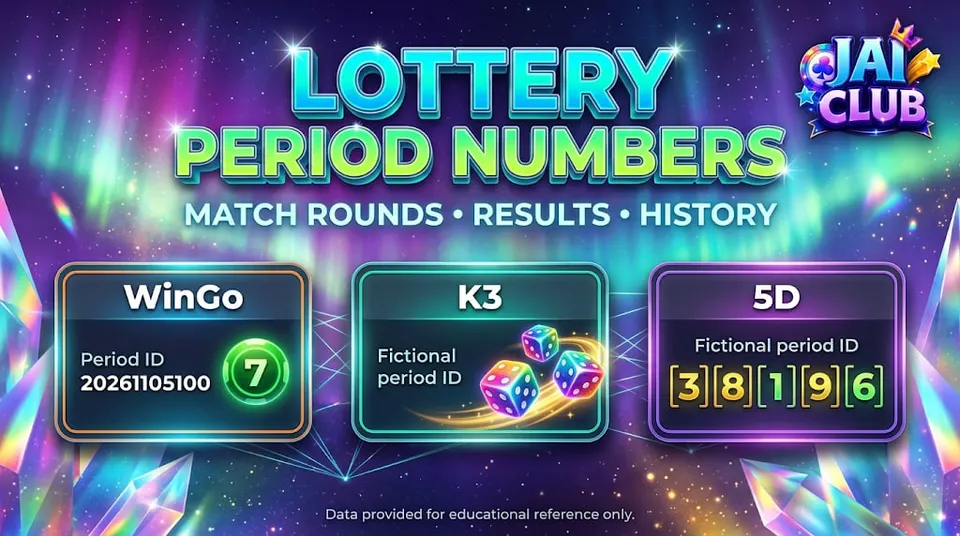
- Do WinGo, K3 and 5D Use the Same Period Numbers?
- How to Match a Result With Its Correct Period
- Why a New Period May Appear Before the Previous Result
- How Period Numbers Work in 5D
- How Period Numbers Work in K3
- Can a Period Number Reveal the Next Lottery Result?
- Common Period Number Mistakes
- What if a Period Result Cannot Be Found?
- Frequently Asked Questions
- What is a Jai Club Lottery period number?
- Is the period number the winning number?
- Do WinGo and K3 share the same period sequence?
- Why does a new period appear before the old result?
- Can I calculate the next result from the period ID?
- What should I check when a result seems missing?
- Conclusion
Jai Club Lottery period number is a term associated with the identifier displayed beside a round in number-based games such as WinGo, K3 and 5D. While the result number describes what happened in a completed round, the period number identifies which round the result belongs to. These two pieces of information serve different purposes, and confusing them can lead to mistakes when reading result-history tables.
A period identifier may look like a long numerical sequence, a date-based code or a combination of several elements. Its exact structure depends on the game provider, so the appearance of a long number does not prove that it represents a date, a countdown or a prediction of the result. The most reliable interpretation is that it acts as a reference used to distinguish one round from another.
This guide focuses on how to match completed results with their period identifiers across different lottery-style game formats. It also explains why a WinGo period cannot automatically be compared with a K3 or 5D period and how delayed history updates can cause apparent mismatches.
What Is a Lottery Period Number?
A lottery period number is an identifier assigned to a particular round or event. It helps a game interface distinguish the current round from earlier and later rounds, especially when many outcomes are recorded during a single day.
In a timed format, the active period may be displayed alongside a countdown. When that period ends, the interface may begin showing a new identifier while the completed result appears in a separate history section.
The distinction is important because the identifier itself is not the outcome. A period labelled DEMO-W-1205 does not imply that the number 5 will appear or that the result will belong to a particular colour group. The identifier simply allows the round to be referenced.
The broader Jai Club Lottery overview explains why WinGo, K3, 5D and Moto Racing can appear within a broad lottery category while using different types of results.
Period Number vs Result Number
The simplest way to understand the difference is to treat the period as a reference and the result as the recorded outcome. A single period might produce a WinGo digit, a set of three dice or a five-digit result, depending on the game.
For example, consider a fictional WinGo history entry containing period DEMO-W-1205 and result digit 7. The digits in the period identifier are part of the reference, while 7 is the numerical outcome. There is no mathematical requirement that the two values resemble one another.
In K3, a period identifier may be associated with three dice showing 2, 3 and 6. Their combined total is 11, but the period identifier remains separate from all four numbers.
The same principle applies to 5D, where one completed period can contain five positions and a calculated SUM. The period is not a sixth result digit.
Do WinGo, K3 and 5D Use the Same Period Numbers?
Not necessarily. Although multiple game formats may use identifiers called period numbers, they can operate on different schedules and use different reference structures.
WinGo may have several timed modes, while K3 and 5D can maintain their own independent sequences. A period appearing at approximately the same time in two games does not establish that the identifiers are interchangeable.
Consider this fictional example:
| Game | Demo period | Recorded result |
|---|---|---|
| WinGo | DEMO-W-1205 | 7 |
| K3 | DEMO-K-0812 | 2, 3, 6 |
| 5D | DEMO-D-0421 | 4, 0, 7, 1, 8 |
All three records could be displayed within one informational dashboard, but they describe different games. Their identifiers should not be compared numerically or interpreted as representing the same draw.
How to Match a Result With Its Correct Period
The most important step is to identify the game mode and completed period together. A WinGo 30-second result should be matched with the corresponding WinGo 30-second period, not another duration mode or a different game category.
Next, check the result-history entry associated with that identifier. The record should provide the appropriate outcome fields, such as a digit for WinGo, three dice for K3 or five positions for 5D.
If the current screen already shows a newer period, avoid assuming that the newest visible identifier belongs to the previous result. Interfaces can update the active round before refreshing the history panel.
For an explanation of how period references are displayed in one particular format, read What Do WinGo Game Records Actually Show?.
Why a New Period May Appear Before the Previous Result
A gaming interface may update several parts of the page independently. The countdown can finish, the next period can begin and the result-history table can refresh at slightly different moments.
For example, the screen may display current period DEMO-W-1206 while the most recent completed history entry still belongs to DEMO-W-1204. That does not establish what happened to DEMO-W-1205. Its result may still be awaiting display, or the history request may not have updated successfully.
A brief difference between the active period and the latest historical record is therefore not sufficient evidence of an incorrect outcome. A persistent missing entry requires verification by the responsible service.
How Period Numbers Work in 5D
A 5D result commonly contains five digit positions, labelled A through E, and may include a combined SUM. All of these values belong to one completed period.
If the fictional result is A=4, B=0, C=7, D=1 and E=8, the corresponding SUM is 20. The period identifier tells the reader which round produced that combination, while the digits and total explain the outcome.
The positions must remain associated with the same period. Combining position A from one entry with position E from another would create a result that was never actually recorded.
Our Jai Club 5D Game guide explains the relationship between individual positions and their combined SUM.
How Period Numbers Work in K3
K3 commonly uses three dice values and their combined total. A period identifier distinguishes one complete three-dice outcome from another.
For example, a result of 2, 2 and 5 produces a total of 9. The combination contains a matching pair, but that property belongs to the result, not to the period number.
Two different periods may contain the same total while showing different dice combinations. This is entirely possible because several three-dice arrangements can produce the same sum.
The K3 Dice Total Chart provides a mathematical reference for how combinations relate to totals from 3 to 18.
Can a Period Number Reveal the Next Lottery Result?
A period identifier does not, by itself, reveal the future outcome. Even if the identifier contains sequential digits or a date-like structure, that information can simply describe how the service organises its rounds.
A system may use a sequence to identify records while determining outcomes through a separate process. Without verified technical documentation, it would be incorrect to infer a result from the final digit of the period number.
Claims that a period number guarantees the next colour, dice total or 5D sequence should therefore be treated cautiously. Historical identifiers are useful for record matching, not as independently verified prediction formulas.
Common Period Number Mistakes
One common mistake is comparing different game modes as though they share the same period sequence. Another is treating the active period as a completed result. A third is confusing the numerical digits of a long identifier with the actual game outcome.
Screenshots can also create confusion when they are captured at different times. A screenshot showing an active countdown may not be directly comparable with a later screenshot showing settled history.
Readers should identify the game, mode, period and completed result before concluding that two screens are inconsistent.
What if a Period Result Cannot Be Found?
If a completed period remains absent from the visible history, the problem may involve a delayed update, connectivity issue or another provider-side condition. Its exact status cannot be established from surrounding results.
Useful information includes the game mode, period identifier and the approximate time when the issue occurred. Personal account details and one-time passwords should not be shared with unofficial support contacts.
The Game Results Not Showing guide explains how to distinguish result-display problems from broader loading failures.
Frequently Asked Questions
What is a Jai Club Lottery period number?
It is an identifier used to distinguish one game round from another.
Is the period number the winning number?
No. The period identifies the round, while the result records its outcome.
Do WinGo and K3 share the same period sequence?
They should not be assumed to. Different game modes can use independent schedules and identifiers.
Why does a new period appear before the old result?
The active-round display and result-history panel may update at different moments.
Can I calculate the next result from the period ID?
No reliable prediction follows from the identifier alone.
What should I check when a result seems missing?
Check the exact game mode, completed period identifier and relevant result-history record.
Conclusion
Jai Club Lottery period numbers are useful for connecting results to the rounds that produced them. They should not be confused with WinGo digits, K3 dice totals or 5D position values, even when all of those numbers appear together on a screen.
Understanding the difference between the active period, completed period and recorded result makes it easier to interpret lottery-style history without combining unrelated information. The precise identifier structure and settlement status must always be verified through the relevant provider.
Disclaimer: JaiClubGame.online is an independent informational website and is not officially affiliated with Jai Club. All period examples are fictional, and no individual result or account status is verified through this article. Real-money gaming involves financial risk and may be restricted or prohibited under applicable laws.