Game Round Completed but Settlement Pending? Understanding the Difference
Understand why a completed game round can appear alongside a pending account settlement, how result status differs from transaction status, and what records are needed to interpret the situation.
In this article
- What Does Game Round Completed Mean?
- Settlement Pending Ka Kya Matlab Hai?
- Game Result vs Settlement
- EXAMPLE: Completed WinGo Round
- Why the Period ID Matters
- Transaction Reference vs Round Number
- Does a Completed Result Mean an Entry Won?
- EXAMPLE: Result and Entry Comparison
- Does Pending Settlement Mean a Server Problem?
- Result Publication vs Account Update
- Can a Pending Settlement Become Completed?
- What About a Failed Settlement?
- Does Settlement Pending Mean Money Is Lost?
- EXAMPLE: Gross Payout vs Net Result
- Why a Balance May Remain Unchanged
- Screenshots and Pending Settlement
- What Information Helps Clarify the Status?
- Is a Pending Settlement Proof of Manipulation?
- Can Independent Websites Confirm Settlement?
- Frequently Asked Questions
- Can a game round be completed while settlement is pending?
- Does a completed result mean the payout was credited?
- Does pending mean a transaction failed?
- Will every pending settlement eventually succeed?
- Can a completed round have several related entries?
- Does an unchanged balance prove settlement failed?
- Can a screenshot prove final settlement?
- Can JaiClubGame.online verify a private settlement?
- Conclusion
A game round can display a completed result while a related account record still shows a pending settlement status.
These labels may appear contradictory, but they can describe different processing stages.
A completed round indicates that the game event has reached a final outcome according to the system displaying it. A pending settlement may indicate that an associated account-related transaction has not yet reached its final recorded state.
The precise meaning depends on the provider's rules and software architecture.
This guide explains the distinction using fictional examples. It does not claim that any particular Jai Club account or settlement has been examined.
What Does Game Round Completed Mean?
A completed game round generally means that the relevant game event has finished.
For example, a WinGo round may have a final result digit.
A crash round may have a recorded ending multiplier.
A slot event may have a final reel or symbol outcome.
The exact field depends on the game.
However, a completed round does not automatically describe every account-related event associated with that result.
The round outcome and individual position records can be maintained as separate pieces of information.
Settlement Pending Ka Kya Matlab Hai?
A pending settlement label usually refers to an account-related event that has not been recorded as final in the relevant interface.
However, pending can have different meanings between systems.
For example, the label might concern a processing stage, confirmation state or another provider-defined condition.
It should not automatically be interpreted as a failed payment.
Likewise, a pending status does not prove that the game result is incorrect.
The status must be read in the context of the specific record displaying it.
Game Result vs Settlement
| Field | Game result | Settlement |
|---|---|---|
| Main purpose | Identifies the game outcome | Records an account-related position outcome |
| Typical identifier | Period or round ID | Entry or transaction reference |
| Possible status | Active, pending, completed | Pending, completed, failed or provider-defined |
| Relevant value | Digit, symbol or multiplier | Settlement value or processing information |
| Proves account credit | Not automatically | Depends on the actual record |
The field names are general examples.
A particular service may use different terminology.
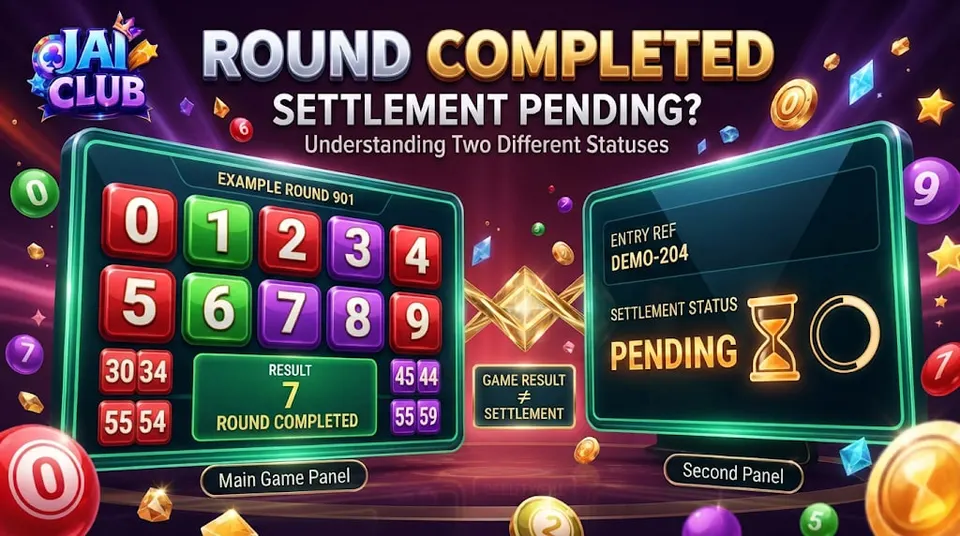
EXAMPLE: Completed WinGo Round
Consider a fictional WinGo event.
| Information | Example value |
|---|---|
| Game | Demo WinGo |
| Period ID | DEMO-W901 |
| Final digit | 7 |
| Round status | Completed |
| Entry reference | ENTRY-204 |
| Settlement status | Pending |
| Account credit | Not verified |
EXAMPLE ONLY: All values are fictional.
The completed digit describes the round outcome.
The pending label belongs to the separate entry record.
These states can appear together without automatically proving an error.
However, the example does not establish why any real provider would leave a settlement pending.
Why the Period ID Matters
A period identifier helps distinguish one game event from another.
For example, DEMO-W901 identifies one fictional round, while DEMO-W902 identifies a different round.
An account-related entry must be matched to the correct game event.
A common mistake is comparing the latest completed game result with an account record from another period.
The two values may be unrelated.
A meaningful investigation should first establish that the records refer to the same event.
Transaction Reference vs Round Number
A round number identifies the game event.
A transaction reference identifies an account-related action.
These can be associated, but they do not necessarily have identical values.
For example, one completed round might correspond to multiple entries in a system that supports such functionality.
Each entry may have its own reference.
The existence of a completed round therefore does not automatically mean that every associated record shares the same status.
The account and game histories serve different purposes.
Does a Completed Result Mean an Entry Won?
No.
A completed result describes what happened in the game.
Whether an individual entry qualifies for a payout depends on the selected outcome and relevant rules.
For example, a WinGo result of 7 does not establish which selections were submitted.
It also does not prove that a particular entry was accepted.
A person may view the result without having an associated account position.
Therefore, the result and settlement records should be examined separately.
EXAMPLE: Result and Entry Comparison
Imagine a fictional completed round with result digit 7.
Entry A is associated with a category that qualifies under the hypothetical rules.
Entry B is associated with another category that does not qualify.
Both relate to the same completed round.
However, their individual settlement outcomes may differ.
The game result is shared, while the account-related consequences depend on each accepted entry.
EXAMPLE ONLY: No actual Jai Club selection or payout rules are assumed.
Does Pending Settlement Mean a Server Problem?
Not necessarily.
A pending status describes the state shown in the record.
It does not independently identify the reason.
Possible explanations in general software systems include separate processing stages, delayed interface updates or other provider-defined conditions.
However, these should not be presented as verified causes of a particular Jai Club issue.
A reliable technical assessment requires relevant logs or authoritative records.
Without those, the cause remains unknown.
Result Publication vs Account Update
A game outcome can be presented in a result-history screen.
An account-related amount may be displayed elsewhere.
The two interfaces may update through different software components.
This can create different visible states.
For example, the completed game record might appear before a separate settlement panel refreshes.
However, this possibility should not automatically be used to explain every pending status.
The actual system design must be verified.
Can a Pending Settlement Become Completed?
Some systems support transitions between pending and completed transaction statuses.
However, the exact status sequence depends on the provider.
A pending label does not guarantee that the final status will be successful.
Likewise, the presence of a completed game result does not prove that a pending transaction will be credited.
The actual account-related record is needed.
Readers should avoid treating a possible state transition as a promised outcome.
What About a Failed Settlement?
A failed settlement status, where supported, can indicate that a particular processing operation did not complete successfully.
However, the meaning of failure depends on the service's terminology.
It should not automatically be treated as proof that a game round was cancelled.
Game completion and account processing can be separate.
A technical investigation would need to identify the relevant transaction and its relationship to the round.
The visible status alone may not explain the underlying cause.
Does Settlement Pending Mean Money Is Lost?
No universal conclusion can be made.
A pending label does not establish that an amount has been permanently lost.
It also does not guarantee that a particular amount will be received.
The outcome depends on the provider's rules and completed account records.
An educational website cannot verify the status of an individual private transaction.
Readers should distinguish what the interface displays from claims about a final financial outcome.
EXAMPLE: Gross Payout vs Net Result
Suppose a hypothetical accepted position uses a stake of ₹100.
Under fictional rules, the qualifying gross payout multiplier is 2.00x.
If the position is successfully settled under those rules:
Gross payout = ₹100 × 2.00 = ₹200.
Net profit = ₹200 − ₹100 = ₹100.
However, a pending settlement does not establish that the ₹200 gross payout has been credited.
The calculation is only an example of how a settled position might be valued.
The actual provider rules and recorded settlement determine the final result.
Why a Balance May Remain Unchanged
An account balance may reflect multiple events rather than one game round.
For example, it could contain earlier adjustments, separate transactions or other activity.
Therefore, an unchanged displayed balance is not sufficient to identify the status of one particular game event.
A balance is a total or category value.
A settlement record concerns a specific event or position.
These should not be confused.
The associated transaction history provides more context than the balance alone.
Screenshots and Pending Settlement
A screenshot can document that an interface displayed Pending at a particular moment.
However, it does not independently prove the final status of a transaction.
The screenshot may also omit important fields, such as the reference number or relevant period.
For example, an image displaying a completed result and a separate pending panel should be interpreted carefully.
The two sections may describe different events.
A valid comparison needs matching identifiers and reliable timestamps.
What Information Helps Clarify the Status?
The exact game and mode are important.
The relevant completed period should be identified.
Where an entry or transaction reference is available, it should be recorded accurately.
The visible status and approximate time can also provide context.
However, private credentials are not needed to explain ordinary record terminology.
Passwords, OTPs and sensitive authentication details should not be exposed.
The purpose is to distinguish the event states, not disclose private account information.
Is a Pending Settlement Proof of Manipulation?
No.
A pending status describes a processing state.
It does not independently establish intent or manipulation.
A genuine dispute requires reliable records and an understanding of the relevant game and account rules.
For example, a screenshot taken before settlement completion cannot prove that a final result was changed later.
The difference between temporary display state and completed authoritative record matters.
Unsupported accusations should be avoided.
Can Independent Websites Confirm Settlement?
An independent informational website cannot automatically access a provider's private account records.
JaiClubGame.online publishes general explanations about game terminology and technical issues.
It is not an official operator or account support service.
Therefore, it cannot confirm whether a particular user's settlement was accepted, rejected or credited.
For related interface concepts, read Reading a Colour Trading Dashboard Without Confusing Bets and Results.
The site's FAQ also explains its independent informational role.
Frequently Asked Questions
Can a game round be completed while settlement is pending?
Yes. The labels may describe separate game and account processing stages.
Does a completed result mean the payout was credited?
Not necessarily. A completed game outcome and account settlement are different records.
Does pending mean a transaction failed?
No. Pending and failed are distinct possible states, depending on the provider.
Will every pending settlement eventually succeed?
That cannot be guaranteed.
Can a completed round have several related entries?
Some systems support multiple entries, but this depends on the game's rules.
Does an unchanged balance prove settlement failed?
No. A balance and an individual transaction record provide different information.
Can a screenshot prove final settlement?
Not independently. The relevant authoritative record may be needed.
Can JaiClubGame.online verify a private settlement?
No. It is an independent educational website.
Conclusion
A completed game round and a pending settlement status can appear together because they may describe different events.
The game record identifies an outcome, while an account-related record describes the processing state of a particular position or transaction.
Matching period identifiers, entry references and status labels helps prevent confusion.
A pending label should not be treated as either a confirmed payout or proof that a game result was manipulated.
Editorial method: All round identifiers, amounts and settlement examples are fictional. No private Jai Club account or provider log was accessed.
Disclaimer: JaiClubGame.online is an independent educational website. It does not process transactions, verify settlements or guarantee payouts.