Why Does a 5D Result Start With Zero? Leading Digits Explained
Learn why a Jai Club 5D result may begin with zero, how leading zeros affect five-digit sequences, position values, SUM calculations and result history.
In this article
- What Is a Leading Zero in 5D?
- Why a Five-Digit Result Can Begin With Zero
- Leading Zero vs Missing Digit
- Examples of 5D Results With Leading Zeros
- Does a Leading Zero Change the 5D SUM?
- Does 04729 Mean the Same Thing as 4729?
- What About a Result of 00000?
- Can Zero Appear in Other 5D Positions?
- Leading Zeros and 5D Result History
- Are Leading-Zero Results Less Likely?
- Frequently Asked Questions
- What does a leading zero mean in Jai Club 5D?
- Is 04729 a valid five-position sequence?
- Does a leading zero count as a digit?
- Does zero change the SUM?
- Is 00000 the same as a blank result?
- Can zero appear in positions B, C, D and E?
- Does a leading zero predict the next 5D result?
- Conclusion
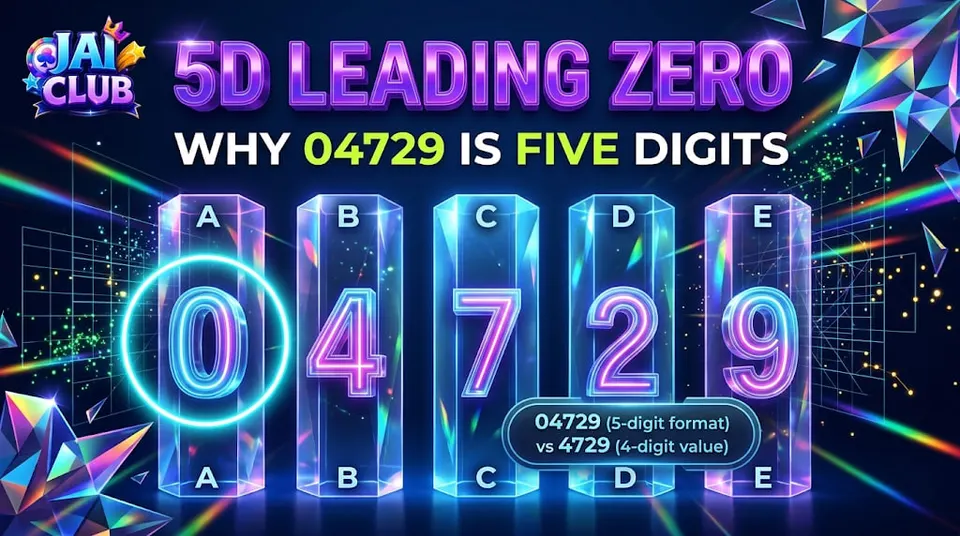
A Jai Club 5D leading zero is a zero that appears at the beginning of a five-position numerical result. For example, a completed sequence might be displayed as 04729 rather than 4729. Although both expressions can represent the same numerical value when treated as ordinary integers, they are not identical as structured five-position records.
This distinction is important because 5D commonly uses five labelled positions, A, B, C, D and E. The digit in each position is meaningful within the result format, including when that digit is zero. Removing a leading zero can make the displayed result appear shorter than it should be and may cause confusion when comparing history tables or screenshots.
This guide explains how leading zeros work, why they should be preserved when displaying 5D results, how zero contributes to SUM calculations and what readers should check if a result appears to have fewer than five digits.
What Is a Leading Zero in 5D?
A leading zero is a zero placed before the first non-zero digit in a sequence. In a conventional five-position format, it may occupy position A, the first position.
For example, the result 04729 contains five digits: A=0, B=4, C=7, D=2 and E=9. The zero is part of the structured result even though an ordinary calculator may display the integer value as 4729.
The difference arises because 5D is commonly interpreted as a sequence of labelled positions rather than simply as one unstructured integer.
A correct record should preserve the number of positions required by its format. If the game defines five positions, an initial zero does not remove one of those positions.
Why a Five-Digit Result Can Begin With Zero
When each position can contain a digit from 0 through 9, there is no mathematical reason that the first position must always contain a non-zero value. Zero can occupy position A just as it can occupy B, C, D or E.
This creates legitimate sequences such as 01234, 00718 and 00046 within a standard five-position numerical model.
These sequences may look unusual because ordinary written integers do not normally retain unnecessary leading zeros. However, structured identifiers, digital codes and fixed-width records frequently preserve them.
In 5D, the important point is that the result contains five ordered positions, not necessarily that its integer representation has five visible non-zero-leading digits.
Leading Zero vs Missing Digit
A leading zero should not be confused with a missing digit. If a result is displayed as 04729, all five positions are present. If the display instead shows 4729 without labels, the first position may have been omitted by a formatting system, or the service may use a different presentation.
The missing-position interpretation cannot be confirmed from the shortened number alone. Readers need the actual A–E fields or documented display format.
For example, a structured record containing A=0, B=4, C=7, D=2 and E=9 should remain associated with those positions even if another interface displays only 4729.
If a result unexpectedly changes format, compare the five position fields before concluding that a number has been altered.
Examples of 5D Results With Leading Zeros
| Complete sequence | A | B | C | D | E |
|---|---|---|---|---|---|
| 04729 | 0 | 4 | 7 | 2 | 9 |
| 00184 | 0 | 0 | 1 | 8 | 4 |
| 00073 | 0 | 0 | 0 | 7 | 3 |
| 09005 | 0 | 9 | 0 | 0 | 5 |
| 00000 | 0 | 0 | 0 | 0 | 0 |
These examples are fictional mathematical sequences, not actual Jai Club results. The table illustrates why the complete position structure matters even when several digits are zero.
Does a Leading Zero Change the 5D SUM?
Under the standard SUM convention, the five position digits are added together. Zero contributes nothing to the arithmetic total, but it still occupies a valid position.
For example, the result 04729 has a SUM of 22 because 0 + 4 + 7 + 2 + 9 = 22. If the zero is hidden in an integer-style display, the remaining visible digits may still produce the same sum, but the position arrangement becomes unclear.
A sequence containing multiple leading zeros, such as 00184, has a SUM of 13. The fact that two positions are zero does not reduce the number of defined positions from five to three.
The Jai Club 5D Game guide provides a broader explanation of position values and combined sums.
Does 04729 Mean the Same Thing as 4729?
As ordinary integers, the two expressions have the same numeric value. As fixed-width strings or structured game records, they can represent different formats.
The expression 04729 explicitly identifies five digits, while 4729 contains only four visible characters. If the game requires five positions, the shorter expression may lose important information about position A.
This distinction is common in software systems. Postal codes, reference numbers and other structured values sometimes preserve leading zeros because each character position matters.
For game history, the safest interpretation is to retain the complete sequence exactly as it appears in the authoritative result record.
What About a Result of 00000?
A five-position sequence of 00000 is mathematically possible when each position permits zero. Its SUM would be 0 because all five component values are zero.
However, mathematical possibility does not prove that a particular gaming provider can or will generate such a result. The actual number-generation rules must be verified independently.
A complete zero sequence should not be confused with a blank result, a loading placeholder or an unpublished outcome. Those display states may look similar in poorly labelled interfaces, but they do not necessarily mean the same thing.
The result status and period identifier are needed to distinguish an actual recorded 00000 from missing information.
Can Zero Appear in Other 5D Positions?
Yes. Under a standard five-digit model, zero can appear in any position from A through E.
For example, 50821 contains zero in position B, while 62004 contains zero in positions C and D. These are different arrangements with different ordered sequences.
The position of zero can matter when the result is interpreted using an individual A–E column. A zero in position A is not interchangeable with a zero in position E when the format distinguishes the two positions.
Readers should therefore examine the labelled columns rather than simply count how many zeros are visible.
Leading Zeros and 5D Result History
A history table may show the five digits in separate columns, making leading zeros straightforward to identify. Another interface may concatenate the digits into one displayed sequence.
If a software system stores a five-digit result as a numerical integer instead of fixed-width text, a leading zero can disappear during formatting. This is a possible technical explanation for a shortened display, but it should not be assumed to be the cause of a particular service's behaviour without evidence.
When comparing records, first match the period identifier and then examine the five component positions. This avoids confusing a formatting difference with a change to the underlying outcome.
Are Leading-Zero Results Less Likely?
Under a hypothetical model where each position independently generates one of ten equally likely digits, position A has a 10% chance of being zero. A complete sequence beginning with zero would therefore represent one-tenth of all possible five-position sequences.
However, these are theoretical values based on a specific mathematical model. They do not establish the actual probabilities used by any Jai Club service.
A leading zero is not evidence that a result is incomplete, suspicious or more likely to be followed by another particular number.
Frequently Asked Questions
What does a leading zero mean in Jai Club 5D?
It means the first position of the five-digit result contains zero.
Is 04729 a valid five-position sequence?
It is mathematically valid under a model allowing digits 0 through 9 in every position.
Does a leading zero count as a digit?
Yes. In a fixed-width five-position record, zero occupies one of the positions.
Does zero change the SUM?
Zero adds nothing to the arithmetic total, but its position remains part of the result.
Is 00000 the same as a blank result?
No. A complete zero sequence and a missing or unpublished result are different concepts.
Can zero appear in positions B, C, D and E?
Yes, if the provider's result format permits digits 0 through 9 in those positions.
Does a leading zero predict the next 5D result?
No. Its appearance does not reliably determine future independent outcomes.
Conclusion
Leading zeros help illustrate why a 5D result should be read as five labelled positions rather than merely as an ordinary integer. A sequence such as 04729 contains five digits even though removing the zero produces the same integer value.
Preserving the complete sequence makes it easier to interpret A–E positions, SUM calculations and historical records correctly. The actual result format and probabilities must be confirmed through the relevant game provider.
Disclaimer: JaiClubGame.online is an independent informational website and is not officially affiliated with Jai Club. The sequences and probabilities are mathematical examples, not verified live game records. Real-money gaming involves financial risk and may be restricted or prohibited under applicable laws.