Dice vs K3: Are These Jai Club Game Formats the Same?
Compare general Dice games with the K3 three-dice format, including result types, number ranges, totals, probability models and game terminology.
In this article
- What Is the K3 Game Format?
- What Does Dice Mean in Digital Games?
- Dice vs K3: Main Differences
- Why Are K3 Totals Not Equally Likely?
- What Are Doubles and Triples?
- Can Dice Games Use Multipliers?
- Dice vs K3 vs 5D
- Are Dice and K3 Both Available on Jai Club?
- Can Previous Dice Results Predict the Next Outcome?
- Frequently Asked Questions
- Is K3 the same as Dice?
- How many dice does K3 use?
- What is the K3 total range?
- Do all Dice games use three dice?
- Is a K3 total a multiplier?
- Are Dice and K3 probabilities identical?
- Conclusion
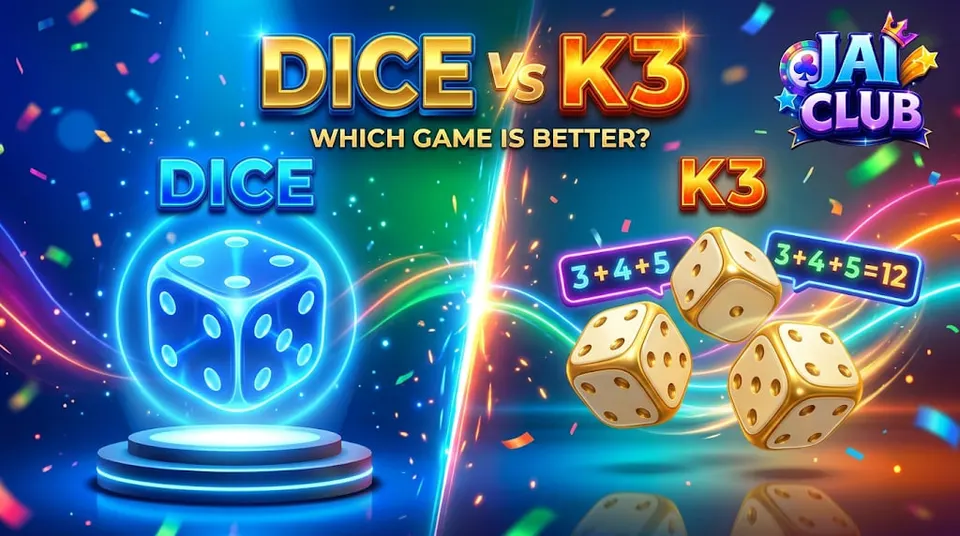
Dice vs K3 is an interesting comparison for readers exploring Jai Club game formats because both names are associated with numerical outcomes, but they are not necessarily interchangeable. K3 is commonly described as a three-dice game using standard six-sided dice, while the broader term Dice can refer to several different digital game systems.
A game simply labelled Dice might involve one die, multiple dice, a numerical threshold or another provider-specific outcome mechanism. K3, by contrast, has a recognisable structure involving three component values and their combined total.
This article compares these formats, explains how their number ranges and probability models can differ, and explores why the game title alone is insufficient to establish its precise rules.
What Is the K3 Game Format?
K3 is commonly associated with a system using three six-sided dice. Each die can display a value from 1 to 6, producing a total between 3 and 18 when the three numbers are added together.
For example, dice showing 2, 4 and 6 produce a combined total of 12. A different result showing 3, 3 and 6 also produces 12, although the two combinations have different individual values.
This means a K3 result can be described through the three component dice, their combined total, Odd or Even classifications and matching patterns such as Doubles or Triples.
The Jai Club K3 Game overview explains the format's main numerical features.
What Does Dice Mean in Digital Games?
Dice is a broad category rather than one universally defined game. Some digital Dice titles simulate conventional dice rolls, while others use numerical outcomes that are compared against predefined thresholds.
A game could use one six-sided die, two dice or a separate numerical scale. Because of this variety, the appearance of a Dice title in a game catalogue does not establish that it uses the same mathematical structure as K3.
For example, a game using one fair six-sided die has six possible face values. A standard three-dice K3 model has 216 ordered combinations. The two systems are not mathematically identical even though both use dice terminology.
Dice vs K3: Main Differences
| Feature | Standard K3 | General Dice Games |
|---|---|---|
| Number of dice | Commonly three | Depends on provider |
| Typical result | Three faces and total | Game-specific number |
| Standard total range | 3–18 | Varies |
| Ordered combinations | 216 with three fair dice | Depends on format |
| Matching dice | Doubles and Triples | May or may not apply |
| Result history | Dice values and totals | Provider-specific |
This table illustrates the differences in terminology rather than confirming the current catalogue of any particular Jai Club platform.
Why Are K3 Totals Not Equally Likely?
In the standard mathematical model, three independent fair six-sided dice produce 216 ordered combinations. However, those combinations are distributed unevenly across totals from 3 to 18.
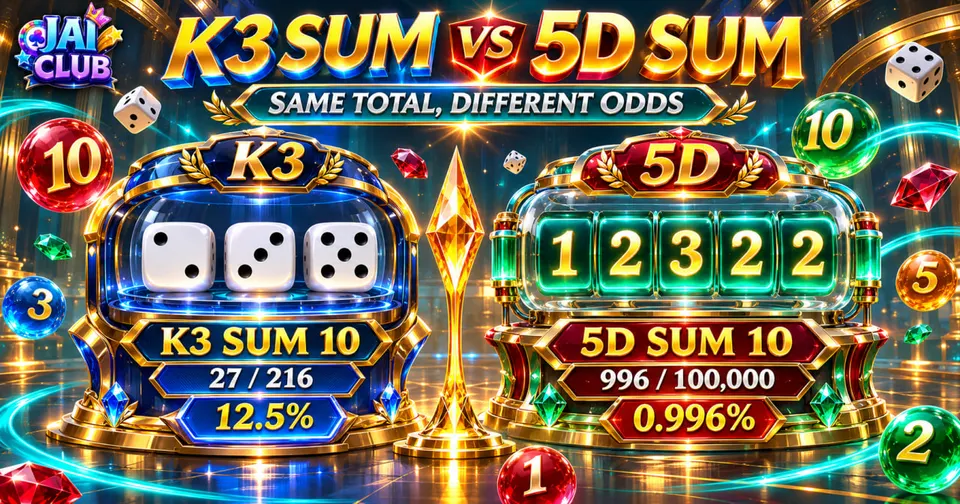
Only one ordered combination produces a total of 3, while twenty-seven combinations produce a total of 10. This makes the middle-range totals more common than the extremes under the stated assumptions.
A different Dice game might use a much simpler distribution. If it generates one uniformly random integer from 1 to 6, each of those six values has the same theoretical probability.
Applying the K3 total distribution to such a game would be mathematically incorrect.
What Are Doubles and Triples?
Doubles describe results where at least two dice show the same value. Triples occur when all three values match. These features make sense in a three-dice arrangement but are not necessarily relevant to a game that produces only one numerical result.
For example, 4–4–2 contains a matching pair, while 5–5–5 is a Triple. Both have sums that can be calculated, but their matching patterns are distinct.
A general Dice game without three separate dice positions may not have comparable Double or Triple results.
For a mathematical reference, explore the K3 Dice Total Chart, which explains the distribution of sums from 3 to 18.
Can Dice Games Use Multipliers?
Some Dice games use multiplier values or numerical thresholds, but the significance of those values is provider-specific. A game may associate a multiplier with a qualifying result, while another may use a traditional dice-combination payout table.
A K3 game's result total should not automatically be interpreted as a payout multiplier. A total of 12 means that the three dice add up to 12, not that the game awards a 12x payout.
These distinctions are important when comparing game interfaces. Similar-looking numbers can represent completely different types of information.
Dice vs K3 vs 5D
K3 and 5D are both number-based formats, but their result structures differ. A standard K3 result contains three dice values from 1 to 6, while a commonly described 5D result contains five digit positions from 0 to 9.
A general Dice game could use another structure altogether. Therefore, Dice, K3 and 5D should not be treated as interchangeable categories without checking their actual rules.
Our Jai Club K3 vs 5D comparison explains why those two systems require different interpretations.
Are Dice and K3 Both Available on Jai Club?
K3 is described in Jai Club-related game content. Dice is also a term found in wider mini-game catalogues, but the specific provider and active availability of a standalone Dice title have not been independently verified for every Jai Club service.
A catalogue entry using the word Dice does not prove it refers to the standard three-dice K3 format. The actual game information should specify the number range, result method and evaluation rules.
Can Previous Dice Results Predict the Next Outcome?
Previous independent random outcomes do not reliably identify future results. A repeated K3 total does not mean that a different total must appear next, and the same limitation applies to independently generated Dice games.
Mathematical charts describe the distribution of possible outcomes under defined assumptions. They do not guarantee a particular result on the next round.
Frequently Asked Questions
Is K3 the same as Dice?
K3 is commonly a three-dice format, while Dice is a broader term that may describe different systems.
How many dice does K3 use?
The commonly described K3 format uses three six-sided dice.
What is the K3 total range?
Under the standard arrangement, totals range from 3 to 18.
Do all Dice games use three dice?
No. The number of dice and result rules depend on the provider.
Is a K3 total a multiplier?
No. The total normally describes the sum of the dice values.
Are Dice and K3 probabilities identical?
Not necessarily. They depend on the actual mathematical configuration.
Conclusion
Dice and K3 share numerical terminology, but they are not necessarily the same game format. K3 commonly uses three six-sided dice and a combined total, while general Dice games may rely on different number ranges and result mechanisms.
Understanding the exact game rules, numerical structure and probability assumptions is essential before comparing them. A familiar game name alone is not enough to establish how a particular implementation works.
Disclaimer: JaiClubGame.online is an independent informational website and is not officially affiliated with Jai Club. Dice and K3 explanations are general and do not confirm the active inventory of any particular service. Real-money gaming involves financial risk and may be restricted or prohibited by applicable laws.