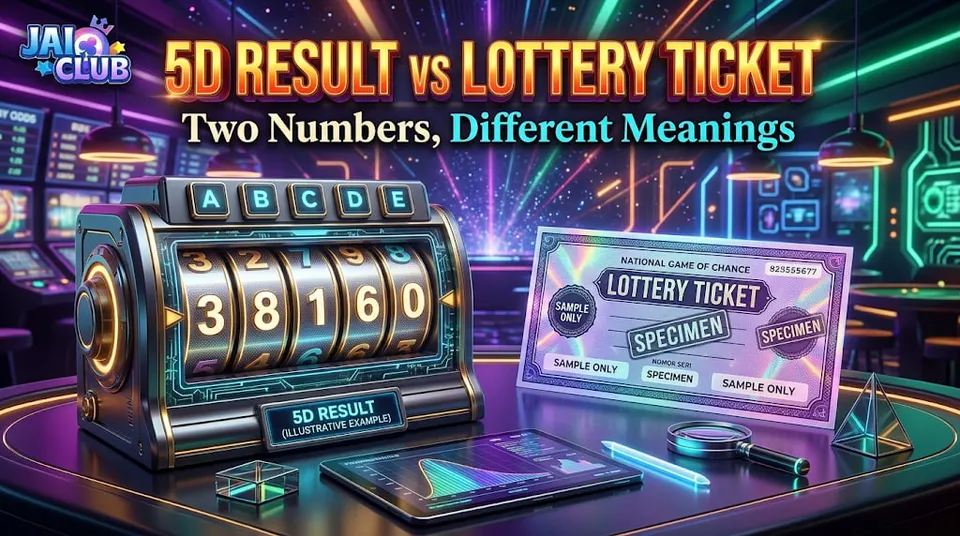
Game History vs Transaction History on Jai Club
Understand how game histories and transaction records serve different purposes, including period IDs, stakes, gross payouts, net results and settlement status.
In this article
- What Is Game History?
- Transaction History Kya Hota Hai?
- Game History vs Transaction History
- Why the Identifiers Are Different
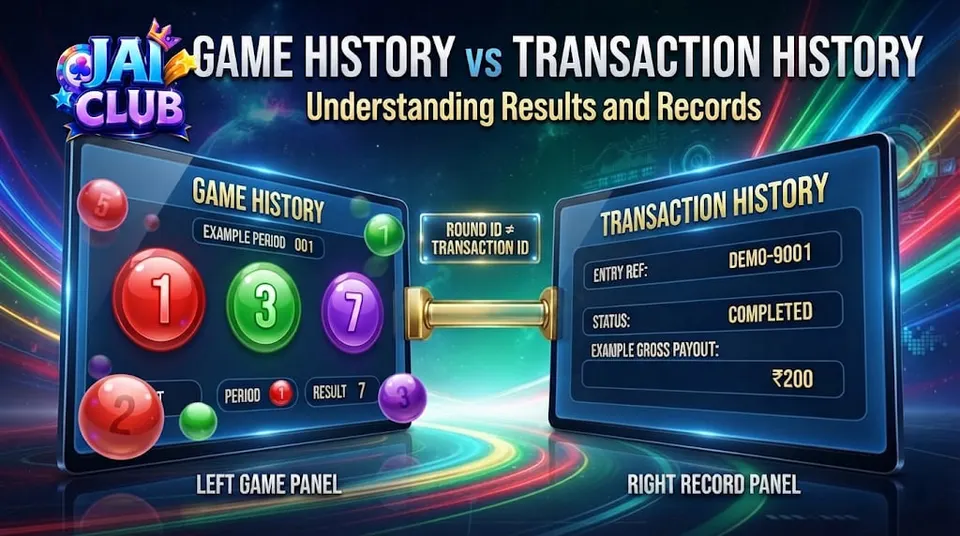
- EXAMPLE: One Result and One Transaction
- A Result Is Not the Same as a Payout
- Gross Payout vs Net Profit
- Can One Round Have Multiple Transaction Records?
- Completed Game vs Pending Transaction
- Why Balances May Not Match a Single Result
- Game History vs Browser History
- Timestamps Can Refer to Different Events
- How to Match Records Correctly
- What if a Record Is Missing?
- Screenshot vs Authoritative Record
- Does Transaction History Prove Game Fairness?
- Frequently Asked Questions
- Is Jai Club game history the same as transaction history?
- Is a period number a transaction ID?
- Can a completed result have a pending settlement?
- Does a winning result show the final amount received?
- Is gross payout the same as profit?
- Can a game round have more than one transaction?
- Does transaction history prove that the game is fair?
- Can a screenshot verify a private transaction?
- Conclusion
Jai Club game history and transaction history should not be treated as identical records. Game history describes completed events and their outcomes, while transaction history generally concerns account-related financial or operational activity.
A WinGo result, slot spin or crash multiplier may appear in a game record. An account transaction could contain a separate reference, amount or processing status.
Understanding the difference is important when two screens show values that do not appear to match.
This guide compares their purposes using fictional examples. It does not claim access to private Jai Club account records or verify the availability of particular transaction screens.
What Is Game History?
Game history records information associated with completed game events.
Depending on the product, the record may contain a period identifier, result digit, symbol arrangement, crash point or other outcome.
For example, a WinGo history table might identify the completed period and its final digit.
A crash history may display the round's ending multiplier.
A slot record could contain a game-specific result identifier and outcome details.
The exact fields depend on the provider.
Game history primarily explains what happened in the game.
Transaction History Kya Hota Hai?
Transaction history describes account-related events.
Depending on the service, these may include entries, recognised settlements, adjustments or other financial transactions.
A transaction record may include an amount, timestamp, reference identifier and status.
However, the labels and types of transaction records vary by provider.
Not every transaction corresponds to a separate game round.
For example, a deposit-related record and a WinGo result record describe completely different events.
Their numerical values should not be directly compared without understanding their purpose.
Game History vs Transaction History
| Field | Game history | Transaction history |
|---|---|---|
| Main purpose | Record game events | Record account-related activity |
| Common identifier | Round or period ID | Transaction or entry reference |
| Typical result | Number, symbol or multiplier | Amount or processing status |
| May include stake | Sometimes | Depending on transaction |
| Shows final game outcome | Often | Not necessarily |
| Shows account settlement | Not necessarily | May show it |
| Can contain pending information | Yes | Yes |
These are general record types, not a verified description of every Jai Club interface.
Why the Identifiers Are Different
A period number identifies a particular game round.
A transaction reference identifies a separate account-related event.
The two can be associated, but they do not have the same role.
For example, a fictional WinGo round might be identified as DEMO-W204.
An associated transaction could have a reference such as ENTRY-9004.
A reader should not expect these identifiers to be numerically identical.
One is used to identify the game event, while the other distinguishes the recorded transaction.
EXAMPLE: One Result and One Transaction
Consider a fictional completed WinGo event.
| Information | Example value |
|---|---|
| Game | Demo WinGo |
| Period ID | DEMO-W204 |
| Completed digit | 7 |
| Entry reference | ENTRY-9004 |
| Example stake | ₹100 |
| Accepted gross multiplier | 2.00x |
| Gross payout | ₹200 |
| Net profit | ₹100 |
| Settlement status | Completed |
EXAMPLE ONLY: The table uses fictional identifiers and financial values.
The gross payout calculation is ₹100 × 2.00 = ₹200.
The net profit calculation is ₹200 − ₹100 = ₹100, assuming no other charges or adjustments.
The digit 7 describes the game outcome, while ₹200 describes an example settlement amount.
Those values should not be confused.
A Result Is Not the Same as a Payout
A completed game result can be recorded without identifying an individual person's payout.
For example, a WinGo result of 7 describes a round outcome.
It does not automatically tell us which entries were submitted or which accounts received settlements.
Likewise, a crash round ending at 4.00x does not prove that every position was settled at 4.00x.
Individual settlements depend on the relevant position records and rules.
The final game result and its financial consequences should therefore be evaluated separately.
Gross Payout vs Net Profit
Gross payout and net profit answer different questions.
Gross payout is the total returned amount under the example calculation.
Net profit subtracts the original stake from that returned amount.
For a fictional ₹100 stake accepted at 1.50x:
Gross payout = ₹100 × 1.50 = ₹150.
Net profit = ₹150 − ₹100 = ₹50.
If the position is unsuccessful under a model in which the stake is lost, the net result would instead be −₹100.
The exact settlement and payout rules must be verified for the actual product.
Can One Round Have Multiple Transaction Records?
Some games and account systems can associate more than one transaction or position with a single round.
For example, a platform supporting separate positions might record each entry independently.
The underlying round can still have one final game outcome.
However, the possibility depends on the software.
It would be incorrect to assume every Jai Club game allows multiple positions per round.
The important distinction is that one event and one transaction are not necessarily the same unit of information.
Completed Game vs Pending Transaction
A game history might show a completed outcome while a related transaction is still marked pending.
These labels can refer to different processing stages.
For example, a result may already have been published, while another system is updating a related settlement record.
However, the cause of a specific pending status cannot be determined without provider information.
A completed game result does not automatically prove that an account transaction has been finalised.
Likewise, a pending transaction does not automatically mean that the game result is wrong.
Why Balances May Not Match a Single Result
An account balance may reflect multiple activities.
It could include earlier transactions, adjustments and other recorded changes.
Therefore, a single completed game result cannot necessarily explain the total displayed balance.
For example, the balance before a round and the balance after settlement may be affected by other events.
A reliable interpretation needs the relevant account timeline.
The result digit or multiplier alone cannot establish an account's entire financial history.
Game History vs Browser History
Browser history records visited pages.
Game history records events associated with the actual game.
These are different.
Opening the same game page several times does not establish that several rounds were played.
Similarly, clearing browser navigation history does not automatically remove remote game records.
The existence of a page visit and the completion of a game event should not be treated as equivalent.
Storage and recordkeeping depend on the actual system.
Timestamps Can Refer to Different Events
A game record may show when a round ended.
A transaction could show when an entry was submitted or settled.
These timestamps may differ without being inconsistent.
A time-zone conversion can create another apparent difference.
For example, 13:00 UTC and 18:30 IST represent the same instant.
Before interpreting a timing discrepancy, identify the event described by each timestamp and its time zone.
Two different event types should not be expected to share an identical timestamp.
How to Match Records Correctly
Start with the exact game title and mode.
Find the completed period or round ID.
Next, identify any separate entry or transaction reference.
Compare the recorded amount and status where that information is available.
A useful comparison should distinguish a requested action from an accepted settlement.
For example, a displayed cashout target is not necessarily an accepted cashout value.
If the fields cannot be matched reliably, the relationship remains unverified.
What if a Record Is Missing?
A missing record in a visible table does not prove that no underlying event exists.
An interface may show only recent entries or use filters.
Some information might also be delayed or accessible through another section.
However, these possibilities are not proof that the record was stored correctly.
The exact source and scope of the table matter.
A useful issue report should identify the relevant event, approximate time and visible status.
Avoid sharing sensitive account credentials.
Screenshot vs Authoritative Record
A screenshot captures what was visible at one moment.
It can help document a period, result or transaction label.
However, a screenshot does not independently verify the server-side record.
It can also omit important context through cropping.
A useful comparison should match the full identifiers and distinguish completed information from pending fields.
A branded screen is not enough to authenticate every value displayed.
Does Transaction History Prove Game Fairness?
No.
A transaction history may document how an account-related event was processed.
It does not necessarily reveal the mathematical method used to generate the game outcome.
Likewise, a result-history table does not by itself establish how financial entries were settled.
Game fairness, result verification and transaction processing are different concepts.
Each requires evidence appropriate to the claim being evaluated.
For background about game-result fields, read What Do WinGo Game Records Actually Show?.
Frequently Asked Questions
Is Jai Club game history the same as transaction history?
No. Game history describes game events, while transaction history generally describes account-related activity.
Is a period number a transaction ID?
Not necessarily. The identifiers can serve different purposes.
Can a completed result have a pending settlement?
That is possible in systems with separate result and transaction processing stages.
Does a winning result show the final amount received?
Not by itself. A settlement record may be needed.
Is gross payout the same as profit?
No. Net profit subtracts the original stake from the gross payout under the stated calculation.
Can a game round have more than one transaction?
Some systems support this, but it cannot be assumed for every game.
Does transaction history prove that the game is fair?
No. Transaction processing and outcome generation are separate questions.
Can a screenshot verify a private transaction?
It can document a displayed value, but authoritative verification may require additional records.
Conclusion
Game history and transaction history describe different aspects of a gaming system.
A completed result records the outcome of a game event. A transaction record can describe an entry, settlement or other account-related action.
Matching the correct identifiers, timestamps and statuses helps prevent confusion between game outcomes and financial records.
Editorial disclosure: Every identifier and financial calculation in this article is fictional. No private Jai Club account or transaction was inspected.
Disclaimer: JaiClubGame.online is an independent educational website and does not process or verify account transactions.