A 5D Result Is Not a Lottery Ticket Number
Learn why a five-digit Jai Club 5D result should not be confused with a lottery ticket serial number, draw reference or individual entry record.
In this article
- What Is a 5D Result Number?
- Lottery Ticket Number Kya Hota Hai?
- 5D Result vs Lottery Ticket Number
- Why Two Five-Digit Numbers Can Mean Different Things
- EXAMPLE: Three Different Identifiers
- Why Positions A to E Matter
- Is a 5D Sum the Same as a Ticket Number?
- What About a Game Period Number?
- Leading Zeros in a 5D Result
- Can a 5D Result Be Used as a Lottery Ticket?
- Official Lottery Draws vs Digital Game Periods
- Does Every 5D Result Have a Unique Ticket Number?
- Why This Difference Matters in Result History
- Does a Matching Number Guarantee a Prize?
- Frequently Asked Questions
- Is a Jai Club 5D result a lottery ticket number?
- Can a 5D result contain leading zeros?
- Is a period number the same as a result?
- Can two different 5D results have the same sum?
- Does a five-digit lottery ticket use A to E positions?
- Can a 5D result be treated as a ticket in an official lottery?
- Does a matching result automatically guarantee payment?
- Conclusion
A five-digit result in Jai Club 5D and a lottery ticket number may look similar, but they represent different things. A Jai Club 5D result describes an outcome containing five numerical positions, while a lottery ticket number generally identifies a particular ticket or entry under the relevant lottery system.
The distinction matters because both can contain digits, leading zeros and other numerical labels. However, similarity in appearance does not make them interchangeable.
A result, a ticket number and a game period identifier should be interpreted separately.
This guide focuses specifically on the differences between those identifiers rather than repeating the basic rules of 5D.
What Is a 5D Result Number?
A commonly described 5D game format uses five digit positions, often labelled A, B, C, D and E.
Each position can contain a digit from 0 through 9 under the assumed format.
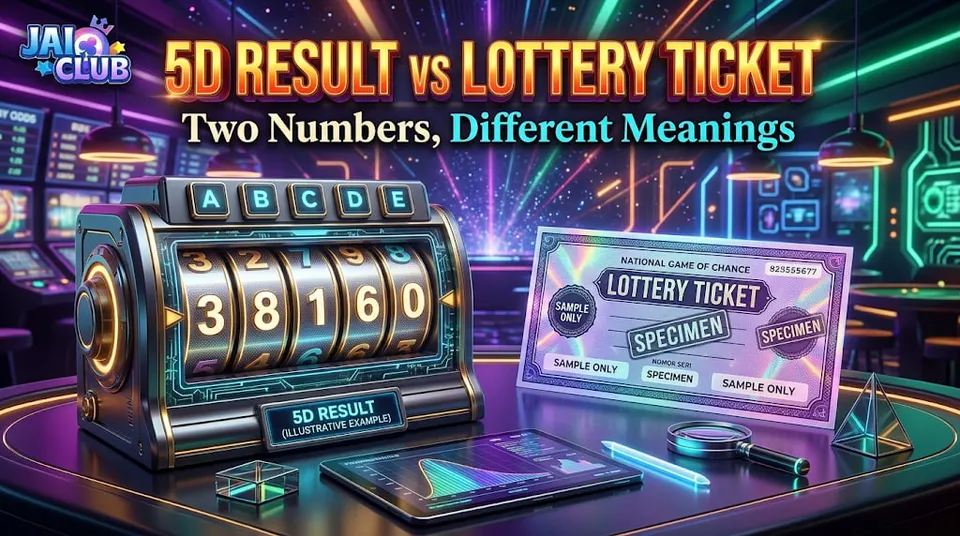
For example, a fictional result may be displayed as:
3 8 1 6 0
The five digits together form an ordered sequence.
In this example, Position A contains 3, Position B contains 8 and Position E contains 0.
These positions have distinct meanings within the result.
The same five digits in a different order would represent a different ordered outcome.
Lottery Ticket Number Kya Hota Hai?
A lottery ticket number is generally an identifier printed on or associated with a ticket.
Depending on the lottery system, a ticket may also carry a series, batch, draw reference or other information.
Its format is defined by the organisation operating that lottery.
Some official lotteries use numbered paper tickets, while digital systems may use different entry references.
The important point is that a ticket identifier is not necessarily the random outcome of a game round.
It is typically used to identify an entry, whereas a result describes an outcome.
These functions should not be confused simply because both appear as numbers.
5D Result vs Lottery Ticket Number
| Feature | 5D game result | Lottery ticket number |
|---|---|---|
| Primary purpose | Describes an outcome | Identifies a ticket or entry |
| Common format | Five ordered digits | Depends on lottery rules |
| Position labels | May use A through E | Not necessarily |
| Associated event | Game period | Lottery draw or ticket issue |
| May contain leading zeros | Yes | Depends on numbering system |
| Meaning of digits | Outcome values | Identifier components |
| Used for comparison | According to game rules | According to lottery rules |
A genuine comparison requires knowing the exact lottery and game format involved.
A ticket number is not automatically a five-digit result, even if both contain five characters.
Why Two Five-Digit Numbers Can Mean Different Things
Consider the number 38160.
In a fictional 5D result, the digit 3 may belong to Position A and 8 to Position B.
The sequence is an outcome value.
In a fictional lottery-ticket system, the same number could simply identify one issued ticket.
Its digits might not represent separate game positions at all.
Therefore, the meaning comes from the system assigning the number, not from the number's appearance.
A reader should first determine whether the label says Result, Ticket, Period or Transaction.
EXAMPLE: Three Different Identifiers
Imagine a fictional digital game record containing the following fields.
| Field | Example value | Purpose |
|---|---|---|
| Period ID | DEMO-5D-0421 | Identifies a round |
| 5D result | 38160 | Describes five outcome digits |
| Entry reference | ENTRY-8024 | Identifies a separate entry |
| Sum | 18 | Adds the five result digits |
The sum is calculated as:
3 + 8 + 1 + 6 + 0 = 18
All values are examples and are not real Jai Club records.
The period, result, entry reference and sum have different functions.
They should not be substituted for one another when reading a result-history table.
Why Positions A to E Matter
In 5D, the individual position labels help identify where each result digit belongs.
A sequence such as 38160 is not the same ordered result as 83160.
The positions of 3 and 8 have changed.
Both examples have the same total sum of 18, but the complete ordered sequences differ.
This illustrates why the result must be read as more than a single unstructured number.
A lottery ticket number, by contrast, may have different formatting and serial-number rules that do not use A to E outcome positions.
For further information, read Jai Club 5D Game: Five-Digit Results, Positions & Sum.
Is a 5D Sum the Same as a Ticket Number?
No.
The 5D sum is a calculation based on the five result digits.
For example, the fictional result 47259 has a sum of 27.
That total does not create a separate lottery ticket or ticket identifier.
A lottery ticket number serves an administrative or entry-identification purpose according to its own rules.
The fact that both systems use numerical values does not make their fields equivalent.
A useful result record should clearly label the digit positions and the calculated sum.
What About a Game Period Number?
A period number identifies a particular game round.
It is not the same as the result produced during that round.
For example, two successive periods can have completely different identifiers while producing the same five-digit result by coincidence.
A period number might include a date, sequence or other components.
However, no universal Jai Club period-number formula should be assumed.
A ticket number, period number and result number may all appear together in a gaming-related interface.
Their meanings remain separate.
Leading Zeros in a 5D Result
A five-position result may begin with zero.
For example:
0 0 4 2 7
The complete sequence is 00427.
If a spreadsheet automatically converts it to the ordinary number 427, the original five-character representation is lost.
This can create confusion when comparing records.
Leading zeros may also appear in ticket serial numbers, depending on the lottery system.
However, the reason for preserving the zeros is based on each identifier's formatting rules.
A leading zero does not prove that the two systems are equivalent.
Can a 5D Result Be Used as a Lottery Ticket?
There is no general rule allowing an outcome from one game to function as an entry in another lottery.
A lottery ticket is valid only under the particular lottery's issue and eligibility rules.
A digit sequence displayed in a 5D result cannot automatically be treated as a ticket for a separate draw.
Likewise, the existence of a ticket bearing the same digits does not establish any relationship with Jai Club 5D results.
These are independent identification systems unless an operator explicitly documents otherwise.
Official Lottery Draws vs Digital Game Periods
A conventional lottery can have scheduled draws associated with issued ticket numbers.
A digital 5D-style game may organise results into recurring periods.
The timing, entry format, payout system and governing rules can differ considerably.
It would therefore be misleading to assume that a digital round and a government-run lottery draw operate in the same manner.
Even if both use numerical outcomes, their underlying systems can be entirely different.
This guide does not claim that Jai Club 5D is part of any official Indian state lottery.
Does Every 5D Result Have a Unique Ticket Number?
Not as a universal rule.
A result sequence describes an outcome.
An entry or transaction reference, when present, serves a different purpose.
Several positions or entries might be associated with a single game period under some systems, but the exact architecture is provider-dependent.
It is not possible to infer a one-to-one relationship between a 5D result and a ticket merely from the name of the game.
The actual rules must define the record structure.
Why This Difference Matters in Result History
A result-history table may display several numerical fields close together.
Reading the wrong field can lead to inaccurate conclusions.
For example, a person could mistake a long period identifier for the five-digit result.
Another reader might mistake an account transaction number for a lottery ticket.
Before interpreting a record, identify the column headings.
The most useful distinction is between the event identifier, recorded outcome and entry reference.
These values answer different questions.
Does a Matching Number Guarantee a Prize?
No.
A matching sequence by itself does not establish eligibility for any payment or award.
The relevant lottery or game rules determine how outcomes and entries are evaluated.
A five-digit match across unrelated systems has no automatic significance.
Likewise, a matching digit sequence does not prove an account-related settlement occurred.
A valid interpretation needs the correct event, entry conditions and completed record.
Frequently Asked Questions
Is a Jai Club 5D result a lottery ticket number?
No. The terms describe different types of information.
Can a 5D result contain leading zeros?
Yes, under a five-position format using digits 0 through 9.
Is a period number the same as a result?
No. The period identifies a round, while the result describes its outcome.
Can two different 5D results have the same sum?
Yes. For example, 38160 and 83160 both produce a sum of 18.
Does a five-digit lottery ticket use A to E positions?
Not necessarily. Ticket-number formats depend on the issuing lottery.
Can a 5D result be treated as a ticket in an official lottery?
Not without explicit rules establishing that relationship.
Does a matching result automatically guarantee payment?
No. The relevant game or lottery rules and valid entry conditions determine eligibility.
Conclusion
A Jai Club 5D result and a lottery ticket number may share a similar numerical appearance, but they serve different purposes.
A 5D result records five ordered outcome digits. A ticket number typically identifies an entry under a separate lottery system. A period identifier, meanwhile, identifies the relevant game event.
Understanding these distinctions helps readers interpret numerical records without mixing unrelated systems.
Editorial method: All examples are fictional and used to explain identifier structures. No official lottery-ticket database or private Jai Club entry record was accessed.
Disclaimer: JaiClubGame.online is an independent educational website. It is not an official lottery operator and does not verify lottery tickets or guarantee gaming outcomes.