Why Violet Has Different Odds in Colour Trading Games
Learn why Violet may have a different probability from Red and Green in certain Colour Trading formats, including special digits 0 and 5, overlapping classifications and theoretical examples.
In this article
- What Does Violet Mean in Colour Trading?
- Why Violet May Have Different Odds
- EXAMPLE: A Common WinGo-Style Mapping
- How Many Digits Are Associated With Violet?
- Violet Probability Kaise Calculate Hota Hai?
- Red vs Green vs Violet
- Why Do the Percentages Add Up to 120%?
- EXAMPLE: Exclusive vs Overlapping Colour Systems
- Does Violet Mean a Different Number Was Generated?
- Why 0 and 5 Are Important
- Is Violet Always Less Likely Than Red?
- Why Payouts Cannot Be Inferred From Probability Alone
- EXAMPLE: Probability vs Payout
- Can Violet Appear Twice in a Row?
- What Happens After a Long Violet Absence?
- How to Interpret Violet Streak Charts
- Why Historical Frequency May Differ From Theory
- Does an App Predict Violet More Accurately?
- Frequently Asked Questions
- What is the probability of Violet in Colour Trading?
- Is Violet always less likely than Red and Green?
- Why are 0 and 5 considered special?
- Can one number be both Violet and Green?
- Why can colour probabilities add up to 120%?
- Does a long Violet absence mean Violet is next?
- Does Violet probability determine its payout?
- Are these verified Jai Club Colour Trading odds?
- Conclusion
Violet can have a different probability from Red and Green in some number-based Colour Trading games because the colour labels may not represent equally sized groups of digits.
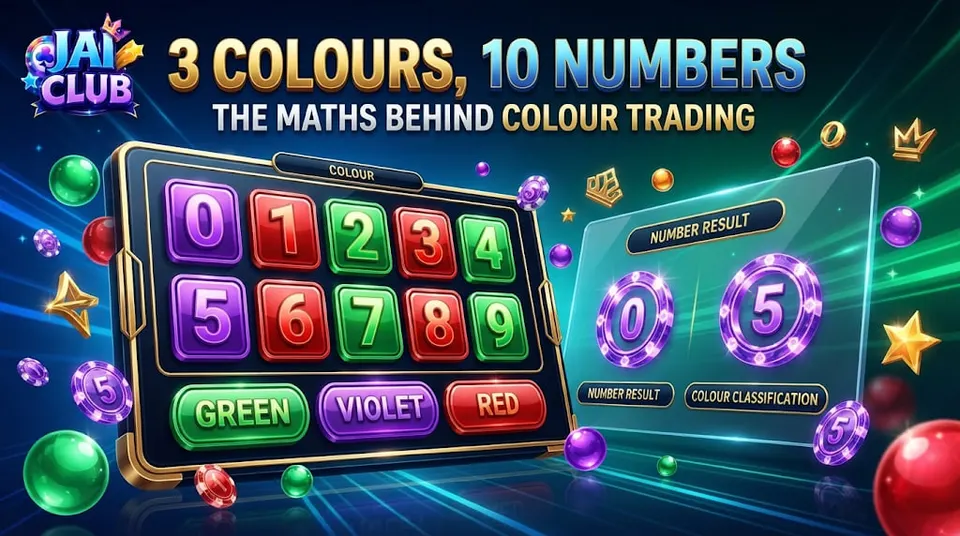
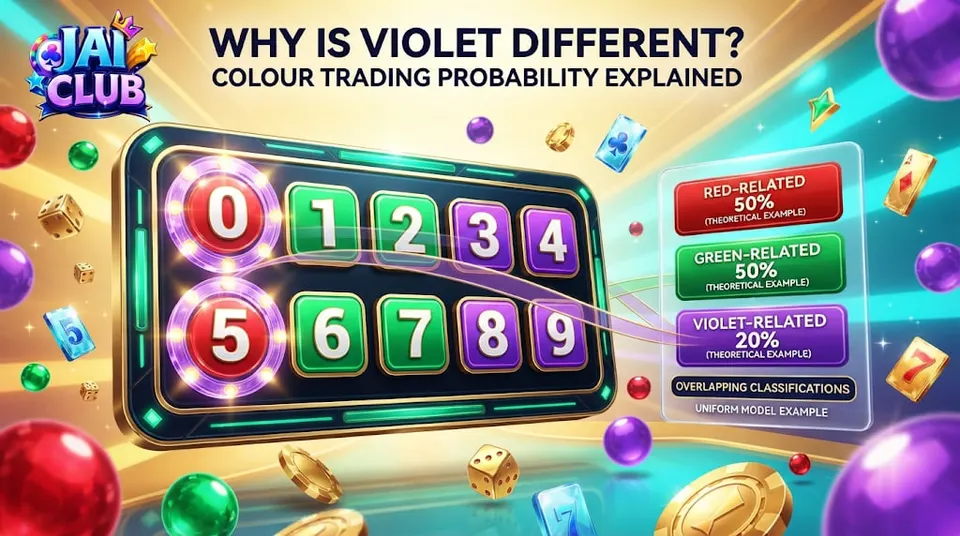
In a commonly described WinGo-style format, results use digits from 0 through 9. Red and Green are associated with several digits, while Violet may appear as an additional classification for special numbers such as 0 and 5.
This arrangement is different from choosing one of three equally likely colours.
The mathematical explanation depends on how the game's rules map numerical results to labels.
This guide uses a clearly defined illustrative model rather than claiming that every Jai Club Colour Trading product follows identical probability rules.
What Does Violet Mean in Colour Trading?
Violet is a colour classification used in some WinGo-style number games.
Unlike an ordinary three-colour wheel, the system may assign colours based on the completed digit.
For example, digit 0 might carry a Red-related and Violet-related classification.
Digit 5 might carry a Green-related and Violet-related classification.
These special cases mean one numerical outcome can belong to more than one descriptive colour category.
However, the exact mapping and settlement rules must be verified for each game version.
Why Violet May Have Different Odds
The number of available colour buttons does not determine the probability of each category.
For example, an interface may display three buttons labelled Red, Green and Violet.
However, their associated outcome sets can contain different numbers of digits.
If Violet corresponds to only two digits while another colour corresponds to five, their probabilities differ under a uniform digit model.
This does not automatically describe the game provider's actual odds.
It is a consequence of the stated mapping and probability assumptions.
EXAMPLE: A Common WinGo-Style Mapping
| Result digit | Illustrative classification |
|---|---|
| 0 | Red + Violet |
| 1 | Green |
| 2 | Red |
| 3 | Green |
| 4 | Red |
| 5 | Green + Violet |
| 6 | Red |
| 7 | Green |
| 8 | Red |
| 9 | Green |
EXAMPLE ONLY: The table illustrates a commonly described format, not a universally verified Jai Club rule.
The important details are the special classifications associated with 0 and 5.
How Many Digits Are Associated With Violet?
Under the illustrative mapping, Violet is associated with two digits:
0 and 5.
There are ten possible numerical results.
If every digit is independently and uniformly generated, each digit has a 10% probability.
Therefore, a Violet-related classification occurs for two of the ten digits.
The theoretical probability is:
2 ÷ 10 = 20%.
This figure applies only to the stated model.
It should not be presented as the verified probability of every real Colour Trading game.
Violet Probability Kaise Calculate Hota Hai?
The probability of a category is calculated by adding the probabilities of the underlying outcomes belonging to that category.
Under the example:
P(Violet-related) = P(0) + P(5).
If digits 0 and 5 each have probability 10%, then:
P(Violet-related) = 10% + 10% = 20%.
However, if the digits have unequal probabilities, the answer changes.
The mapping alone is not enough to establish the actual game odds.
The underlying outcome distribution is also required.
Red vs Green vs Violet
Using the illustrative mapping and a uniform digit model:
Red-related classification covers five digits.
Green-related classification covers five digits.
Violet-related classification covers two digits.
The corresponding theoretical probabilities are:
Red-related: 50%.
Green-related: 50%.
Violet-related: 20%.
The total is 120% because the classification events overlap.
This should not be interpreted as three mutually exclusive outcomes.
Why Do the Percentages Add Up to 120%?
When events overlap, one outcome can be counted in more than one category.
For example, digit 0 belongs to both the illustrative Red-related set and Violet-related set.
Digit 5 belongs to both the Green-related set and Violet-related set.
Therefore, the probabilities of these three labels can add to more than 100%.
This does not mean the result generator produces more than one digit.
It means the same digit is described by multiple classification labels.
Probabilities of overlapping events should not be added as though they were mutually exclusive.
EXAMPLE: Exclusive vs Overlapping Colour Systems
Consider two fictional models.
Model A: Overlapping labels
Red-related: 5 digits.
Green-related: 5 digits.
Violet-related: 2 digits, already included in the other categories.
Model B: Exclusive categories
Red-only: 4 digits.
Green-only: 4 digits.
Violet-only: 2 digits.
Under a uniform 0–9 model, Model B gives 40%, 40% and 20%, which sum to 100%.
Model A instead gives incidence probabilities of 50%, 50% and 20%.
The two models describe different classification systems.
Their settlement rules may also differ.
Does Violet Mean a Different Number Was Generated?
No, not under the overlapping-label model.
For example, suppose the completed numerical outcome is 5.
The interface may describe that result as Green and Violet.
The underlying result remains digit 5.
It does not mean the game generated a second independent Violet outcome.
The additional colour is a classification of the same result.
This distinction is essential when interpreting historical colour counts.
Why 0 and 5 Are Important
Digits 0 and 5 often receive special attention in WinGo-style colour mappings.
They also occupy different positions in the common Big/Small grouping.
Zero belongs to Small, while 5 belongs to Big.
Under the illustrative colour mapping, zero is Red-related and Violet-related.
Five is Green-related and Violet-related.
A special colour does not replace the mathematical value or size classification of the underlying digit.
These labels describe different aspects of one outcome.
Is Violet Always Less Likely Than Red?
Not universally.
It is less likely under the specific illustrative uniform model used in this guide.
However, another game may use a different mapping or probability distribution.
For example, a game could define three exclusive colour categories with equal probabilities.
That would be a different mathematical system.
A familiar Violet button is not enough to determine the odds.
The exact rules and outcome model matter.
Why Payouts Cannot Be Inferred From Probability Alone
A colour category's theoretical probability does not establish its payout multiplier.
For example, a less frequent category might have a different advertised award under the game rules.
However, expected return depends on both the probability and the payout structure.
A 20% probability does not automatically justify any particular financial reward.
Similarly, a category that occurs less frequently is not necessarily a better selection.
The actual paytable must be verified.
EXAMPLE: Probability vs Payout
Imagine a fictional selection with a 20% theoretical success probability.
Suppose the example's gross payout multiplier is 4.00x.
For an illustrative ₹100 stake:
Gross payout on a qualifying outcome = ₹400.
However, the probability of that outcome remains 20% under the assumed model.
The expected gross return would be:
0.20 × ₹400 = ₹80.
This simplified calculation assumes zero return on non-qualifying outcomes and no other rules.
It demonstrates why probability and payout must be considered together.
The values are fictional and do not describe Jai Club's actual settlement conditions.
Can Violet Appear Twice in a Row?
Yes.
Under an independent uniform model where Violet-related outcomes have probability 20%, two specified consecutive rounds both being Violet-related have probability:
0.20 × 0.20 = 0.04.
That equals 4%.
A pair of consecutive Violet-related outcomes is therefore possible under the model.
It does not establish that the next result will be Violet or that the system is malfunctioning.
The multiplication assumes independence between rounds.
Actual provider independence must be verified separately.
What Happens After a Long Violet Absence?
Under a fixed independent model, a long absence does not change the next round's probability.
For example, if the next round has a theoretical Violet-related probability of 20%, that remains the same regardless of how many preceding rounds were non-Violet.
This is a basic property of independent events.
The belief that a colour is due after a long absence is the gambler's fallacy.
Historical frequency can describe the past without determining the future.
How to Interpret Violet Streak Charts
A chart may display consecutive Violet-related outcomes or periods without Violet.
However, the interpretation depends on how the colour mapping is applied.
For example, if digits 0 and 5 are classified as Violet-related, both should be counted consistently.
A chart that records only primary Red and Green labels might omit the special Violet relationship.
Therefore, different chart definitions can produce different totals.
For general classification terminology, read Colour Trading Buttons and Labels.
Why Historical Frequency May Differ From Theory
A theoretical probability describes the underlying model.
Observed frequency describes a finite sample.
For example, a fictional sample of fifty rounds might contain seven Violet-related results.
Its observed frequency is:
7 ÷ 50 × 100 = 14%.
That differs from the theoretical 20% under the illustrative uniform model.
Such variation can occur in finite samples.
The difference alone does not prove that the underlying probability has changed.
A suitable statistical assessment would require more information and a properly defined model.
Does an App Predict Violet More Accurately?
An application may display historical Violet frequencies or produce future suggestions.
However, calculating frequency does not establish forecasting ability.
A predictor claiming improved accuracy should preserve complete advance forecasts and corresponding outcomes.
It should also use the correct category definition.
For example, a model evaluated against Violet-only outcomes should not quietly count other colour classifications as successful.
The prediction target must remain consistent.
Frequently Asked Questions
What is the probability of Violet in Colour Trading?
Under an illustrative uniform 0–9 model where Violet is associated with digits 0 and 5, it is 20%.
Is Violet always less likely than Red and Green?
Not universally. It depends on the actual mapping and probability model.
Why are 0 and 5 considered special?
Some WinGo-style formats assign them additional Violet-related classifications.
Can one number be both Violet and Green?
Yes, under certain overlapping-label conventions, such as the illustrative treatment of digit 5.
Why can colour probabilities add up to 120%?
Because overlapping categories count some outcomes in more than one label.
Does a long Violet absence mean Violet is next?
No. That conclusion does not follow under an independent probability model.
Does Violet probability determine its payout?
No. Settlement values depend on separate game rules.
Are these verified Jai Club Colour Trading odds?
No. They are mathematical examples under stated assumptions.
Conclusion
Violet can have different theoretical odds because Colour Trading colour labels may represent different sets of numerical outcomes.
Under a common illustrative 0–9 mapping, Violet relates to digits 0 and 5, producing a theoretical probability of 20% when all digits are equally likely.
However, overlapping classifications, settlement rules and the actual outcome model must be understood before interpreting any provider-specific probability claim.
Editorial method: All mathematical examples use explicitly defined mappings and a hypothetical uniform digit model. No provider's actual result-generation system was audited.
Disclaimer: JaiClubGame.online is an independent educational website. Probability explanations do not guarantee future game outcomes.