Can AI Predict Red or Green? What Colour Trading Accuracy Tests Reveal
Examine claims that AI can predict Red or Green in Colour Trading, including historical-data training, baseline accuracy, out-of-sample testing and the difference between forecasting and classifying known results.
In this article
- What Does AI Red Green Prediction Mean?
- AI Analysis vs Actual Forecasting
- EXAMPLE: Classification Is Not Prediction
- How AI Models Use Historical Data
- What Is Overfitting?
- How Should an AI Prediction Test Work?
- Training Data vs Test Data
- EXAMPLE: AI Model Evaluation
- Is 54% Accuracy Better Than Random Guessing?
- Why the Correct Baseline Matters
- AI Confidence vs Actual Accuracy
- EXAMPLE: Confidence Calibration
- What Is Data Leakage?
- Why Screenshots Are Weak Evidence
- Can AI Learn a True Pattern?
- Does More Historical Data Guarantee Better Predictions?
- What About Paid AI Prediction Panels?
- A Practical Accuracy Review
- Frequently Asked Questions
- Can AI predict Red or Green?
- Does AI always outperform random guessing?
- Is 90% confidence the same as 90% accuracy?
- Can historical data predict future independent results?
- What is overfitting?
- Why must predictions be recorded before results?
- Is 54% accuracy proof of a useful AI model?
- Does a paid AI panel guarantee accurate signals?
- What a Credible AI Claim Must Show
Artificial intelligence can analyse historical Colour Trading results and produce forecasts labelled Red or Green. However, generating a forecast is not the same as demonstrating reliable predictive ability.
An AI tool may identify patterns in previous results, but those patterns may not continue in future rounds.
The key question is whether the model can correctly predict outcomes that were genuinely unknown when the forecast was made.
This guide explains how Red/Green AI prediction claims should be evaluated through proper testing rather than screenshots, impressive dashboards or unsupported accuracy percentages.
What Does AI Red Green Prediction Mean?
An AI Red Green prediction system is software that attempts to forecast a future colour classification.
The model may use historical numbers, colour labels, timestamps or other information.
However, the usefulness of those inputs depends on the actual outcome-generation process.
If future results are independent of the available historical information, an AI model may have no reliable advantage.
A trained model can still produce confident-looking predictions.
Confidence does not automatically mean correctness.
AI Analysis vs Actual Forecasting
AI can perform several different tasks.
For example, it can classify a completed digit into a colour category using a known mapping.
It can also calculate historical frequency or identify previous streaks.
These are descriptive operations.
Forecasting a future unknown result is a different task.
A model that correctly classifies completed outcomes has not necessarily predicted anything.
The evaluation must distinguish known information from genuinely unavailable future data.
EXAMPLE: Classification Is Not Prediction
Suppose a fictional game has a rule assigning digit 2 to Red.
An AI tool receives a completed result of 2 and outputs Red.
That is a correct classification.
However, the digit was already known.
The tool did not forecast the result before the round.
EXAMPLE ONLY: This illustrates the difference between applying a mapping rule and predicting an unknown event.
A perfect classification score does not establish future prediction accuracy.
How AI Models Use Historical Data
Machine-learning models are often trained using examples.
For Colour Trading, a dataset might contain completed periods, result digits and colour labels.
The model may attempt to identify relationships between past values and later outcomes.
However, a relationship visible in historical data might be accidental.
This is particularly important when the underlying process is random or independent.
A model can fit past observations without discovering a pattern that reliably predicts the future.
That problem is known as overfitting.
What Is Overfitting?
Overfitting occurs when a model learns details specific to its training dataset that do not generalise well.
For example, an AI system could memorise a historical sequence of Red and Green results.
It might then report excellent performance when evaluated on the same sequence.
However, performance could drop when it encounters genuinely new rounds.
A model's ability to reproduce the past is not the same as predicting unseen events.
Reliable testing needs data not used to develop the model.
How Should an AI Prediction Test Work?
A meaningful test should define the prediction target in advance.
For example, the target might be the primary Red/Green classification for the next completed one-minute period.
The model should produce its prediction before the result becomes available.
The prediction and timestamp should then be preserved.
Once the result is completed, it should be compared against the original forecast.
Every eligible prediction should be counted, including failures.
This prevents a publisher from reporting only successful examples.
Training Data vs Test Data
Training data is used to develop the model.
Test data is used to evaluate its performance on unseen examples.
For time-ordered game records, the distinction should respect chronology.
For example, a model might be developed using earlier periods and evaluated on later periods.
However, information from the later periods must not leak into the model's training or feature selection.
Otherwise, the measured accuracy may be misleading.
The evaluation should reproduce the information actually available when a forecast would have been made.
EXAMPLE: AI Model Evaluation
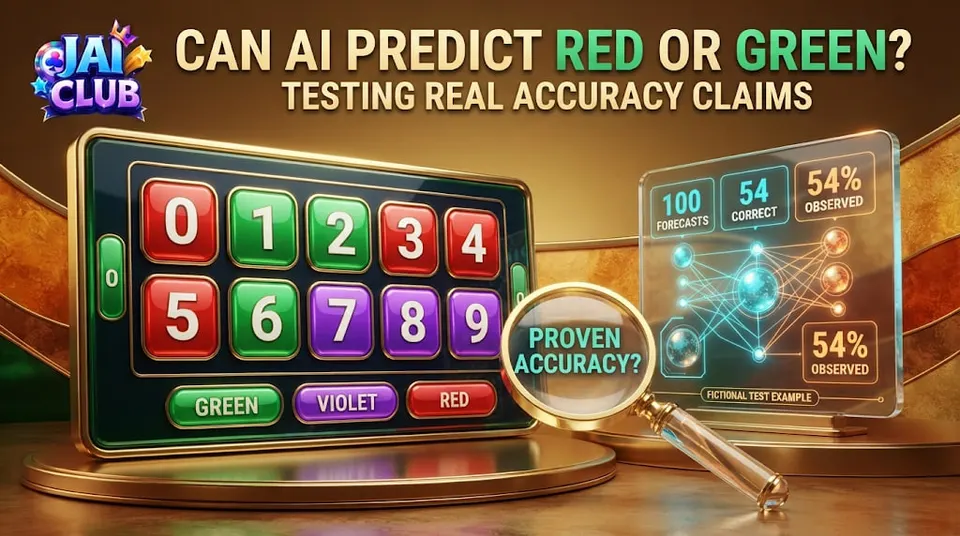
Consider a fictional model tested on one hundred future rounds.
| Measurement | Example value |
|---|---|
| Total forecasts | 100 |
| Correct forecasts | 54 |
| Incorrect forecasts | 46 |
| Observed accuracy | 54% |
| Example baseline | 50% |
EXAMPLE ONLY: This model and its results are fictional.
The observed accuracy is 54%.
However, this does not automatically establish a meaningful predictive advantage over a 50% baseline.
Sampling variation must be considered.
Is 54% Accuracy Better Than Random Guessing?
Under a simplified independent two-category model with equal probabilities, a random guess has a 50% expected success rate.
In one hundred forecasts, the number of correct guesses can vary.
For example, 54 correct outcomes are possible through ordinary chance.
A proper statistical assessment considers the sample size and uncertainty.
A result slightly above 50% in one small test is not proof of a reliable edge.
Repeated prospective testing and transparent methodology provide stronger evidence.
Why the Correct Baseline Matters
Not every Colour Trading format uses three mutually exclusive colours with equal probabilities.
Some commonly described WinGo-style mappings associate special digits 0 and 5 with Violet-related classifications.
This can create overlapping colour labels.
Therefore, a prediction test must define exactly what counts as Red, Green or Violet.
For example, classifying digit 0 as Red-related and Violet-related is different from treating Violet as a separate exclusive result.
An undefined classification can inflate or confuse accuracy claims.
AI Confidence vs Actual Accuracy
A model might output:
Red — 92% confidence.
However, that number is a model-generated estimate.
It is not automatically a calibrated probability.
For example, a tool can be frequently incorrect even while displaying high confidence.
A credible probability forecast should be evaluated by comparing predicted confidence levels with actual observed frequencies over many independent cases.
A visually precise percentage does not establish mathematical reliability.
EXAMPLE: Confidence Calibration
Imagine a fictional AI tool that issues fifty forecasts marked 90% confident.
If only twenty-five of those predictions are correct, its observed success rate is 50%.
That is far below the displayed 90% confidence.
This suggests the reported probabilities are poorly calibrated on that sample.
However, the sample and testing conditions still matter.
EXAMPLE ONLY: The figures do not describe any actual WinGo application.
The point is that confidence labels require testing.
What Is Data Leakage?
Data leakage happens when a model uses information it would not have had when making a real prediction.
For example, a dataset might accidentally include a colour label derived from the completed future result.
The model could then appear extremely accurate because it has access to the answer.
Another problem occurs when future observations influence the choice of model parameters.
Such testing does not represent genuine forecasting.
A reliable evaluation must use only information available before the target outcome.
Why Screenshots Are Weak Evidence
A screenshot showing several correct AI predictions may be genuine but incomplete.
It might not include unsuccessful forecasts.
It may also fail to prove that the predictions were published before the results.
A complete prediction archive should preserve the original messages and corresponding periods.
The model's success rate should be calculated from all eligible forecasts.
Selected highlights are not a substitute for a reliable test.
Can AI Learn a True Pattern?
AI can identify genuine predictive relationships when such relationships exist in usable data.
However, the existence of a model does not prove that the underlying game contains exploitable patterns.
If results are generated independently under a stable random process, past outcomes may provide no advantage.
A provider-specific conclusion requires reliable information about the outcome process and proper evaluation.
Therefore, the accurate position is not that every AI forecast must fail.
It is that a particular claimed advantage needs evidence.
Does More Historical Data Guarantee Better Predictions?
No.
A larger dataset can improve statistical estimation in some tasks.
However, additional historical data does not create predictive information when the target process lacks a usable relationship.
For example, collecting ten thousand independent random digits does not necessarily reveal the next digit.
More data may strengthen a frequency estimate without improving next-round prediction.
The distinction between estimation and forecasting remains important.
What About Paid AI Prediction Panels?
Payment does not establish forecasting ability.
A subscription can provide software access, charts or other services.
However, it does not prove that future Red/Green outcomes can be known.
Likewise, an attractive dashboard may be technically functional while making unsupported accuracy claims.
The correct evidence is a complete prospective test with reliable timestamps and defined scoring.
Promotional claims should be assessed through results rather than pricing or branding.
A Practical Accuracy Review
A meaningful review should answer the following questions.
What exactly is the model predicting?
Which game mode does the forecast concern?
Was the prediction recorded before the outcome?
Were all eligible predictions counted?
Was the test data separate from model development?
What baseline is appropriate?
Are confidence percentages calibrated?
If those questions cannot be answered, a high accuracy claim remains unverified.
For general chart-reading concepts, read WinGo Number Trends and Frequency Guide.
Frequently Asked Questions
Can AI predict Red or Green?
AI can produce forecasts, but reliable predictive advantage must be demonstrated through proper testing.
Does AI always outperform random guessing?
No. Performance depends on the underlying data and process.
Is 90% confidence the same as 90% accuracy?
No. Confidence is a model estimate that needs calibration.
Can historical data predict future independent results?
Not reliably merely because the history contains patterns.
What is overfitting?
It occurs when a model learns training-data details that do not generalise to new outcomes.
Why must predictions be recorded before results?
Otherwise, the evaluation may count already known outcomes as successful forecasts.
Is 54% accuracy proof of a useful AI model?
Not by itself. Sample size, uncertainty and testing quality matter.
Does a paid AI panel guarantee accurate signals?
No. Payment and forecasting reliability are separate issues.
What a Credible AI Claim Must Show
A meaningful Colour Trading AI claim requires more than a prediction screen.
It needs clearly defined targets, complete forecasts made before each outcome, an appropriate probability baseline and honest reporting of unsuccessful predictions.
Without this evidence, the accuracy percentage remains an unverified claim, regardless of how advanced the interface looks.
Editorial method: All AI models, prediction scores and examples are fictional. The discussion follows general principles of statistical evaluation and machine learning.
Disclaimer: JaiClubGame.online is an independent educational website. It does not offer guaranteed AI game predictions.