Odd or Even in Colour Trading? Why It Isn't the Same as Red or Green
Learn why Odd/Even and Red/Green describe different result classifications, how digits 0 and 5 affect special colour labels, and when the categories appear to overlap.
In this article
- What Does Odd or Even Mean?
- What Do Red and Green Mean?
- EXAMPLE: Odd Even and Colour Classification
- Is Every Even Digit Red?
- Is Every Odd Digit Green?
- Why Zero Matters
- Why Number 5 Is Special
- Odd Even vs Big Small
- EXAMPLE: Four Classifications of One Result
- What Is the Probability of Odd and Even?
- Do Red and Green Have the Same Probability?
- EXAMPLE: Overlapping Labels
- Why Charts Can Create Confusion
- Does an Odd Streak Predict Green?
- Why Mapping and Probability Are Separate
- Can Other Games Use Different Colour Rules?
- Frequently Asked Questions
- Is Odd the same as Green in Colour Trading?
- Is Even always Red?
- Is zero Odd or Even?
- Is number 5 Odd or Even?
- Can 5 be Green and Violet?
- Are Odd and Big the same?
- Can Odd/Even history predict the next colour?
- Are Red and Green always equally likely?
- Conclusion
Odd and Even describe the mathematical parity of a number. Red and Green, by comparison, are colour labels assigned according to a particular game's classification rules.
The two systems may appear closely related in some Colour Trading formats, but they are not automatically identical.
For example, a commonly described WinGo-style mapping associates several even digits with Red and several odd digits with Green. However, special treatment of digits 0 and 5 can make the relationship more complicated.
Understanding the distinction is important when reading result-history charts and comparing prediction claims.
This guide explains parity, colour classification and overlapping labels using clearly stated mathematical examples.
What Does Odd or Even Mean?
Odd and Even are standard mathematical classifications of integers.
An Even integer is divisible by two without a remainder.
For example, 0, 2, 4, 6 and 8 are Even.
An Odd integer leaves a remainder of one when divided by two.
For example, 1, 3, 5, 7 and 9 are Odd.
These definitions are mathematical properties of the digits.
They do not depend on a gaming interface.
A number's parity remains the same regardless of the colour assigned by a particular game.
What Do Red and Green Mean?
Red and Green are labels used by some number-based Colour Trading games.
Their mapping depends on the game's specific rules.
One commonly described WinGo-style format uses a division that broadly follows even and odd digits.
However, special digits may also carry Violet-related classifications.
This means a colour label is a game-defined convention rather than a mathematical property of the number itself.
A separate game could use another mapping.
Therefore, parity and colour should not be treated as universal synonyms.
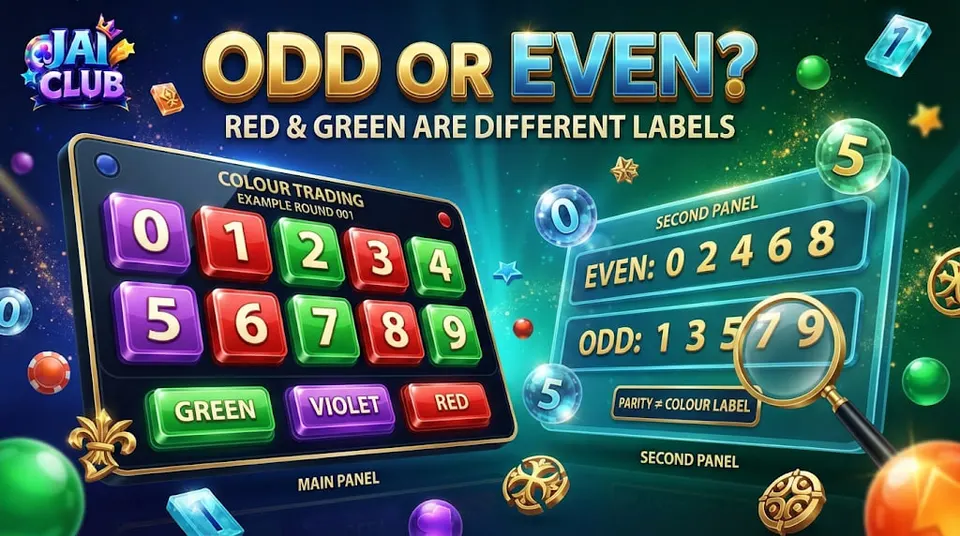
EXAMPLE: Odd Even and Colour Classification
Consider this illustrative mapping.
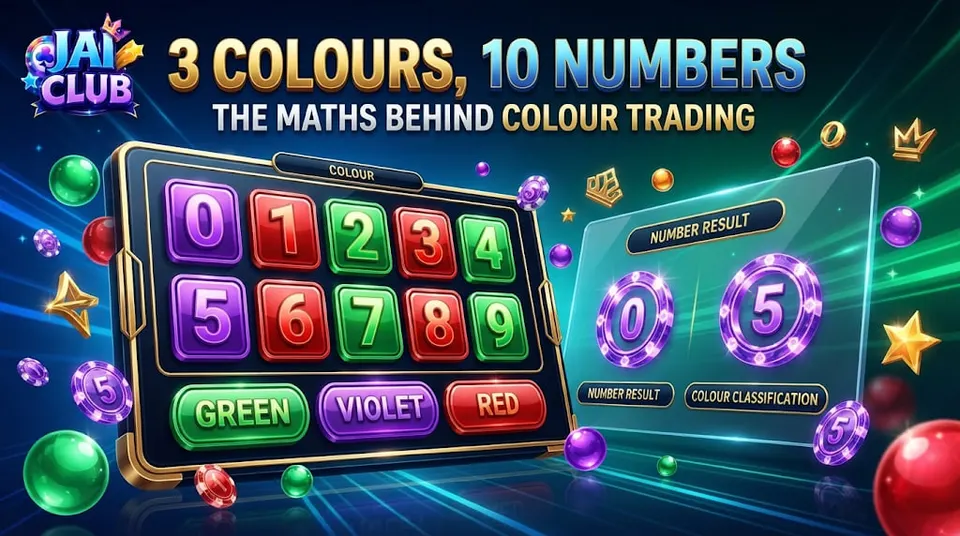
| Digit | Mathematical parity | Example colour |
|---|---|---|
| 0 | Even | Red + Violet |
| 1 | Odd | Green |
| 2 | Even | Red |
| 3 | Odd | Green |
| 4 | Even | Red |
| 5 | Odd | Green + Violet |
| 6 | Even | Red |
| 7 | Odd | Green |
| 8 | Even | Red |
| 9 | Odd | Green |
EXAMPLE ONLY: The colours follow a commonly described format. The actual rules of a particular game must be checked.
The table shows that parity and colour classifications can overlap.
However, their meanings remain different.
Is Every Even Digit Red?
Under the particular illustrative mapping above, every even digit has a Red-related classification.
However, this is not a universal mathematical rule.
The digit 2 is Even regardless of how a game colours it.
Another game could assign 2 to a different category without changing its parity.
The colour depends on provider rules, while parity does not.
This distinction becomes important when comparing records from unrelated products.
A familiar button colour does not automatically establish a universal mapping.
Is Every Odd Digit Green?
Under the illustrative mapping, every odd digit has a Green-related classification.
However, digit 5 also receives a Violet-related label.
Therefore, the statement "Odd means only Green" would be incomplete under this system.
The mathematical definition of Odd does not change.
The additional label reflects how the game classifies the digit.
Readers should identify whether a chart displays the primary colour, a special colour or both.
Why Zero Matters
Zero is Even.
This follows from the mathematical definition because zero is divisible by two.
However, some Colour Trading interfaces also give digit 0 a special Violet-related classification.
This creates a situation where one digit has a mathematical parity and multiple colour-related labels.
The result is not contradictory.
Even describes the number mathematically.
Red and Violet describe its treatment under the illustrative game mapping.
Why Number 5 Is Special
The digit 5 is Odd.
In a commonly described WinGo-style mapping, it may be associated with Green and Violet.
That does not make it Even.
It also does not mean that two separate numerical outcomes occurred.
The same completed result can carry more than one classification.
For example, a record showing digit 5 could be described as Odd, Big and Green/Violet under the corresponding conventions.
Each label answers a different question.
Odd Even vs Big Small
Odd/Even and Big/Small are also different.
Under a common 0–9 Big/Small grouping:
Small contains digits 0 through 4.
Big contains digits 5 through 9.
A digit can therefore be both Small and Odd.
For example, 3 is Small and Odd.
Likewise, 8 is Big and Even.
The categories overlap rather than replacing one another.
A prediction about Big/Small should not be interpreted as a prediction about Odd/Even.
EXAMPLE: Four Classifications of One Result
Consider a fictional completed result of 5.
Under the example rules:
Result digit: 5
Parity: Odd
Size: Big
Colour: Green + Violet
All four descriptions concern one completed numerical outcome.
They do not represent four independent results.
The example illustrates why a chart containing several labels should be interpreted carefully.
What Is the Probability of Odd and Even?
Suppose one digit is drawn uniformly from 0 through 9.
There are five Odd digits and five Even digits.
Under this hypothetical model:
P(Odd) = 5/10 = 50%.
P(Even) = 5/10 = 50%.
These values depend on the assumption that all ten digits are equally likely.
The actual game's result-generation model would need verification before claiming that its probabilities match.
Do Red and Green Have the Same Probability?
Not necessarily.
Their probabilities depend on the precise mapping and underlying digit probabilities.
Under the illustrative uniform mapping, five digits carry a Red-related classification and five carry a Green-related classification.
However, Violet also overlaps with digits 0 and 5.
This means the combined incidence of colour labels can exceed 100% if overlapping categories are counted separately.
The settlement treatment of each selection is another issue.
A mathematical classification count does not establish payout values.
EXAMPLE: Overlapping Labels
Under the illustrative uniform model:
P(Red-related) = 5/10 = 50%.
P(Green-related) = 5/10 = 50%.
P(Violet-related) = 2/10 = 20%.
These figures add up to 120% because the categories overlap.
Digits 0 and 5 are counted in their primary and Violet-related classifications.
This should not be misunderstood as a distribution of three mutually exclusive outcomes.
The result digit remains one of ten possible values.
Why Charts Can Create Confusion
Some history charts display only colour circles.
Others show the completed digit and its classifications together.
A chart that hides the digit can make it harder to distinguish parity from colour labels.
For example, a Violet marker might represent a special digit whose parity is still known.
The colour indicator alone may not explain the complete classification.
Readers should prefer the original result digit when comparing overlapping categories.
For general interface terminology, see Colour Trading Buttons and Labels.
Does an Odd Streak Predict Green?
No reliable prediction follows from historical parity alone.
For example, several consecutive Odd results do not establish that Green must appear next.
Under the illustrative mapping, the relationship between Odd and Green is a classification rule for a completed digit.
It does not reveal which digit will be generated in the next round.
Historical streaks cannot automatically provide information about independent future outcomes.
The same applies to Red and Even patterns.
Why Mapping and Probability Are Separate
A mapping rule assigns labels to numerical outcomes.
A probability model determines how likely the underlying numerical outcomes are.
These are different components.
For example, a mapping may assign Red to five digits.
However, if those digits are not equally likely, a simple five-out-of-ten calculation may not describe the actual Red probability.
The probability model must be known.
A colour chart alone does not provide complete evidence about how the result is generated.
Can Other Games Use Different Colour Rules?
Yes.
Other products may associate colours with different digit groups or use completely different outcome ranges.
Therefore, the illustrative mapping in this guide should not be transferred automatically to another game.
Likewise, a dice game involving totals from 3 through 18 uses different numerical structures from a ten-digit result game.
Parity remains mathematically defined, but the provider's colour and size classifications may differ.
The exact game rules must always be identified.
Frequently Asked Questions
Is Odd the same as Green in Colour Trading?
Not universally. Odd is a mathematical property, while Green is a provider-defined label.
Is Even always Red?
Only under a mapping that explicitly assigns the relevant even digits to Red.
Is zero Odd or Even?
Zero is Even.
Is number 5 Odd or Even?
Five is Odd.
Can 5 be Green and Violet?
Some commonly described WinGo-style formats assign it both labels.
Are Odd and Big the same?
No. For example, 3 is Odd but Small.
Can Odd/Even history predict the next colour?
Not reliably from historical classification alone.
Are Red and Green always equally likely?
No. Their probabilities depend on the mapping and outcome-generation model.
Conclusion
Odd and Even are mathematical properties of digits, while Red and Green are classifications defined by a game.
The two can overlap under a particular number-to-colour mapping, but they should not be treated as universal synonyms.
Understanding this distinction helps readers interpret special digits, colour charts and Big/Small labels more accurately.
Editorial method: All mappings and probability examples are illustrative. The mathematical parity classifications are exact.
Disclaimer: JaiClubGame.online is an independent educational website. Historical colour patterns do not guarantee future results.