A Colour Trading Demo Can Look Real Without Proving Live Game Results
Learn why Colour Trading demo screens can resemble live interfaces while showing simulated outcomes, virtual credits and records that cannot automatically verify a real game.
In this article
- What Is a Colour Trading Demo?
- Demo Result vs Real Result
- EXAMPLE: Two Similar Screens
- Why Matching Graphics Are Not Evidence
- Virtual Credits vs Account Values
- Does a Demo Use the Same Probability Model?
- EXAMPLE: Simulated Result Frequency
- Demo History vs Live History
- Can Demo Screenshots Prove Game Fairness?
- What About Demo Predictions?
- EXAMPLE: Why a Demo Cannot Prove 90% Accuracy
- What Can a Demo Teach?
- Demo vs Screenshot-Based Tutorial
- How to Identify a Fictional Round
- Frequently Asked Questions
- Is a Colour Trading demo the same as a real game?
- Can a demo show real-looking results?
- Do demo credits represent real money?
- Can a demo prove live-game RTP or fairness?
- Are demo period numbers official?
- Can demo predictions prove a tool works?
- Why can two interfaces show the same digit?
- Is a demo still useful?
- Conclusion
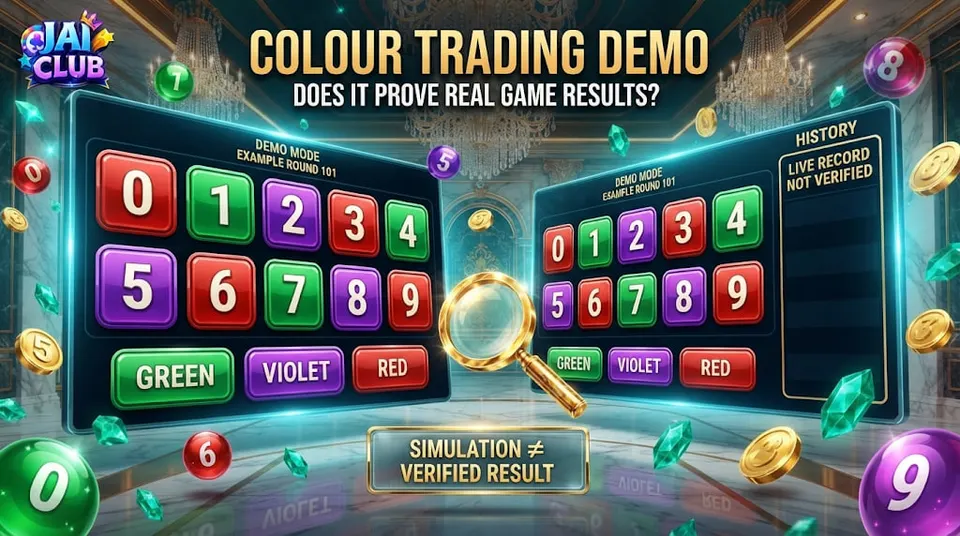
A Colour Trading demo can look almost identical to a live game interface. It may display Red, Green and Violet buttons, a countdown, numerical results and a history table.
However, visual similarity does not establish that the demo is connected to the same game provider or uses identical outcome-generation rules.
A demonstration may be designed to explain interface controls using simulated records. Another demo may use a mathematical model that resembles a real game, but that relationship needs separate verification.
This guide explains what demo screens can demonstrate and what they cannot prove.
What Is a Colour Trading Demo?
A Colour Trading demo is a practice or demonstration interface used to illustrate a game format.
It may show selectable colours, numbered buttons and example game rounds.
Some demos use virtual credits, while others may simply animate result histories.
The term demo does not automatically describe one particular software architecture.
A demonstration might be developed independently from the actual game provider.
Therefore, the presence of familiar artwork does not establish that its results come from a live gaming system.
Demo Result vs Real Result
A demo result is an outcome shown within a demonstration environment.
A real game result refers to an event completed under the rules and systems of the relevant live game.
These records can look identical.
For example, both interfaces might display the digit 7 and classify it as Green.
However, that does not make the events identical.
A valid comparison would require matching the actual provider, game mode and period identifier.
EXAMPLE: Two Similar Screens
Consider two fictional interfaces.
| Field | Demo screen | Live-style screen |
|---|---|---|
| Game mode | DEMO 1-minute | Example live mode |
| Number grid | 0–9 | 0–9 |
| Colour buttons | Red, Green, Violet | Red, Green, Violet |
| Current period | DEMO-C101 | SAMPLE-C701 |
| Latest result | 7 | 7 |
| Record source | Simulated | Not verified |
| Financial status | Virtual only | Provider-dependent |
EXAMPLE ONLY: The displays are fictional.
Both show the same result digit, but that coincidence does not establish shared outcome processing.
Their period identifiers and data sources differ.
Why Matching Graphics Are Not Evidence
Graphics can be reproduced or reused.
A number grid containing ten buttons is relatively simple to imitate.
Similarly, an attractive result-history panel can display manually created records.
A demo can therefore look convincing without connecting to an authoritative provider.
This does not automatically make every demo misleading.
A clearly labelled educational simulation can be useful.
The problem begins when simulated information is presented as proof of actual game outcomes.
Virtual Credits vs Account Values
Some demonstration environments display virtual credits.
These numbers are intended for illustrative or practice purposes.
They should not be interpreted as actual account funds.
For example, a demo might show a balance of 5,000 credits.
That figure does not establish that a user has ₹5,000 in a real account.
The units and status matter.
An educational screenshot should clearly identify virtual amounts to avoid confusion.
Does a Demo Use the Same Probability Model?
Not necessarily.
A simulation may use independently generated sample outcomes.
It might use a mathematical model designed to resemble another game.
A different demo might cycle through a fixed example sequence.
These approaches can create very different result distributions.
Without documentation, the probability model of the demonstration cannot be assumed identical to that of a live product.
Visual similarity does not establish mathematical equivalence.
EXAMPLE: Simulated Result Frequency
Imagine a fictional demo containing twenty completed rounds.
Eight results are Green-related, ten are Red-related and two are Violet-only under an exclusive demonstration mapping.
The recorded proportions are:
Green: 8/20 = 40%.
Red: 10/20 = 50%.
Violet: 2/20 = 10%.
These percentages describe only the twenty fictional demo events.
They do not establish live game probabilities.
They also depend on the stated classification rule, which may differ from another game's overlapping colour labels.
Demo History vs Live History
A history table can show period identifiers, result digits and timestamps.
However, the source of those records matters.
A demo may generate its own historical sequence.
A live game may maintain separate completed records.
Therefore, two history panels should not be compared only by their final digits.
Matching a period number also requires confidence that the identifiers belong to the same provider-managed event.
An independently generated demo period is not automatically a live-game reference.
Can Demo Screenshots Prove Game Fairness?
No.
A screenshot can document what an interface displayed.
It cannot independently establish the mathematics or randomness of the underlying game.
For example, a screenshot of five different colours does not prove that future colours are independently generated.
Likewise, a sequence of matching demo and real-looking results does not establish that both environments use identical software.
Claims about fairness require evidence appropriate to the actual game system.
A visual demonstration is not a substitute for such evidence.
What About Demo Predictions?
A demo can be programmed to show a forecast and then reveal a result.
However, it may control both the forecast and the simulated result.
This means successful demo predictions do not independently establish performance on genuine unknown live outcomes.
For example, a scripted interface could display ten successful forecasts in a row.
Such a demonstration may illustrate what an application looks like.
It does not prove that the same tool can predict independent real rounds.
Forecasting claims require proper prospective testing.
EXAMPLE: Why a Demo Cannot Prove 90% Accuracy
Consider a fictional demo displaying nine correct predictions out of ten simulated rounds.
Its observed success rate is 90%.
However, the outcomes were generated inside the demonstration.
Unless the testing process is independently controlled and genuinely predictive, the 90% result does not establish performance on live game events.
The sample is also small.
A marketing screenshot of successful demo forecasts therefore provides limited evidence.
A valid accuracy test must count all predictions against independently established outcomes.
What Can a Demo Teach?
A demo can help explain the relationship between number buttons, colour labels and completed result records.
It may show how an interface displays the current period separately from the latest completed period.
A demonstration can also illustrate how virtual balances or counters work.
These are educational functions.
However, understanding the interface is different from establishing that its backend is identical to a live provider.
A demo can be useful without being evidence of live-game fairness or forecast accuracy.
Demo vs Screenshot-Based Tutorial
A screenshot captures a particular visual state.
A demo provides an interactive or animated illustration.
Both can help communicate interface terminology.
However, both can also omit important information about actual recordkeeping.
For example, neither format necessarily provides access to authoritative server logs.
A tutorial should be clear about whether its information is simulated, historical or independently verified.
For related guidance, read What Makes a Colour Trading Screenshot Reliable Evidence?.
How to Identify a Fictional Round
A well-labelled educational demo can use identifiers such as DEMO-C101 or EXAMPLE ROUND 001.
These labels make clear that the period is illustrative.
However, a polished interface with an ordinary-looking period number could still be fictional.
The number alone does not authenticate the source.
Readers should verify the publisher and context rather than rely on realistic formatting.
A fake or illustrative identifier should never be presented as an actual completed provider record.
Frequently Asked Questions
Is a Colour Trading demo the same as a real game?
Not necessarily. The interface may be similar while the data and underlying systems differ.
Can a demo show real-looking results?
Yes. Simulated results can be presented through realistic game graphics.
Do demo credits represent real money?
No. Virtual demonstration credits should not be treated as actual account funds.
Can a demo prove live-game RTP or fairness?
No. A visual simulation is not sufficient evidence.
Are demo period numbers official?
Not automatically. Their source must be verified.
Can demo predictions prove a tool works?
Not without valid testing against independent unknown outcomes.
Why can two interfaces show the same digit?
The same number can appear in unrelated or separately generated records.
Is a demo still useful?
Yes. It can explain interface elements and result terminology.
Conclusion
A Colour Trading demo can be visually convincing without proving anything about the live game's result-generation system.
Demo interfaces are useful for understanding controls, classifications and historical displays.
However, simulated outcomes, virtual credits and scripted demonstrations should be clearly separated from authoritative live records.
Editorial method: All demo periods, frequencies and interfaces are fictional. No provider's live game or demonstration backend was audited.
Disclaimer: JaiClubGame.online is an independent educational website. Demo results do not establish real gaming outcomes or prediction accuracy.