Scratch Card vs Lottery Draw: Why the Results Work Differently
Understand how scratch-card reveals differ from lottery draws, including predetermined outcomes, ticket symbols, number combinations, result timing and digital game implementations.
In this article
- What Is a Scratch Card Game?
- What Is a Lottery Draw?
- Scratch Card vs Lottery Draw
- What Does a Scratch Reveal Actually Do?
- EXAMPLE: A Fictional Scratch Card
- EXAMPLE: A Fictional Lottery Draw
- Why Result Timing Is Different
- Can Scratching Faster Change the Result?
- What Is an Instant-Win Game?
- Ticket Identity vs Draw Identity
- Are Scratch Cards and Lottery Games Equally Random?
- EXAMPLE: Different Mathematical Models
- Can Digital Scratch Results Be Predetermined?
- Why Digital Animations Can Be Misleading
- Can a Scratch Card Have Multiple Prize Rules?
- Is a Lottery Result Shared by Multiple Players?
- What About Result Verification?
- Does a Scratch Game Have the Same RTP as a Lottery?
- Can Previous Scratch Results Predict Another Ticket?
- Frequently Asked Questions
- What is the main difference between a scratch card and a lottery draw?
- Does scratching faster improve the result?
- Is a digital scratch outcome always predetermined?
- Can a lottery draw have multiple entries?
- Are scratch cards always instant-win games?
- Do scratch and lottery games have identical odds?
- Is a scratch animation proof of fairness?
- Does Jai Club offer every scratch-card feature described here?
- Conclusion
A scratch card and a lottery draw can both involve uncertain outcomes, but their result mechanisms are not necessarily the same.
A conventional scratch card reveals information associated with a particular ticket. A lottery draw normally produces a result through a separate drawing event.
This distinction is important when comparing digital Mini Games with number-based lottery formats.
For example, scratching a hidden symbol does not necessarily generate the outcome at the moment the animation appears. In some implementations, the result may already be assigned.
However, digital game systems can vary, so the exact generation and reveal process must be verified for the particular product.
This guide explains the common differences without claiming that every Jai Club-branded platform offers a specific scratch-card game.
What Is a Scratch Card Game?
A scratch card is a game format in which concealed information is revealed.
In a traditional physical scratch ticket, printed symbols or numbers are hidden beneath a removable covering.
The player reveals them by scratching the surface.
The result is determined according to the ticket's printed information and relevant game rules.
Digital scratch games imitate this reveal experience through a screen.
However, their internal outcome-generation systems may differ from physical tickets.
What Is a Lottery Draw?
A lottery draw generally involves selecting or generating a winning number, combination or other outcome in a defined drawing event.
The drawing process may be physical or digital, depending on the game.
For example, a fictional lottery could generate a three-digit result from 000 through 999.
Participants may compare their previously selected numbers against the completed drawing.
The draw result may apply to multiple entries associated with that event.
This differs from a conventional scratch ticket in which each ticket carries its own prize information.
Scratch Card vs Lottery Draw
| Feature | Scratch Card | Lottery Draw |
|---|---|---|
| Typical experience | Reveal hidden ticket information | Wait for a drawing event |
| Result association | Particular ticket or play | Drawing period or event |
| Visual mechanism | Scratch or reveal animation | Number or symbol draw |
| Result timing | Depends on ticket design | Defined draw process |
| Common identifier | Ticket or play reference | Draw or period identifier |
| Possible digital implementation | Preassigned or generated outcomes | Event-based generation |
These descriptions are general. Specific game rules can differ.
What Does a Scratch Reveal Actually Do?
The scratching action exposes information that was previously hidden from the player.
On a physical ticket, the outcome information is already printed beneath the covering.
Therefore, scratching a different corner first does not change the ticket's printed contents.
In a digital game, the scratch animation is a software presentation.
It may reveal a result already determined by the game system.
However, not every digital implementation works identically.
The provider's documented rules and technical design determine when the outcome becomes final.
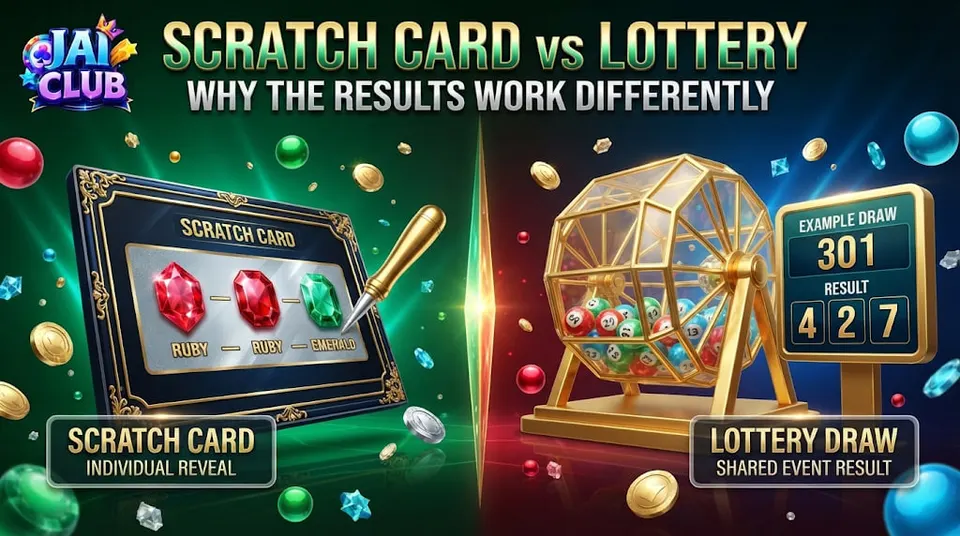
EXAMPLE: A Fictional Scratch Card
Imagine a fictional card containing three hidden gemstone symbols.
The revealed symbols are:
Ruby — Ruby — Emerald.
Under the hypothetical rule, three matching symbols would be required for a qualifying result.
This card contains only two matching Rubies.
Therefore, it would not meet the example's three-symbol condition.
EXAMPLE ONLY: This is an invented mechanic, not a verified Jai Club scratch-card rule.
The example illustrates that the visible symbols need to be interpreted according to the specific prize condition.
EXAMPLE: A Fictional Lottery Draw
Now imagine a different game with a three-digit draw.
Draw identifier: DEMO-L301.
Completed drawing: 427.
A fictional entry containing 427 would match the exact combination.
An entry containing 472 would not match the ordered result if the rules require exact positional order.
The result belongs to the drawing event.
That is different from an individual scratch ticket revealing its own hidden combination.
The actual payout conditions still depend on the relevant game rules.
Why Result Timing Is Different
A conventional physical scratch ticket contains its printed outcome before the player scratches it.
A lottery draw produces or reveals the winning combination at a defined event.
These processes have different timing structures.
For example, revealing a previously printed scratch ticket does not require waiting for a future number draw.
A draw-based game may instead use scheduled result periods.
Digital scratch games can use different implementations, so their result timing should not be assumed from the animation alone.
Can Scratching Faster Change the Result?
In a conventional physical scratch card, scratching speed does not change the printed symbols.
Similarly, a digital scratch animation does not automatically provide control over the result-generation algorithm.
For example, clearing the screen from left to right is not evidence of a more favourable outcome.
A claim that scratching technique changes digital prize probabilities requires independent evidence.
Visual interactions and underlying result generation are separate concepts.
The game's actual rules are the appropriate reference.
What Is an Instant-Win Game?
The term instant-win commonly describes a game in which the outcome can be revealed during a short individual play rather than requiring a later scheduled draw.
Scratch cards are a familiar example.
However, the phrase does not guarantee that every digital scratch game uses the same result mechanism.
Some instant-win products may use different mathematics or prize structures.
An instant reveal also does not mean a prize is guaranteed.
The outcome remains subject to the game's rules.
Ticket Identity vs Draw Identity
A scratch ticket may have a ticket reference or another unique identifier.
A draw-based game may use a drawing number or period identifier.
These references serve different purposes.
For example, two scratch tickets from the same product may contain different outcomes.
By comparison, several entries associated with one lottery draw may be assessed against the same completed draw result.
A ticket ID and draw ID should not automatically be treated as equivalent.
The exact software and game structure determine their meaning.
Are Scratch Cards and Lottery Games Equally Random?
They can both involve chance, but their probability models may differ.
A physical scratch product may have a defined population of tickets and prizes.
A number draw may use another defined set of possible combinations.
Digital implementations can also use specific random-number generation systems.
Therefore, a scratch game's prize distribution cannot be inferred from an unrelated lottery's digit probabilities.
The probability model must be established for each product separately.
EXAMPLE: Different Mathematical Models
Consider two hypothetical games.
Game A is a digital lottery that independently generates one digit from 0 through 9 with equal probability.
A specified digit has a probability of 1/10 or 10%.
Game B is a fictional scratch product containing 1,000 tickets, of which 100 have a particular qualifying prize.
The proportion of qualifying tickets is also 10%.
Although both percentages are 10%, the underlying structures are different.
Game A concerns independent digit generation.
Game B concerns a defined ticket population.
Their shared percentage does not make the games equivalent.
Can Digital Scratch Results Be Predetermined?
Some digital scratch implementations may determine a result before the scratch animation is completed.
For example, the game system might assign an outcome when the play begins.
The interface then reveals that result visually.
However, that implementation is not universal.
Other software may use different processing points.
A screenshot of the animation cannot independently reveal when the outcome was generated.
A verified technical description would require reliable provider information.
Why Digital Animations Can Be Misleading
A digital scratch effect can feel interactive because the player moves a finger across the screen.
However, interaction with the display is not necessarily control over the underlying outcome.
The same applies to animated lottery balls.
A realistic drawing animation does not independently establish the mathematical process used to generate the result.
The interface communicates the outcome, but it does not provide a complete audit of the game system.
This distinction is important when reviewing gaming screenshots and promotional demonstrations.
Can a Scratch Card Have Multiple Prize Rules?
Yes, depending on the product.
For example, one scratch game might require three identical symbols.
Another might use a matching-number condition.
A third could provide a bonus area or separate prize symbol.
These are game-specific mechanics.
The existence of a scratch surface does not identify the winning rule.
The paytable or help section should explain which combinations qualify.
A familiar scratch design should not be used to guess prize conditions.
Is a Lottery Result Shared by Multiple Players?
In many draw-based lottery systems, one completed result is used to evaluate multiple entries associated with that draw.
However, the exact arrangement depends on the game.
A scratch-card product can instead associate an outcome with an individual ticket.
This distinction affects how result records are organised.
A draw identifier may help match several entries to the same event.
A ticket identifier commonly serves a more individual purpose.
The relevant rules should be confirmed.
What About Result Verification?
A scratch-card result may be associated with a ticket or play record.
A lottery result may be associated with a completed draw record.
The appropriate verification method depends on the product.
For example, a screenshot of three matching symbols cannot automatically verify that a digital scratch result is official.
Similarly, a number combination displayed after a draw needs a reliable reference to the correct event.
Screenshots are supporting information, not universal proof of backend integrity.
Does a Scratch Game Have the Same RTP as a Lottery?
No universal comparison can be made.
RTP depends on the mathematical model and prize distribution of the particular product.
A game format alone is not enough to calculate theoretical return.
For example, two scratch-card products can offer different prize structures.
Two lottery games can also have different outcome spaces and settlement rules.
The actual provider's documentation is needed for meaningful comparisons.
A familiar visual theme does not establish a common RTP.
Can Previous Scratch Results Predict Another Ticket?
Not automatically.
A previously revealed ticket describes one completed event.
Whether it changes the probabilities of other tickets depends on the actual ticket population and distribution process.
Likewise, earlier independent lottery draws do not automatically reveal the next result.
Historical screenshots should not be treated as guaranteed prediction signals.
The distinction between finite ticket populations and independent random draws matters mathematically.
Frequently Asked Questions
What is the main difference between a scratch card and a lottery draw?
A scratch card commonly reveals information associated with an individual ticket, while a lottery draw generates or announces an event-based result.
Does scratching faster improve the result?
No such advantage follows from the reveal action itself.
Is a digital scratch outcome always predetermined?
Not universally. The timing depends on the game's implementation.
Can a lottery draw have multiple entries?
Yes, many draw-based games evaluate multiple entries against one completed result.
Are scratch cards always instant-win games?
Scratch cards are commonly associated with instant-win formats, but individual rules can differ.
Do scratch and lottery games have identical odds?
Not necessarily. Their probability models and prize distributions can differ.
Is a scratch animation proof of fairness?
No. Visual presentation does not independently establish the underlying mathematics.
Does Jai Club offer every scratch-card feature described here?
Availability and exact features have not been independently verified.
Conclusion
Scratch cards and lottery draws can both involve uncertain outcomes, but their result structures differ.
A conventional scratch card reveals ticket-associated information. A lottery draw generally produces an event-based outcome used to evaluate relevant entries.
Understanding ticket identity, result timing and the difference between animation and generation helps readers interpret these game formats accurately.
Editorial method: All example symbols, identifiers and probability calculations are hypothetical. No specific Jai Club scratch-card implementation was independently tested.
Disclaimer: JaiClubGame.online is an independent educational website. Game availability, rules and outcomes require provider-specific verification.