HiLo Card Values and What Happens When the Next Card Matches
Understand how card values are compared in HiLo-style games, why equal cards need special rules, and how deck composition affects higher, lower and matching-card probabilities.
In this article
- HiLo Card Game Kya Hai?
- How Are Card Values Ranked?
- Higher, Lower and Equal Results
- Same Card Aane Par Kya Hota Hai?
- EXAMPLE: Probability in a Standard Deck
- Why Card Removal Matters
- Does the Suit Matter?
- Ace High or Ace Low?
- Does a Higher Card Have a Better Chance?
- HiLo Probability vs Payout Multiplier
- Is a Digital HiLo Card Really Drawn From a Deck?
- Can Earlier Cards Predict the Next One?
- What to Check in a HiLo Game's Rules
- Frequently Asked Questions
- What is HiLo in card games?
- HiLo Me Same Card Aaye To Kya Hoga?
- Is Ace always the highest card?
- Can two different suits produce equal cards?
- Does a standard deck contain four cards of each rank?
- Can previous cards help calculate probability?
- Is HiLo confirmed on every Jai Club platform?
- Conclusion
In a HiLo card game, the basic concept is comparing a displayed card with the next card to determine whether the next value is higher or lower. A third possibility is an equal-value card, and its treatment can change the rules significantly.
People researching the Jai Club HiLo game should understand the difference between card rank, suit and game-specific conditions. Two cards can have different suits but the same numerical rank. Whether that counts as a tie, a special result or another outcome depends on the actual game.
This guide explains standard card comparisons and mathematical examples. It does not confirm that a particular HiLo title is currently available on Jai Club or claim that every developer uses identical rules.
HiLo Card Game Kya Hai?
HiLo is a name commonly associated with higher-or-lower card comparisons.
A card is displayed, and the next card is evaluated relative to its rank. Some versions allow a higher or lower selection, while other versions use additional outcomes, bonus features or different card rules.
The key point is that HiLo is a family of related game formats, not one universal implementation.
For example, one version might use a conventional 52-card deck. Another could use independently generated ranks or a digital configuration with different payout rules.
Before applying any probability calculation, readers must identify the exact card model.
How Are Card Values Ranked?
Under one common convention, the ranks are ordered from 2 through 10, followed by Jack, Queen, King and Ace.
However, Ace may be treated as high, low or subject to a special rule depending on the game.
For a standard Ace-high comparison, the order is:
2, 3, 4, 5, 6, 7, 8, 9, 10, J, Q, K, A.
This is a general example rather than a verified rule for a Jai Club game.
A game may also exclude certain ranks or use additional card symbols. Those possibilities change the number of available outcomes.
Higher, Lower and Equal Results
Suppose the current card has a rank of 8 under the Ace-high convention.
A card with rank 9, 10, Jack, Queen, King or Ace is higher.
A card with rank 2 through 7 is lower.
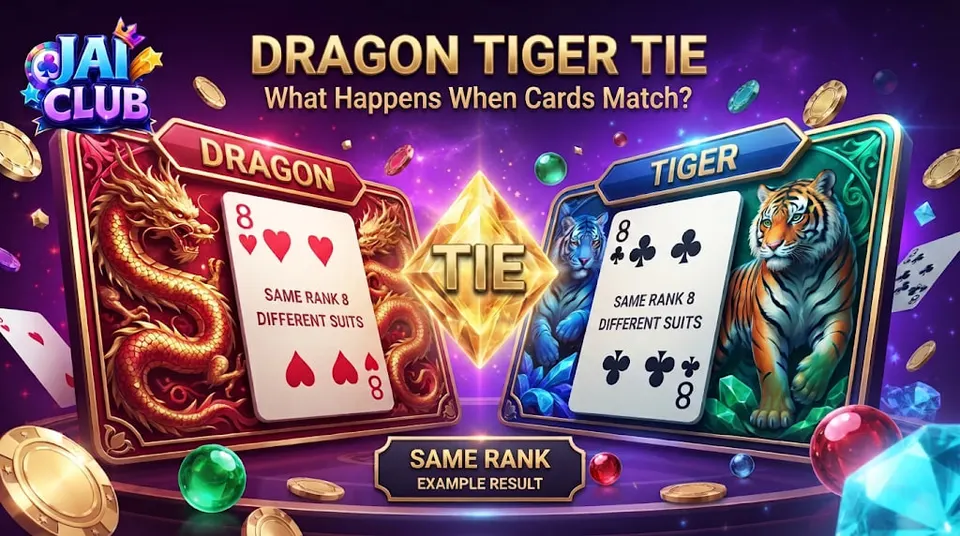
Another 8 has the same rank.
This final possibility is sometimes overlooked when a game is described simply as Higher or Lower.
Equal-ranked cards can occur in a normal deck because each rank has four suits.
A card does not need to have the same suit to match the rank of another card.
Same Card Aane Par Kya Hota Hai?
An equal-card outcome does not have one universal settlement rule.
A particular HiLo game might treat equal ranks as a loss, a push or a separate payable outcome. Another version may prevent equal outcomes through its own mechanics.
A push generally means that the original amount is returned without a net gain or loss, but that definition only applies when the game explicitly uses such a rule.
Readers should never assume that a tie automatically returns the original amount.
The correct answer depends on the title's documented paytable.
EXAMPLE: Probability in a Standard Deck
Consider a conventional 52-card deck containing four cards of each rank.
Suppose the current card is an 8 and has been removed from the deck.
There are now 51 cards remaining.
Under the Ace-high convention, six ranks are higher than 8, six ranks are lower, and three other cards share the rank of 8.
| Outcome | Remaining cards | Probability |
|---|---|---|
| Higher rank | 24 | 24/51 ≈ 47.06% |
| Lower rank | 24 | 24/51 ≈ 47.06% |
| Equal rank | 3 | 3/51 ≈ 5.88% |
| Total | 51 | 100% |
These numbers follow from a specific hypothetical model: one complete 52-card deck, Ace high, and no replacement before the next draw.
They are not verified odds for a Jai Club HiLo product.
Why Card Removal Matters
A deck that removes dealt cards changes its composition as cards are revealed.
If a rank or suit has already been removed, it may no longer be available in the same quantity.
A digital game that independently generates each next card may instead follow another probability model.
This distinction can change calculations substantially.
For example, the probability of drawing another 8 from a 51-card deck is different from the probability of independently selecting rank 8 from thirteen equally likely ranks.
A reliable probability explanation must state whether cards are replaced.
Does the Suit Matter?
Suit and rank describe separate card attributes.
A standard deck uses hearts, diamonds, clubs and spades.
In a basic rank-comparison format, the higher-or-lower result may depend on rank rather than suit.
However, a developer could introduce suit-based rules or features.
A matching suit should therefore not be treated as an equal-ranked result unless the game specifically defines it that way.
Likewise, two cards with different suits can share the same rank.
Ace High or Ace Low?
Ace is one of the most important rule details to verify.
In an Ace-high system, Ace ranks above King. In an Ace-low system, Ace may rank below 2.
Some card games allow Ace to occupy special positions or use it differently in bonus features.
This changes which next cards qualify as higher or lower.
For example, a current King has only Ace above it in a conventional Ace-high model.
The same comparison changes if Ace is assigned another position.
Readers should avoid importing Ace rules from unrelated card games.
Does a Higher Card Have a Better Chance?
No particular direction is always more likely under every HiLo configuration.
The probability depends on the current rank, remaining card distribution and game rules.
For example, when a low-ranked card is displayed, more possible ranks may be above it than below it under a standard ordering.
The reverse may apply for high-ranked cards.
However, probability is not the same as financial value. A payout table may account for different likelihoods, and any house edge also matters.
Without the actual paytable, expected returns cannot be established.
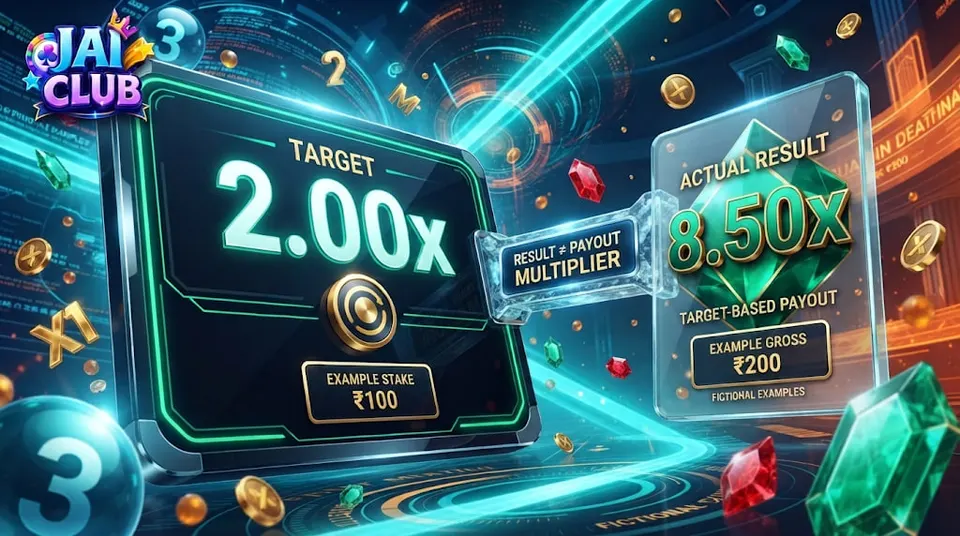
HiLo Probability vs Payout Multiplier
A probability describes how likely an outcome is under a defined model.
A payout multiplier describes the gross amount associated with a successful outcome under the rules.
These values should not be confused.
A relatively unlikely outcome might have a higher displayed multiplier, but that does not mean it provides a favourable expected return.
To evaluate expected value, the result probabilities and the settlement for every possible outcome must be known.
The treatment of equal cards is especially relevant because it can affect the full calculation.
Is a Digital HiLo Card Really Drawn From a Deck?
Not every digital card game needs to simulate a physical deck.
A developer can define an outcome model using software and then display card artwork representing that outcome.
Other products may explicitly model a finite deck and its changing composition.
The animation alone cannot identify which approach is used.
A screenshot of the next card also does not reveal whether cards were replaced between rounds.
That is a question for the actual game's documentation.
Can Earlier Cards Predict the Next One?
Previous cards can affect probabilities in a finite deck without replacement, because the remaining composition changes.
However, that is different from guaranteeing the next card.
In an independent digital model, previous results may provide no useful information about the next outcome at all.
Therefore, the claim that a sequence such as High, High, Low must be followed by Low is not a reliable general rule.
A proper explanation begins with the outcome-generation model, not a historical pattern.
What to Check in a HiLo Game's Rules
Before interpreting a game, identify the card ordering, number of available ranks and treatment of Ace.
Next, confirm whether the software models a finite deck, returns cards after each draw or uses another procedure.
Finally, examine the handling of equal values and the payout table.
These details are necessary to understand what a result actually means.
For other game concepts and mechanics, explore the Jai Club Mini Games category.
Frequently Asked Questions
What is HiLo in card games?
HiLo commonly refers to a higher-or-lower comparison involving card ranks.
HiLo Me Same Card Aaye To Kya Hoga?
It depends on the game's rules. Equal ranks might count as a loss, push or separate result.
Is Ace always the highest card?
No. Ace ranking depends on the particular game.
Can two different suits produce equal cards?
Yes, if equality is defined by rank alone.
Does a standard deck contain four cards of each rank?
Yes. A conventional 52-card deck has thirteen ranks and four suits.
Can previous cards help calculate probability?
They may affect the remaining composition of a finite deck without replacement, but do not guarantee an outcome.
Is HiLo confirmed on every Jai Club platform?
No. Availability and rules must be checked for the exact platform and game title.
Conclusion
HiLo card comparisons depend on more than the words Higher and Lower.
Card ranking, Ace placement, equal-value results and whether the game models a finite deck all influence how outcomes should be understood.
Readers should identify the exact rules before interpreting probabilities or settlement values. A familiar card display does not guarantee that two digital HiLo products work identically.
Editorial method: The probability example uses a hypothetical standard 52-card deck and clearly stated assumptions. It is not a verified Jai Club game model.
Disclaimer: JaiClubGame.online is an independent educational website. It does not operate HiLo games or guarantee any gaming outcome.