When Dragon and Tiger Show the Same Card Value
Understand what a Tie means in Dragon Tiger card games, how equal ranks differ from identical cards, and why tie probabilities and settlement rules depend on the game version.
In this article
- What Is Dragon Tiger?
- Dragon Tiger Me Tie Kab Hota Hai?
- Same Rank vs Same Card
- Dragon Tiger Card Ranking
- EXAMPLE: Comparing Card Values
- Does Suit Decide a Tie?
- What Happens to a Dragon Selection on a Tie?
- Does a Tiger Selection Follow the Same Tie Rule?
- Dragon Tiger Tie Probability Kaise Calculate Hota Hai?
- What if Cards Come From Independent Decks?
- Comparison of Two Hypothetical Models
- Is a Tie Rare?
- Why a Previous Tie Does Not Predict Another
- Dragon Tiger vs HiLo
- Result History vs Settlement History
- Can Dragon and Tiger Have the Same Number but Different Colours?
- What Makes a Tie Record Clear?
- Frequently Asked Questions
- What is Tie in Dragon Tiger?
- Can two different suits produce a Tie?
- Is Ace always high in Dragon Tiger?
- Does a Tie return the original stake?
- What is the Tie probability with one standard deck?
- Can different card models have different Tie probabilities?
- Does a previous Tie make another Tie more likely?
- Is Dragon Tiger confirmed on every Jai Club platform?
- Conclusion
A Tie in a Dragon Tiger card game generally means that the cards assigned to Dragon and Tiger have equal ranks under the game's comparison rules.
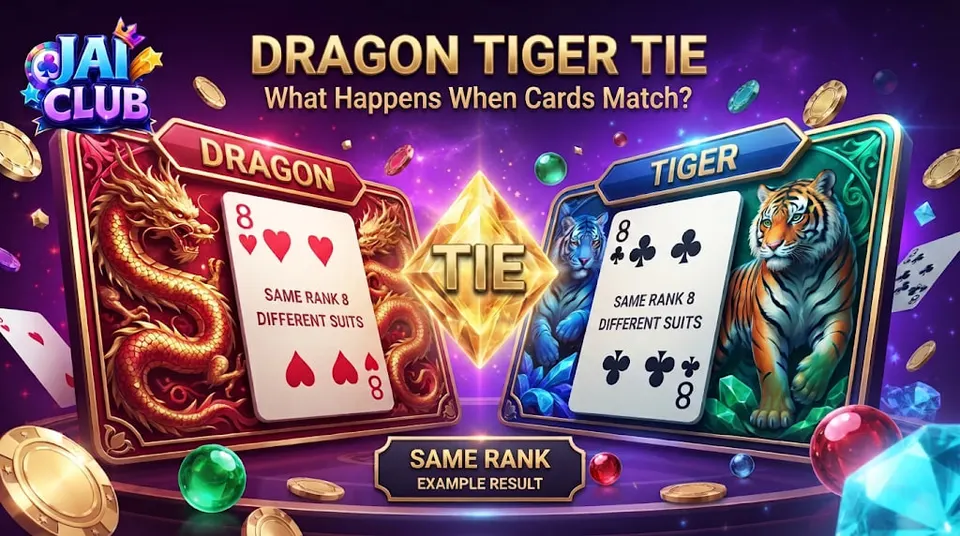
For example, a Dragon card showing 8 and a Tiger card showing another 8 may produce a Tie, even when their suits are different.
However, the treatment of equal cards, the number of decks used and the settlement of individual selections depend on the specific game version.
This guide explains Dragon Tiger Tie rules using common card concepts and clearly stated mathematical examples. It does not claim that a particular Dragon Tiger product is currently available on Jai Club or that every provider uses identical rules.
What Is Dragon Tiger?
Dragon Tiger is a card-comparison game in which two positions are commonly labelled Dragon and Tiger.
One card is associated with each position.
The result is determined by comparing the values under the particular game's rules.
If Dragon has the higher rank, Dragon is the higher-card outcome.
If Tiger has the higher rank, Tiger is the higher-card outcome.
An equal-rank comparison creates the Tie condition in versions that recognise that result.
The exact ranking and settlement rules must come from the game provider.
Dragon Tiger Me Tie Kab Hota Hai?
A Tie generally occurs when both displayed cards have the same rank.
For example:
Dragon: 8 of Hearts
Tiger: 8 of Clubs
The suits are different, but both cards have rank 8.
Under a rank-based comparison, they are equal.
However, this example describes a common interpretation rather than a universal rule for every digital card product.
Any special card ranking or game-specific condition must be checked separately.
Same Rank vs Same Card
Two cards can share a rank without being identical physical cards.
In a conventional deck, each rank appears in four suits.
For example, the 8 of Hearts and 8 of Clubs have the same rank.
They are still different cards.
When a game uses rank-only comparison, the suit does not necessarily break the tie.
A screenshot showing matching ranks but different suits should therefore not automatically be interpreted as a non-tie.
The actual rules determine whether suit has any effect.
Dragon Tiger Card Ranking
A common convention places cards in order from Ace low through King high.
However, card rankings can vary between versions, and Ace treatment should always be confirmed.
For example, some card games assign Ace the highest value, while others make it the lowest.
An incorrect assumption about Ace can change the interpretation of a Dragon-versus-Tiger result.
A reliable guide should describe the specific game's rule rather than import rankings from unrelated card formats.
The Tie concept itself concerns equality under the chosen ranking convention.
EXAMPLE: Comparing Card Values
Consider these fictional card comparisons.
| Dragon | Tiger | Result under rank-only comparison |
|---|---|---|
| 8 of Hearts | 8 of Clubs | Tie |
| 9 of Diamonds | 4 of Spades | Dragon |
| 3 of Clubs | Jack of Hearts | Tiger |
| King of Spades | King of Diamonds | Tie |
| 6 of Hearts | 6 of Spades | Tie |
EXAMPLE ONLY: The comparisons assume a conventional ranking where Jack is higher than 3 and 9 is higher than 4.
These examples explain card equality. They do not represent actual Jai Club game history.
Does Suit Decide a Tie?
Not necessarily.
In many rank-comparison games, suits are not used to determine which side wins.
For example, two Kings can be equal even if one is a Heart and the other is a Spade.
However, a specific variant may include special rules.
The correct interpretation depends on the published game information.
Readers should not assume that Red suits beat Black suits or that one suit is automatically stronger without an explicit rule.
Card colour and card rank are separate properties.
What Happens to a Dragon Selection on a Tie?
The settlement depends on the game's paytable.
Some card-comparison products use special rules for Dragon and Tiger selections when a Tie occurs.
A particular version may return part of a stake, treat the selection as unsuccessful or apply another documented condition.
There is no safe universal payout assumption.
For example, an educational article should not claim that every Tie returns half the original stake.
The actual game's settlement instructions are required.
A Tie result and the financial treatment of a Dragon selection are separate questions.
Does a Tiger Selection Follow the Same Tie Rule?
Not automatically, although some game versions may treat Dragon and Tiger symmetrically.
The provider's paytable must explain the settlement of each selection.
Two interfaces using similar Dragon Tiger artwork can have different rules.
A reader should therefore distinguish the outcome classification from the settlement procedure.
A Tie can be identified from matching ranks while the associated payout rules remain unknown.
That distinction prevents unsupported financial claims.
Dragon Tiger Tie Probability Kaise Calculate Hota Hai?
Tie probability depends on how the cards are generated.
Consider a hypothetical game that draws two cards without replacement from one standard 52-card deck.
After the first card is drawn, 51 cards remain.
Exactly three of those cards share the first card's rank.
Therefore, the probability that the second card matches the first card's rank is:
3 ÷ 51 = 1 ÷ 17.
That is approximately 5.88%.
This calculation assumes one deck, no replacement and rank-based equality.
It is not a verified probability for a Jai Club Dragon Tiger game.
What if Cards Come From Independent Decks?
Now consider a different hypothetical model.
Suppose Dragon and Tiger each receive a card independently drawn from a standard deck.
After the Dragon rank is known, the Tiger card has four matching-rank possibilities among 52 cards.
The probability of an equal rank is:
4 ÷ 52 = 1 ÷ 13.
That is approximately 7.69%.
This differs from the 5.88% result in the single-deck, no-replacement model.
The comparison demonstrates why the number of decks and draw procedure matter.
A familiar card animation does not reveal those details.
Comparison of Two Hypothetical Models
| Model | Matching-rank probability |
|---|---|
| One 52-card deck without replacement | 3/51 ≈ 5.88% |
| Independent draws from separate standard decks | 4/52 ≈ 7.69% |
Both are mathematical examples.
Neither should be applied to an actual digital game without verifying its card-generation rules.
The difference is not evidence that one product is unfair.
It shows how different mathematical models create different probabilities.
Is a Tie Rare?
Under the two hypothetical models described above, Tie is less frequent than either individual higher-card outcome.
However, the actual likelihood depends on the game.
A Tie can still occur in consecutive rounds.
For example, two successive Tie results are possible under an independent model with a positive Tie probability.
Their occurrence does not automatically indicate a software error.
Likewise, a long period without a Tie does not prove that one must occur next.
Why a Previous Tie Does Not Predict Another
If rounds are independent, one completed Tie does not change the probability of the next outcome.
A history panel may display several previous results.
Those results can be useful for describing the past.
However, their order does not establish a guaranteed future sequence.
For example, Dragon, Tiger, Dragon, Tie does not imply that another Tie must follow.
Prediction claims need valid evidence beyond a short historical pattern.
Dragon Tiger vs HiLo
Dragon Tiger and HiLo both involve card values, but their comparison structures differ.
Dragon Tiger generally compares two positions within one event.
HiLo commonly compares a displayed card with another card to determine whether the next value is higher or lower.
The treatment of equal cards can also differ.
A Tie rule from Dragon Tiger should not automatically be applied to a HiLo game.
For more about card values, read HiLo Card Values and Equal Card Rules.
Result History vs Settlement History
A Dragon Tiger result history may show whether Dragon, Tiger or Tie occurred.
An individual account-related record would describe the settlement of a particular selection, where such records exist.
These are different types of information.
A Tie result alone does not establish how every related position was settled.
A screenshot showing two equal cards is useful for understanding the outcome classification.
It does not independently verify any account payout.
The paytable and completed settlement record matter.
Can Dragon and Tiger Have the Same Number but Different Colours?
Yes.
For example, the 6 of Hearts and 6 of Spades share the same rank.
One suit is red and the other is black.
Under a rank-only comparison, they are equal.
The colour difference does not necessarily affect the result.
However, readers should not assume that every card game uses rank-only comparison.
The specific product must define its card-ranking rules.
What Makes a Tie Record Clear?
A useful result display should identify the game and show both card ranks.
It may also show their suits and an explicit Tie label.
A completed status helps distinguish a finished event from an unfinished animation.
If a round reference is available, it can help match the result with a separate record.
However, a screen displaying equal cards does not automatically reveal the underlying dealing algorithm.
Result presentation and game mathematics remain different questions.
Frequently Asked Questions
What is Tie in Dragon Tiger?
Tie generally means that Dragon and Tiger have equal card ranks under the game's rules.
Can two different suits produce a Tie?
Yes, when the game compares rank rather than suit.
Is Ace always high in Dragon Tiger?
No universal ranking should be assumed. The exact game rules must be checked.
Does a Tie return the original stake?
Not necessarily. Settlement depends on the game's paytable.
What is the Tie probability with one standard deck?
For two cards drawn without replacement from one fair 52-card deck, matching ranks have a probability of 3/51, approximately 5.88%.
Can different card models have different Tie probabilities?
Yes. The deck and draw procedure affect the mathematics.
Does a previous Tie make another Tie more likely?
Not merely because it happened previously, if rounds are independent.
Is Dragon Tiger confirmed on every Jai Club platform?
No. Availability and rules must be checked for the exact service.
Conclusion
A Dragon Tiger Tie generally describes an equal-rank comparison between the two displayed cards.
The important details are card ranking, suit treatment, deck composition and the paytable's settlement rules.
Understanding these distinctions prevents confusion between the result itself and the account-related consequences of that result.
Editorial method: Probability examples use hypothetical standard 52-card models with clearly stated assumptions. No particular Jai Club Dragon Tiger game was independently tested.
Disclaimer: JaiClubGame.online is an independent educational website. Game availability, odds and settlement conditions require verification from the exact provider.