Mini Game Result History Without Round Numbers: What Can Be Checked?
Understand which details can help identify Mini Game results when a period or round number is not visible, including game title, timestamps, outcome type and transaction references.
In this article
- What Is a Mini Game Result Record?
- Why a Round Number May Not Be Visible
- Mini Game History Me Kya Check Kare?
- Round ID vs Transaction Reference
- EXAMPLE: Mini Game History With Limited Fields
- Why Game Title Matters
- Result Type Matters Too
- Timestamps Without Period Numbers
- EXAMPLE: Two Identical Results
- Can Result Order Help?
- Why Screenshots Are Limited
- Completed vs Pending Results
- Can a Result Be Verified Without a Round Number?
- Why Game History and Account History Can Differ
- EXAMPLE: Matching Two Partial Records
- Does a Missing Round Number Mean the Game Is Unfair?
- How to Document a Mini Game Issue
- Can Historical Results Predict the Next Mini Game Outcome?
- What Makes a Useful History Interface?
- Frequently Asked Questions
- Why does a Mini Game history not show round numbers?
- Can I verify a result using only its timestamp?
- Is a transaction reference the same as a round number?
- Can two Mini Game rounds have the same result?
- Does a missing period ID prove the game is unfair?
- Is a screenshot enough to identify a completed round?
- What if several results have the same number?
- Can Mini Game history predict the next result?
- Conclusion
A Mini Game result history does not always display a long round number or period identifier in the same way as a number-based game.
For readers checking Jai Club Mini Game result history, this can make it difficult to distinguish two similar outcomes or identify which completed event belongs to a particular screen.
Some game interfaces may display a result value, timestamp or another reference instead of a conventional period number. Others may show only a limited history.
This guide explains what can be checked when round numbers are missing and why an incomplete interface should not be treated as proof that no record exists.
What Is a Mini Game Result Record?
A result record describes information associated with a game event.
Depending on the product, it could include a final multiplier, card outcome, number combination or another recognised result.
A Mini Game may use a different record structure from WinGo, K3 or 5D.
For example, a crash-style game might focus on the ending multiplier.
A card-based game might show the relevant card values.
The exact information depends on the developer and the game type.
There is no universal Mini Game result format.
Why a Round Number May Not Be Visible
A game interface may prioritise the latest result rather than display a long identifier.
For example, a compact mobile history panel might show several previous outcomes as coloured tiles or numerical values.
The underlying software may maintain additional information that is not included in that visible panel.
However, the existence of hidden identifiers cannot be assumed for every product.
Some interfaces may organise events differently.
The important distinction is between what the user can see and what the provider actually records.
Mini Game History Me Kya Check Kare?
Begin with the exact game title.
Next, identify the type of result shown.
Look for a timestamp, status label or another available reference.
If several results look identical, their order and completion context may be important.
However, these details do not always provide enough information for unique identification.
When a proper record reference is unavailable, the correct conclusion may be that the event cannot be independently matched from the visible information.
A reliable explanation should acknowledge that limit.
Round ID vs Transaction Reference
A round ID identifies a game event.
A transaction reference identifies a separate account-related action.
These can be associated but are not necessarily identical.
For example, two entries could relate to one shared game round in a system that supports that arrangement.
Conversely, a simple Mini Game might use another mechanism entirely.
An account-related reference should not automatically be treated as the game's round number.
The meanings depend on the actual service's record structure.
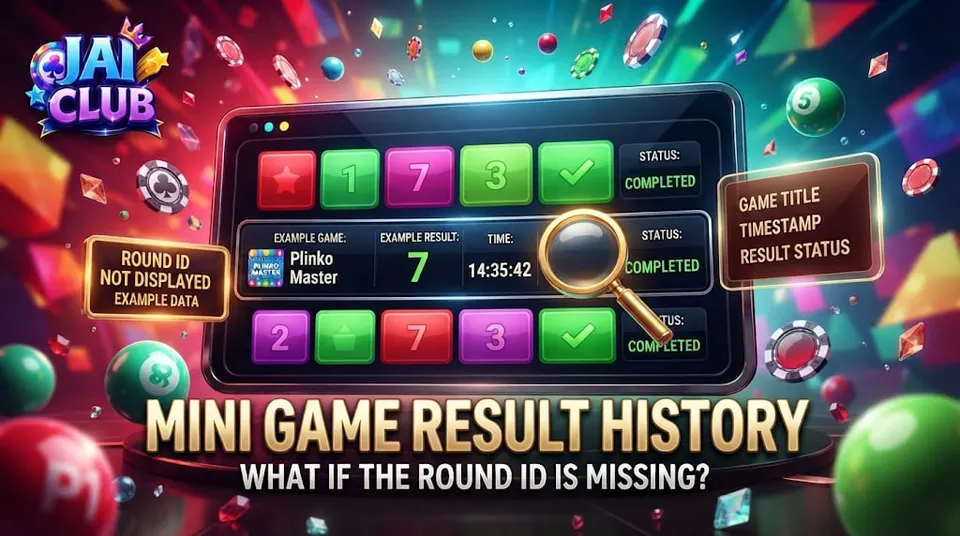
EXAMPLE: Mini Game History With Limited Fields
Consider the following fictional result table.
| Visible field | Example value |
|---|---|
| Game title | Demo Number Wheel |
| Result | 7 |
| Completed time | 14:35 IST |
| Status | Completed |
| Round number | Not displayed |
| Account reference | Not displayed |
The table tells us that an interface displayed a completed result of 7 at a stated time.
However, it does not provide enough information to prove which underlying event produced the result if another identical event occurred nearby.
The missing identifier limits verification.
Why Game Title Matters
Mini Games may use similar result formats.
For example, a wheel game and a number-based game could both display the digit 7.
That does not make their outcomes interchangeable.
A result must first be connected to the correct product.
The provider and game version can also matter when interpreting rules.
An isolated number without its game context has limited meaning.
Readers should avoid comparing results from unrelated games simply because they look similar.
Result Type Matters Too
A result of 5 could represent several different things.
It might be a numerical outcome in one game.
Another title might display 5 as a card value, feature count or multiplier component.
The meaning is determined by the game's rules.
For example, 5x and the digit 5 should not automatically be interpreted as the same result.
Units and result labels matter.
A good record preserves the type of value rather than only its numerical appearance.
Timestamps Without Period Numbers
A timestamp can help identify when a game event was recorded or displayed.
However, timestamps have limitations.
Two events may occur within the same minute or second.
Different systems may use different time zones.
A displayed clock value might refer to submission, completion or publication.
Therefore, a timestamp alone does not always uniquely identify a round.
The event type, precision and time-zone label must be considered.
EXAMPLE: Two Identical Results
Imagine a fictional wheel game with these entries.
| Time | Result | Status |
|---|---|---|
| 14:35:10 | 7 | Completed |
| 14:35:42 | 7 | Completed |
Both events have the same displayed result.
However, they occurred at different times.
If the interface shows only the digit 7 without timestamps or identifiers, it would be difficult to distinguish them.
A reader should not assume that the second result is a duplicate merely because its number matches the first.
Repeated outcomes are possible.
Can Result Order Help?
Result order may help explain the sequence of completed events.
For example, an interface might display the newest result on the left and earlier results to the right.
Another might use the reverse arrangement.
However, ordering conventions differ.
A screenshot taken at one moment may also become outdated as new results appear.
Therefore, position in a visual row is not a reliable permanent identifier.
The meaning of the order must come from the relevant interface.
Why Screenshots Are Limited
A screenshot can show the game title, visible outcome and available status fields.
It may also document a loading error or unexpected display.
However, it cannot automatically prove the identity of an underlying server-side event.
Cropping can remove important context.
An image may also contain an interface state that was not yet final.
For example, a highlighted number could be a selection rather than a completed result.
A screenshot is supporting information, not a universal replacement for a record reference.
Completed vs Pending Results
Some interfaces distinguish between ongoing and completed events.
A pending status generally means that the relevant process has not reached its final state under that system's definitions.
However, the meaning of the status can vary.
A pending game outcome and a pending account transaction are not necessarily the same.
Readers should check which panel the label belongs to.
An empty result should not automatically be interpreted as zero.
Unknown, pending and completed-zero values are different.
Can a Result Be Verified Without a Round Number?
Sometimes enough alternative information is available to identify an event.
For example, the exact game title, precise timestamp and a unique provider reference could help locate a completed record.
However, this is not guaranteed.
If several events share the same visible result and no reliable identifier exists, the available information may be insufficient.
A responsible guide should not invent an identifier or claim that a screenshot provides complete verification.
The limitations of the record should be stated.
Why Game History and Account History Can Differ
A game-history view concerns recorded outcomes.
An account-history view may concern financial or operational activity.
They can have different identifiers, timestamps and statuses.
For example, a completed Mini Game outcome might not display a related transaction reference.
A financial record might also describe a separate processing stage.
A visible completed result therefore does not automatically establish the final status of an associated account action.
The two records should be compared using matching information where available.
EXAMPLE: Matching Two Partial Records
Imagine the following fictional information.
Game history:
- Game title: Demo Number Wheel
- Result: 7
- Completion time: 14:35:42
Account-related history:
- Reference: ENTRY-505
- Game title: Demo Number Wheel
- Recorded time: 14:35:42
The matching game and time provide useful context.
However, without an explicit relationship between the event and account reference, the two records cannot necessarily be confirmed as a unique match.
This is especially important if several actions occurred at nearly the same time.
The example illustrates the limits of partial evidence.
Does a Missing Round Number Mean the Game Is Unfair?
No such conclusion follows from the missing label alone.
A limited user interface may omit information for design reasons.
However, the absence of an identifier can make independent verification more difficult.
These are different observations.
Fairness concerns the rules and process used to generate outcomes.
Record visibility concerns how information is presented to users.
A game can have a detailed history interface without demonstrating fairness, and a compact interface without automatically proving unfairness.
Each claim needs its own evidence.
How to Document a Mini Game Issue
Start by identifying the game and relevant result type.
Record the approximate time, including the time zone where known.
Note whether the interface showed a completed, pending or error state.
Preserve the visible context of any screenshot.
Avoid sharing passwords, OTPs or private account details.
If a provider reference is available, record it accurately rather than inventing a period number.
This creates a more useful technical description.
For other game mechanics and formats, browse the Jai Club Mini Games information on the homepage.
Can Historical Results Predict the Next Mini Game Outcome?
Historical records describe completed events.
They do not automatically provide a reliable forecast for an unknown future outcome.
A sequence of identical wheel or card values might occur by chance.
The mathematical relationship between outcomes depends on the specific game design.
A history panel without period numbers does not change this principle.
Prediction claims still require complete prospective testing and a verified outcome model.
What Makes a Useful History Interface?
A useful interface should make it reasonably clear which result belongs to which game event.
Fields such as event references, precise timestamps, status labels and outcome types can reduce ambiguity.
However, the relevant design requirements depend on the product.
An educational comparison should focus on whether the visible records provide enough context for the question being asked.
A clear result display is useful, but it should not be overstated as proof of every underlying system property.
Frequently Asked Questions
Why does a Mini Game history not show round numbers?
Some interfaces may use a simplified display or other identifiers. The reason depends on the game.
Can I verify a result using only its timestamp?
Sometimes a timestamp helps, but it may not uniquely identify an event.
Is a transaction reference the same as a round number?
Not necessarily. They identify different types of records.
Can two Mini Game rounds have the same result?
Yes. Repeated outcomes are possible.
Does a missing period ID prove the game is unfair?
No. Interface visibility and outcome fairness are different questions.
Is a screenshot enough to identify a completed round?
It depends on the visible information and whether a unique matching record exists.
What if several results have the same number?
Compare the exact game, timestamps and other available identifiers.
Can Mini Game history predict the next result?
Historical records alone do not establish reliable prediction of independent future outcomes.
Conclusion
A Mini Game history without visible round numbers can still provide useful information, but it may not contain enough detail to uniquely identify every event.
Game title, result type, timestamps, completion status and available references help provide context.
When those details are missing, the correct approach is to acknowledge the limits of verification rather than invent missing record information.
Editorial method: All examples, timestamps and identifiers are fictional. No private Jai Club Mini Game history was accessed.
Disclaimer: JaiClubGame.online is an independent educational website. It does not verify private account transactions or guarantee game results.