Plinko vs Crash Games: Comparing Jai Club Multipliers
Compare Plinko and crash-style games, including ball-drop mechanics, landing slots, rising multipliers, game history, probability models and key differences.
In this article
- What Is the Difference Between Plinko and Crash Games?
- How Does a Plinko Board Work?
- How Do Crash-Style Games Work?
- Plinko vs Crash: Main Feature Comparison
- What Does a Plinko Multiplier Mean?
- What Does a Crash Multiplier Mean?
- Why Are Plinko and Crash Probabilities Different?
- Does Plinko Have Better RTP Than Crash Games?
- How Do Result Histories Differ?
- Is Plinko Available in Jai Club Mini Games?
- Can Previous Results Predict the Next Plinko or Crash Outcome?
- Frequently Asked Questions
- Is Plinko the same as a crash game?
- Do Plinko and crash games both use multipliers?
- Why does a Plinko ball often land near the centre?
- Is a 5x Plinko result the same as a 5x crash result?
- Does one game type have a higher RTP?
- Can past game results predict the next multiplier?
- Is Plinko available on every Jai Club platform?
- Conclusion
Jai Club Plinko vs Crash is a comparison topic involving two different types of multiplier-based games. Plinko is recognised for its falling ball, triangular peg board and landing slots, while crash-style games display a multiplier that rises until the round reaches a crash point. Although both formats may display values such as 2x, 5x or 10x, their interfaces and outcome mechanisms are fundamentally different.
A Plinko multiplier is commonly associated with the position where the ball lands. In a crash game, the multiplier develops during an animated round and the result is associated with the point at which that round ends. These differences affect how each game's outcome is presented, interpreted and recorded in its history.
This article compares the mechanics of Plinko and crash-style games, including their multiplier systems, mathematical models, result histories and common misconceptions. The explanations describe general game formats rather than verified rules for every Jai Club service.
What Is the Difference Between Plinko and Crash Games?
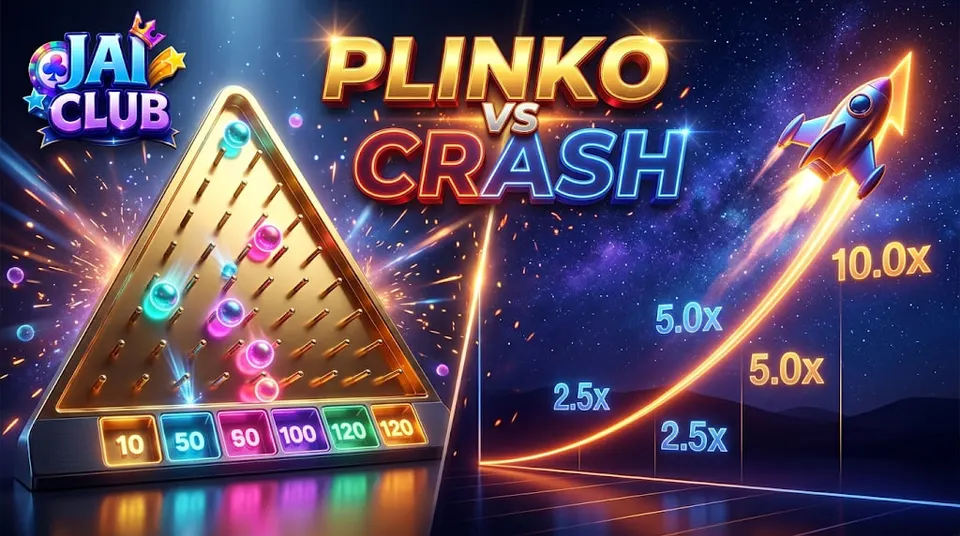
The most visible difference is the event through which a game presents its final outcome. Plinko uses a ball that travels down a peg-filled board before entering a landing slot, while a crash-style game presents a multiplier increasing until the round ends at a predetermined or randomly generated crash point, depending on the provider's design.
In Plinko, readers can identify the result by observing the final landing position and the multiplier assigned to that slot. In a crash-style game, the key recorded value is the final crash multiplier. Both values use multiplier notation, but they represent different events.
Another important distinction is that an animated game interface does not necessarily reveal how the underlying software determines its result. A physical-looking ball animation and a rising multiplier curve can both be visual presentations of outcomes generated through software.
How Does a Plinko Board Work?
A typical Plinko board contains rows of pegs arranged in a triangular formation. A ball enters from the top and appears to move left or right as it travels through the obstacles. At the bottom, several landing slots display the available outcomes or multiplier values.
A simplified mathematical Plinko model treats each left-or-right movement as an independent event with equal probability. Under these assumptions, more movement sequences lead to central landing positions than to the outermost edges. This produces a binomial distribution in which the centre is generally more probable than either extreme.
However, the mathematics of a digital Plinko implementation must be established through the actual game rules. An animation showing the ball bouncing through pegs does not prove that its probabilities follow the simplified fair-bounce model.
How Do Crash-Style Games Work?
Crash games commonly present a multiplier that increases during an active round. The round ends when the multiplier reaches its crash point, which is recorded as the final result. Individual providers may use different visual themes, timing systems and settlement conditions.
Aviator is a familiar example of the crash-game format. Its main visual element is often an aircraft-like animation associated with a rising multiplier, but the aircraft itself is not evidence of how outcomes are generated.
Our Jai Club Aviator Game explanation describes the relationship between rising multipliers, crash points and completed results. These details provide useful context when comparing crash games with Plinko.
Plinko vs Crash: Main Feature Comparison
| Feature | Plinko | Crash Games |
|---|---|---|
| Primary animation | Falling ball | Rising multiplier |
| Main visual | Peg board | Curve or moving object |
| Outcome | Landing position | Crash point |
| Multiplier | Associated with a slot | Associated with round progression |
| Board rows | Common feature | Not a defining feature |
| History display | Landing values or multipliers | Final crash multipliers |
| Main mathematical question | Landing-position probability | Crash-point distribution |
The comparison describes common designs. Individual games may have additional rules or interface features that differ from the examples.
What Does a Plinko Multiplier Mean?
A Plinko multiplier generally represents a numerical factor assigned to a landing slot. Depending on the game, central and edge positions may carry different multiplier values. Some versions allow different row counts or risk configurations, which can also affect the displayed multiplier table.
For example, a fictional Plinko board might contain landing slots labelled 0.5x, 1x, 2x and 5x. The ball's final position would determine the applicable multiplier under the game's rules. These values are illustrative rather than confirmed Jai Club payouts.
A larger multiplier does not necessarily correspond to a more probable outcome. In some common designs, the highest multipliers appear in less probable landing positions, creating a trade-off between the size of a potential payout and the chance of reaching it.
What Does a Crash Multiplier Mean?
A crash multiplier describes the value reached when an individual crash round ends. A completed history entry might show values such as 1.24x or 6.41x, indicating different recorded crash points. These figures do not represent Plinko landing positions, even though they use similar numerical notation.
The significance of a crash multiplier also depends on the game's specific rules. An increasing on-screen multiplier may form part of the settlement mechanism, while the final crash point determines when the round ends.
For readers examining previously completed rounds, our Jai Club Crash Game History guide explains how final multiplier values are displayed and why historical sequences do not establish future results.
Why Are Plinko and Crash Probabilities Different?
The probability model of a simplified Plinko board can be described through the number of paths reaching each landing position. In a symmetric model with independent fair left-or-right movements, central positions receive more paths than the outer edges.
Crash games do not generally use peg paths to define outcomes. Their mathematics instead depends on the distribution of possible crash multipliers and the associated settlement rules.
A comparison of two particular games therefore requires more than knowing their maximum multipliers. Reliable analysis would need their actual probability distributions, multiplier tables and published theoretical return information.
The game categories alone do not establish which format has a higher or lower expected return.
Does Plinko Have Better RTP Than Crash Games?
There is no universal answer. Return to Player, or RTP, is determined by the mathematical configuration of the specific game rather than whether its interface uses a falling ball or rising multiplier.
Two games can publish similar RTP figures while distributing their outcomes very differently. One might produce more frequent small payouts, while another has greater variation between individual outcomes. Both could still share a comparable theoretical return over a sufficiently large number of trials.
RTP is not a guarantee of an individual result or a promise that a particular session will be profitable. It is therefore misleading to describe Plinko as automatically better or worse than crash games without reliable game-specific evidence.
How Do Result Histories Differ?
Plinko history may record the multiplier associated with each completed ball drop, while crash history commonly shows the final multiplier at which each round ended. Both tables describe previous events, but the underlying meaning of their recorded values differs.
For example, a Plinko history entry showing 2x may mean that the ball reached a landing slot labelled 2x. A crash history entry showing 2x describes a round ending at that multiplier. The two entries cannot be compared as though they represent the same mathematical process.
History panels may also differ in the information they provide. Some show round identifiers and timestamps, while others display only a short sequence of completed multipliers. Readers should use the actual provider's documentation to interpret these records correctly.
Is Plinko Available in Jai Club Mini Games?
Plinko is a recognised mini-game format and is discussed in Jai Club-related searches, but current availability on a particular Jai Club service has not been independently verified. A game appearing in a third-party catalogue does not establish that it is active in every related platform.
The same caution applies when comparing game names across services. Two platforms may use similar terminology while offering different providers, multiplier tables or game features.
For a broader introduction to compact gaming formats, visit our Jai Club Mini Games List. The article explains how Mines, Plinko, Limbo and crash-style formats differ conceptually.
Can Previous Results Predict the Next Plinko or Crash Outcome?
Past independently generated outcomes do not reliably identify the next result in either game format. Several central Plinko landings do not make an edge result certain, and a long sequence of low crash multipliers does not establish that a high crash value must follow.
A history table can be useful for reviewing completed rounds, but its patterns must not be confused with the mathematical rules that generate future results. Apparent streaks can occur in independent random processes without providing a dependable prediction method.
Third-party claims of guaranteed Plinko paths or crash multiplier predictions should therefore be approached cautiously, especially when they are unsupported by independently verifiable evidence.
Frequently Asked Questions
Is Plinko the same as a crash game?
No. Plinko uses a ball-drop board with landing slots, while crash games display a multiplier rising until a crash point.
Do Plinko and crash games both use multipliers?
Many versions do, but the multipliers refer to different events and settlement conditions.
Why does a Plinko ball often land near the centre?
In a simplified symmetric model with fair independent left-or-right movements, more possible paths reach central positions than the edges.
Is a 5x Plinko result the same as a 5x crash result?
No. They use similar numerical notation but describe different outcomes and may have different probabilities.
Does one game type have a higher RTP?
Not automatically. RTP depends on the specific game's mathematical design.
Can past game results predict the next multiplier?
Previous independent outcomes do not reliably determine future multipliers.
Is Plinko available on every Jai Club platform?
Its current availability has not been verified across all services and should not be assumed.
Conclusion
Plinko and crash-style games use multiplier notation in visibly different ways. Plinko associates results with landing slots on a peg board, while crash games display a changing multiplier that ends at a crash point. Their interfaces, result records and mathematical models should therefore be understood separately.
The most useful comparison considers actual game rules, probabilities and published theoretical returns rather than headline multiplier values alone. No general game format guarantees favourable results or reliable future predictions.
Disclaimer: JaiClubGame.online is an independent educational website and is not officially affiliated with Jai Club. Plinko availability and individual game specifications have not been verified for every service. This article does not provide gambling recommendations or guarantees. Real-money gaming involves financial risk and may be restricted or prohibited by applicable laws.