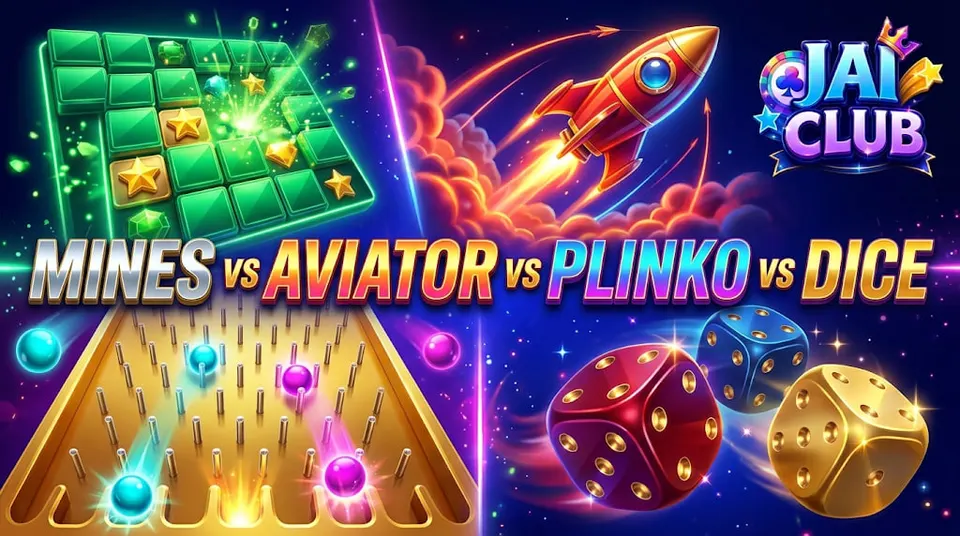
Mines vs Aviator vs Plinko vs Dice: How These Games Really Differ
Compare Mines, Aviator, Plinko and Dice games through their interfaces, result mechanics, multiplier systems, mathematical models and key differences.
In this article
- Mines vs Aviator vs Plinko vs Dice: Main Differences
- How Mines Game Mechanics Work
- How Aviator Crash Games Differ
- Understanding the Plinko Peg Board
- What Makes Dice Games Different?
- Why Similar Multipliers Do Not Mean Similar Probabilities
- Which Games Use Result History?
- Are All Four Games Available on Jai Club?
- Frequently Asked Questions
- What is the main difference between Mines, Aviator, Plinko and Dice?
- Is Plinko the same as Aviator?
- Does Mines use the same probability model as Dice?
- Can all four games use multipliers?
- Are Dice and K3 identical?
- Can previous results predict the next round?
- Conclusion
Comparing Mines, Aviator, Plinko and Dice games reveals four very different approaches to presenting digital game results. Mines uses concealed tiles and hidden hazards, Aviator displays a rising multiplier that ends at a crash point, Plinko represents results through a ball falling into a landing slot, and Dice games use numerical outcomes. All four may appear in discussions of Jai Club mini games, but their interfaces, rules and mathematical structures are not interchangeable.
One reason these formats are often compared is that some display numerical multipliers. However, a multiplier attached to a Plinko slot means something different from the value recorded at the end of an Aviator round. Similarly, the probability of revealing a safe tile in Mines cannot be calculated using the same assumptions as the sum of three dice.
This guide compares their underlying concepts, explains the role of result histories and identifies the information readers should check before relying on a particular game's rules.
Mines vs Aviator vs Plinko vs Dice: Main Differences
Each format is built around a recognisable main event. Mines involves selecting a position on a grid, Aviator involves a crash-style round, Plinko uses a ball-drop display and Dice involves numerical values. These different events determine how the completed result is presented.
| Feature | Mines | Aviator | Plinko | Dice |
|---|---|---|---|---|
| Main interface | Covered tiles | Rising multiplier | Peg board | Dice or numbers |
| Result event | Safe tile or mine | Crash point | Landing slot | Numerical outcome |
| Typical visual | Grid | Flight or curve | Falling ball | Dice faces |
| Multipliers | May change with reveals | Related to crash progression | Assigned to landing slots | Game-specific |
| Main mathematical concept | Hidden-position probability | Crash-point distribution | Landing distribution | Numerical probability |
These descriptions represent common game formats. Actual implementation, availability and settlement rules depend on the provider.
How Mines Game Mechanics Work
Mines is commonly built around a grid of covered tiles. Some positions are designated as mines, while others are safe. When a position is revealed, the game shows whether that selection satisfied the conditions for continuing the round.
In a simplified model with a fixed number of mines, the proportion of initially safe positions depends on the total grid size and mine count. For example, a hypothetical 25-tile board containing five mines has twenty safe positions at the beginning. If all positions were equally likely and the mine placement were uniform, the probability that one randomly chosen first tile is safe would be 20 out of 25, or 80%.
This mathematical illustration does not establish the rules of any particular Jai Club Mines implementation. The actual game could have different grid sizes, mine counts, reveal rules or payout calculations.
For a more detailed explanation of this format, see Jai Club Mines Game: Grid, Mines & Reveal Mechanics.
How Aviator Crash Games Differ
Aviator is associated with a crash-game structure in which a multiplier rises during an animated round before the round ends at a crash point. The final crash multiplier is normally the most recognisable numerical result.
Unlike Mines, Aviator does not require revealing hidden positions. Its interface focuses on the progress of a round and the multiplier value displayed as that round develops. The animated aircraft or curve is a visual representation of the game rather than independent evidence of the underlying outcome-generation method.
The probability of a crash multiplier reaching a particular threshold depends on the provider's mathematical design. Observing a few high or low multipliers in previous rounds is not enough to establish those probabilities.
Readers can explore Jai Club Aviator Game: How Crash Multipliers Work for additional information.
Understanding the Plinko Peg Board
Plinko is visually different from both Mines and Aviator. A ball travels down a triangular peg board before reaching one of several landing positions, which may carry different multiplier values.
In a simplified mathematical model where every movement is independently equally likely to go left or right, central landing positions can be reached through more movement combinations than extreme edge positions. This produces a familiar distribution in which middle results are generally more common than the outermost outcomes.
For instance, an illustrative board with eight independent binary movements has 256 possible movement sequences and nine final positions. The central position can be reached through seventy sequences, while each extreme edge corresponds to just one sequence.
Actual online Plinko software does not necessarily use this physical-bounce model. The displayed animation and the true result-generation algorithm must be evaluated separately.
What Makes Dice Games Different?
Dice games produce numerical results rather than ball landing positions or hidden-tile reveals. A conventional six-sided die has six possible values, and the probabilities of combinations depend on the number of dice involved and the rules used.
For example, a standard three-dice system has 216 ordered combinations. Totals near the middle of its possible range occur through more combinations than extreme sums. However, not every game labelled Dice is identical to K3, and providers may use different numbers of dice or evaluation rules.
Our Jai Club K3 Dice Total Chart provides a useful mathematical example of totals from 3 to 18.
The important distinction is that numerical dice calculations cannot be applied directly to Plinko landing positions, crash multipliers or the placement of mines.
Why Similar Multipliers Do Not Mean Similar Probabilities
Two games may both display 5x, yet that does not prove the same probability of producing a qualifying result. In Plinko, 5x might be associated with a particular landing slot. In Aviator, it could represent a crash threshold. In Mines, the multiplier might depend on a defined sequence of successful reveals.
Each of these mechanisms requires its own probability distribution and payout rules. A headline multiplier describes a possible factor but not how often it can be reached.
The same limitation applies to Return to Player, or RTP. Two games can have similar theoretical returns while producing very different patterns of individual results.
Which Games Use Result History?
Many online games display previous outcomes, although the recorded information differs by format. Mines may show completed game information, Aviator commonly records crash multipliers, Plinko may show landing multipliers and Dice may display the resulting numbers.
These histories are useful for interpreting the outcome format, but they are not interchangeable. A crash value of 3x cannot be read as though it were a Dice total of 3 or a Mines grid position.
Past independent random outcomes also do not guarantee future results. Apparent streaks and repeated values can occur without indicating a predictable cycle.
Are All Four Games Available on Jai Club?
Mines and Aviator are discussed on JaiClubGame.online, and the broader mini-game category also covers Plinko and Dice as recognised game formats. However, a title being discussed in an informational article does not confirm its current availability on every service using the Jai Club name.
Game catalogues can differ between providers and website versions. Readers should verify actual game names, rules and available features rather than assume that a third-party list represents a single official catalogue.
For a broader overview, explore the Jai Club Mini Games List or return to the Jai Club Game homepage.
Frequently Asked Questions
What is the main difference between Mines, Aviator, Plinko and Dice?
They use different result mechanisms: hidden tiles, crash multipliers, ball landing positions and numerical outcomes.
Is Plinko the same as Aviator?
No. Plinko is a ball-drop format, while Aviator is a crash-style multiplier format.
Does Mines use the same probability model as Dice?
No. Their probabilities depend on different structures and assumptions.
Can all four games use multipliers?
Some implementations do, but the meaning and application of multipliers can differ considerably.
Are Dice and K3 identical?
Not necessarily. K3 is commonly described as a three-dice format, while the term Dice can refer to several different games.
Can previous results predict the next round?
Previous independently generated outcomes do not reliably determine future results.
Conclusion
Comparing Mines, Aviator, Plinko and Dice highlights how different games can share a broad category while using unrelated result mechanics. Hidden positions, crash points, landing slots and numerical combinations each require separate explanations and mathematical assumptions.
Understanding these differences helps readers interpret game interfaces and histories without confusing one game's rules with another's. Specific probabilities, payouts and availability should always be established through reliable provider information.
Disclaimer: JaiClubGame.online is an independent educational website and is not officially affiliated with Jai Club. The examples describe general game mechanics rather than confirmed rules or availability for every service. Real-money gaming involves financial risk and may be restricted or prohibited by applicable laws.