After Jaiclub Login: Understanding Account IDs, Game IDs & Round Numbers
Understand the differences between Jaiclub account IDs, game identifiers, round numbers and transaction references, including what each identifier represents and why they should not be confused.
In this article
- What Is an Account ID?
- Account ID vs Username vs Mobile Number
- What Is a Game ID?
- Game ID vs Game Version
- What Is a Round Number or Period ID?
- Account ID vs Game ID vs Round Number
- What Is a Transaction Reference?
- Why Can Several IDs Appear on One Screen?
- Does a Round ID Contain the Result?
- Are Account IDs Secret?
- Can an Account Have More Than One Game ID?
- Can Two Accounts Use the Same Game ID?
- Why Correct Identifiers Matter for Troubleshooting
- Is an Account ID the Same as a Referral Code?
- Frequently Asked Questions
- What is an account ID after Jaiclub login?
- Is an account ID the same as a phone number?
- What does game ID mean?
- Is a game ID the same as a period number?
- Can a period ID predict a result?
- Does a transaction reference confirm that a payment succeeded?
- Should account IDs be posted publicly?
- Does JaiClubGame.online access private account records?
- Conclusion
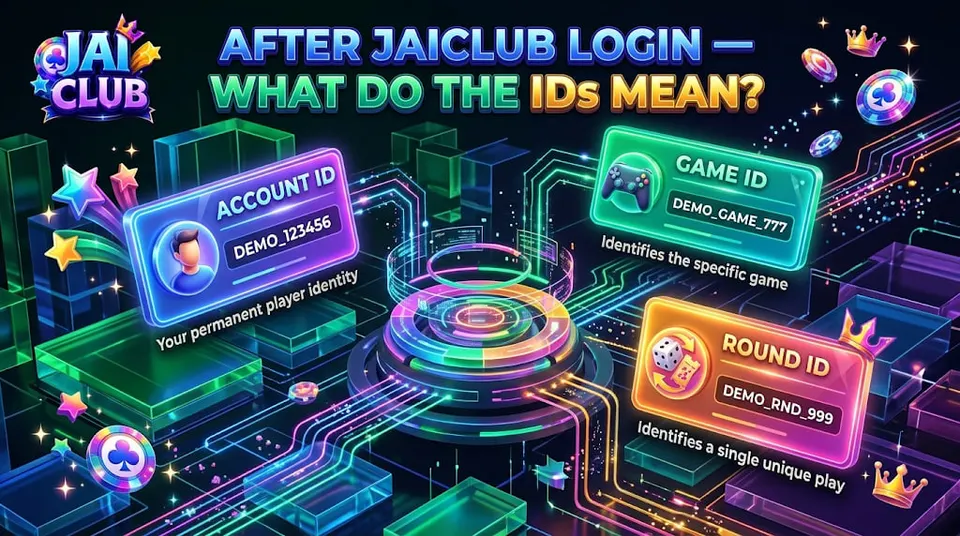
After Jaiclub login, an account-based gaming interface may display several different identifiers. These can include an account ID, a game identifier, a round number or another reference connected with an activity. Although they may all contain digits or letters, these identifiers represent different things and should not be treated as interchangeable.
An account ID generally identifies a user record, while a game ID identifies a game or product. A round or period number identifies one particular event within a game, and a transaction reference may identify an account-related operation. The exact names, formats and availability of these fields depend on the service provider.
This guide explains the differences between these identifiers, how they relate to one another and why matching the correct reference to the correct activity is important. It does not describe a verified Jaiclub account interface or claim that every service displays all these fields.
What Is an Account ID?
An account ID is a reference associated with a user account in a software system. It allows the service to distinguish one account record from another.
An account ID can be different from the username or phone number used during sign-in. For example, a person might use a mobile number as a login credential while the service maintains a separate internal identifier for the corresponding account.
The identifier may be numerical, alphanumeric or represented through another system. Its specific structure depends on the operator.
A visible account ID should not be confused with proof of account ownership. Knowledge of an identifier alone does not establish that someone is authorised to access the account.
Account ID vs Username vs Mobile Number
These three fields can serve different purposes. A username may be a chosen or assigned label, while a mobile number may be used as a contact detail or authentication identifier. An account ID is typically a system-level reference.
Some services use one value for multiple purposes, but that cannot be assumed universally.
For example, a hypothetical service could let a person sign in using a phone number while displaying a different account ID in the profile section. A change in the contact number would not necessarily require the internal account ID to change.
The important point is that login information and database identity are related concepts, not automatically identical pieces of data.
What Is a Game ID?
A game ID is a reference used to identify a specific game or product within a platform's catalogue. This can help software distinguish one title from another even when their visible names are similar.
For example, two slot games may share a broad theme but have different titles, versions and provider details. A platform might maintain separate identifiers for each title.
A game ID is therefore generally associated with the game itself rather than one person's account.
A person opening the same game from two different accounts may encounter the same catalogue identifier, depending on the provider's implementation.
Game ID vs Game Version
A game identifier and a version number have different purposes. The identifier distinguishes the product or title, while the version describes a particular release or configuration of that product.
For example, a fictional game named Crystal Wheel could have a stable catalogue identifier while its interface changes through several software releases.
A newer version might introduce visual improvements, updated assets or revised game information. Whether such changes affect underlying rules must be established from reliable documentation.
A game ID should therefore not be interpreted as a version number simply because both appear in technical records.
What Is a Round Number or Period ID?
A round number identifies one occurrence of a game event. Number-based formats such as WinGo, K3 and 5D commonly display period identifiers alongside completed results.
Unlike a game ID, which identifies a game, a period number identifies one particular round within that game.
For example, a hypothetical WinGo game might have the catalogue identifier DEMO-GAME-A, while one completed round uses DEMO-ROUND-1048. The first references the game and the second references one occurrence of the game.
Neither identifier automatically represents the numerical outcome.
For a detailed explanation of period references across Lottery formats, read Lottery Period Numbers on Jai Club.
Account ID vs Game ID vs Round Number
These identifiers can be compared through their basic functions.
| Identifier | What it commonly identifies | Scope |
|---|---|---|
| Account ID | User account record | One account |
| Game ID | Game or product | One title |
| Version identifier | Software release | One version |
| Round/period ID | Completed or active event | One round |
| Transaction reference | Particular account operation | One transaction |
The example represents general software concepts, not the verified internal database structure of a particular Jaiclub service.
What Is a Transaction Reference?
A transaction reference is an identifier associated with a recorded operation. Different digital systems use such references for purchases, payments, transfers, refunds or other transactions.
In a gaming environment, transaction-related records may be separate from game-round records. A particular game round and an account operation may therefore have different references.
A transaction reference should not automatically be interpreted as proof that an operation succeeded. The actual recorded status and reliable provider information remain necessary.
A reference may identify a request that was submitted, rejected, pending or completed, depending on the service.
Why Can Several IDs Appear on One Screen?
Modern platforms often connect multiple software systems. An account system maintains user information, a game catalogue identifies available titles and a result-history system records completed rounds.
These components can use separate identifiers because they describe different entities.
For instance, a fictional activity record could contain one account ID, one game ID and one round ID. Their appearance together does not mean that the same identifier should be used for every purpose.
A well-designed interface may label these fields clearly, but some services present abbreviated names that require explanation in their help documentation.
Does a Round ID Contain the Result?
Not necessarily. A round identifier may contain sequential digits, date-related information or another reference structure.
Those digits do not automatically reveal the result of the round. A system can allocate a round number separately from the process that determines its outcome.
It would therefore be unreliable to treat the last digit of a period ID as a guaranteed number, colour or multiplier.
For an introduction to different game results, explore the Jai Club Games & Features overview.
Are Account IDs Secret?
An account identifier is not necessarily a password, but it can still be sensitive in context. Sharing an ID publicly may make it easier for an unauthorised person to refer to a particular account or imitate account-support communications.
Account IDs should not be combined with private contact information, passwords or one-time passwords in public screenshots.
A legitimate support process may ask for a reference to identify a specific record, but the identity of the support provider should be verified before any information is shared.
An OTP should never be disclosed simply because someone claims they already know an account ID.
Can an Account Have More Than One Game ID?
An account may interact with several different titles, each with its own catalogue identifier. This is normal in platforms that offer multiple game categories.
For example, a system could distinguish a WinGo-style title from a K3 game or a slot game using separate product records.
The account identifier could remain the same while the game identifier changes depending on the selected title.
This illustrates why an account ID should not be confused with a list of games or a record of individual rounds.
Can Two Accounts Use the Same Game ID?
Yes, in many software architectures. A game ID identifies a title within the catalogue, so it does not necessarily belong exclusively to one account.
Two people could access the same product while maintaining separate account records. Their account IDs would differ, but the game title could have the same catalogue identifier.
Round identifiers may be shared across a game-wide sequence or created through another mechanism. The exact approach is provider-specific and should not be guessed.
Why Correct Identifiers Matter for Troubleshooting
If someone reports that a completed result is missing, a round or period ID may be more relevant than a general game title.
If the issue concerns access to an account, an account reference may be relevant. If it concerns a particular game version, the title and release information could be more useful.
Confusing these fields can lead to incorrect explanations. A transaction reference does not necessarily identify a game round, and a game ID does not necessarily identify an individual user.
Our Game Results Not Showing guide explains general result-display issues.
Is an Account ID the Same as a Referral Code?
Not necessarily. An account ID identifies a record, while a referral code may be used to associate an invitation with a particular account or promotional programme.
Some services derive referral identifiers from existing account information, but the exact relationship depends on their design.
A referral code should therefore not automatically be used as an account-support reference.
Readers should rely on the actual field labels and documented purpose of each identifier.
Frequently Asked Questions
What is an account ID after Jaiclub login?
It is generally a reference used to identify an account record within a system.
Is an account ID the same as a phone number?
Not necessarily. A phone number can be a contact or sign-in credential, while the account ID can be separate.
What does game ID mean?
It commonly identifies a particular game or title within a software catalogue.
Is a game ID the same as a period number?
No. A game ID identifies a title, while a period number identifies an event within that game.
Can a period ID predict a result?
No reliable prediction follows from the identifier alone.
Does a transaction reference confirm that a payment succeeded?
No. The recorded transaction status is necessary to establish the outcome.
Should account IDs be posted publicly?
Avoid publicly sharing identifiable account information, especially alongside other personal details.
Does JaiClubGame.online access private account records?
No. It is an independent informational website without access to Jaiclub account databases.
Conclusion
Account IDs, game IDs and round numbers describe different parts of an account-based gaming system. An account ID refers to a user record, a game ID identifies a title and a round ID identifies a particular game event.
Understanding these differences helps readers interpret interface labels and result histories without confusing account information with game outcomes.
Disclaimer: JaiClubGame.online is an independent educational website and is not officially affiliated with Jaiclub. The identifier structures discussed are general software concepts, not authenticated internal Jaiclub account details.