Repeated Numbers in Jai Club Lottery: Patterns, Sequences & Their Meaning
Understand repeated numbers, matching digits, ascending sequences and result patterns across Jai Club Lottery formats, including WinGo, K3 and 5D.
In this article
- What Are Number Patterns in Jai Club Lottery?
- Repeated Numbers in WinGo History
- Repeated Dice Values in K3
- Repeated Digits in 5D
- Ascending and Descending Number Sequences
- Common Lottery Number Pattern Examples
- Does Repetition Mean a Result Is More Likely?
- Why Some Patterns Look More Surprising Than Others
- What Does a Number Frequency Chart Show?
- Repeated Totals vs Repeated Combinations
- Can a Number Pattern Predict the Next Lottery Result?
- Frequently Asked Questions
- What are Jai Club Lottery number patterns?
- What does a repeated WinGo number mean?
- What is a Triple in K3?
- Can 5D contain repeated digits?
- Is 12345 more unusual than another five-digit sequence?
- Can different K3 combinations have the same total?
- Do frequent numbers become more likely next?
- Conclusion
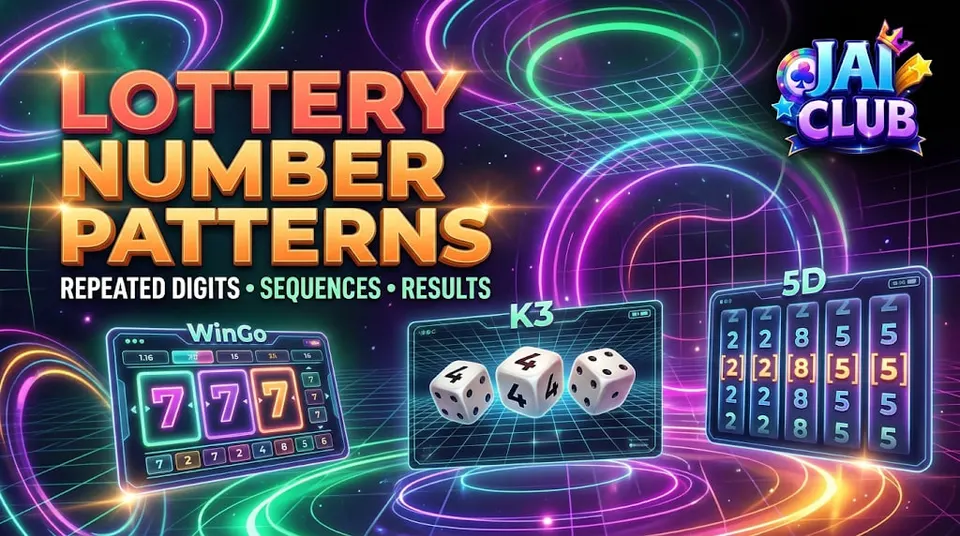
Jai Club Lottery number patterns is a topic that covers repeated digits, matching dice, number sequences and other recognisable arrangements found in number-based games. A series of identical WinGo results, a K3 outcome containing matching dice and a 5D result with repeated digits may all look like patterns, but they describe different mathematical situations.
One important distinction is between patterns within a single result and patterns across multiple completed rounds. A 5D result containing two identical digits is a pattern within one five-digit outcome. Three consecutive WinGo periods producing the same number form a sequence across separate rounds. These observations are not interchangeable, and neither establishes that a future result can be predicted.
This guide explores how repeated numbers and common sequences are recognised in Jai Club Lottery formats, why apparently unusual arrangements can occur naturally, and what historical patterns can actually tell readers about recorded outcomes.
What Are Number Patterns in Jai Club Lottery?
A number pattern is a recognisable arrangement of numerical values. It might involve identical digits, consecutive numbers, alternating values or a repeated combination. Patterns can occur within one result or across several separate records.
For example, the five-digit sequence 3-3-7-1-7 contains repeated digits. A series of WinGo outcomes such as 4, 4 and 4 contains the same numerical result across three completed periods. Meanwhile, a K3 outcome of 2-2-2 contains three matching dice within one round.
Although all three examples involve repetition, their mathematical structures differ. WinGo commonly produces one digit, K3 produces three dice and 5D uses five digit positions.
For an overview of these formats, explore What's Inside Jai Club Lottery?.
Repeated Numbers in WinGo History
A WinGo-style result commonly contains a digit from 0 through 9. A repetition occurs when the same digit appears in two or more completed periods.
Consider the fictional sequence 7, 7, 2, 7 and 4. The first two results repeat, while the third interrupts that sequence. A later appearance of 7 does not form part of the original consecutive streak because number 2 appeared between them.
This distinction between consecutive repetition and overall frequency is useful. A number can appear frequently in a history table without appearing in consecutive periods.
In an illustrative system where each digit is selected independently and uniformly from ten possibilities, the probability of any specified digit appearing in one round is 10%. The probability of the same specified digit appearing in three consecutive predetermined rounds would be 0.1%, while the probability that all three match each other, regardless of which digit appears, would be 1%.
These calculations rely on specific mathematical assumptions and do not establish actual Jai Club WinGo probabilities.
Repeated Dice Values in K3
K3 is commonly described as a three-dice game. Repeated values can therefore occur within a single result, rather than only between successive periods.
A result such as 2-2-5 contains one matching pair, while 4-4-4 contains a Triple. A result of 1-3-6 has three distinct values.
These are different patterns even when their totals happen to be equal. For example, 2-2-5 and 1-3-5 both produce a total of 9, but only the first contains a pair.
This means a history table showing combined totals alone cannot identify all repeated-dice patterns. The three individual dice values are needed.
The K3 Dice Total Chart provides additional mathematical background on three-dice outcomes.
Repeated Digits in 5D
A 5D result commonly contains five digits labelled A, B, C, D and E. Repetition can occur when two or more positions contain the same digit.
For example, the fictional result 2-7-2-4-7 contains two pairs of repeated digits. The digit 2 appears in positions A and C, while 7 appears in positions B and E.
Another result such as 5-5-5-1-8 contains three occurrences of the digit 5. A result with all five digits identical would be visually more unusual, but it is still a possible arrangement in the standard five-digit mathematical model.
Repeated digits do not mean the positions are duplicates or that the interface has accidentally copied a value. Each position is a separate component of the recorded result, even when its digit matches another position.
For the basic position structure, see the Jai Club 5D Game guide.
Ascending and Descending Number Sequences
An ascending sequence places numbers in increasing order. For example, 1-2-3-4-5 is strictly increasing, while 9-7-5-3-1 is strictly decreasing.
However, not every visually recognisable sequence follows a strict mathematical progression. The result 2-4-6-8-0 is not a continuously increasing sequence because the final digit is lower than 8.
Readers should also distinguish between the numerical order of digits and the order in which game periods occur. A series of results such as 1, 2 and 3 appearing across separate periods is different from one five-digit result containing 1-2-3 in adjacent positions.
A neat-looking sequence can occur by chance in a random system. Its visual simplicity does not establish that it was deliberately generated or that a related pattern will follow.
Common Lottery Number Pattern Examples
| Example | Game format | Pattern type |
|---|---|---|
| 7, 7, 7 across three periods | WinGo | Consecutive repeated result |
| 2-2-5 | K3 | Matching pair |
| 4-4-4 | K3 | Triple |
| 3-3-7-1-7 | 5D | Repeated digits |
| 1-2-3-4-5 | 5D | Ascending sequence |
| 8-6-4-2-0 | 5D | Descending sequence |
| 5-5-5-5-5 | 5D | All digits identical |
These examples are fictional and are provided to illustrate how different patterns can be classified.
Does Repetition Mean a Result Is More Likely?
No. Repetition describes what has been observed, not whether the same arrangement is more likely to appear next.
If a game uses independent random outcomes, the appearance of a repeated value in previous rounds does not change the underlying probability of that value in the following round.
For example, seeing the same WinGo digit three times consecutively does not establish that it must appear a fourth time. It also does not establish that it cannot appear again.
Both expectations can reflect misunderstandings about independent random events.
Why Some Patterns Look More Surprising Than Others
People naturally notice orderly sequences such as 1-2-3-4-5 or five matching digits. These arrangements stand out because they are easy to describe and recognise.
However, under a model where all ordered five-digit sequences from 00000 through 99999 are equally likely, one specific ordered result has the same probability as any other specific ordered result.
The sequence 12345 is therefore not less probable than a particular sequence such as 48271 under that hypothetical model. What differs is how memorable the arrangement appears.
There are, however, different numbers of possible outcomes belonging to broader pattern categories. For example, there are ten five-digit sequences in which all five digits are identical, but many more sequences containing some mixture of repeated and distinct digits.
What Does a Number Frequency Chart Show?
A frequency chart counts how often a digit or classification appeared during a selected set of completed periods. It can describe which values were observed more or less frequently within the chosen sample.
For example, a fictional history of twenty WinGo results might contain four appearances of digit 3 and one appearance of digit 8. This would indicate that 3 appeared more frequently in that sample, but it would not prove that 3 has a higher probability in the underlying game.
Small historical samples can contain substantial variation. A frequency chart also does not reveal the result-generation method by itself.
The WinGo Game Records guide explains how historical numbers and periods should be interpreted.
Repeated Totals vs Repeated Combinations
K3 and 5D illustrate an important difference between repeated totals and repeated combinations. Two K3 results can share the same sum while containing different dice values. Likewise, two 5D results can produce the same SUM even when their five digit positions differ.
For example, 2-3-6 and 1-4-6 both sum to 11 in K3. The total repeats, but the full outcome does not.
In 5D, the sequences 1-2-3-4-5 and 5-4-3-2-1 both produce a SUM of 15. Their ordered positions differ, even though the digits and total are the same.
Readers should therefore identify whether a history chart is discussing repeated totals, repeated component values or identical ordered outcomes.
Can a Number Pattern Predict the Next Lottery Result?
A historical arrangement is not a reliable prediction method for an independently generated outcome. Repeated digits, ascending sequences and frequent totals can all occur naturally without forming a rule that governs the next round.
The correct mathematical interpretation depends on the game's underlying probability model, which must be verified separately. Simply identifying a visually attractive pattern is not enough to establish that model.
Third-party prediction systems claiming guaranteed future numbers from short sequences should be assessed cautiously, particularly when they provide no independently verifiable evidence.
Frequently Asked Questions
What are Jai Club Lottery number patterns?
They are recognisable arrangements such as repeated digits, matching dice, number sequences and repeated results.
What does a repeated WinGo number mean?
It means the same digit appeared in more than one completed round. It does not guarantee a future repetition.
What is a Triple in K3?
A Triple occurs when all three dice show the same face value.
Can 5D contain repeated digits?
Yes. Multiple positions can contain identical digits in one completed result.
Is 12345 more unusual than another five-digit sequence?
It is more visually recognisable, but under an equally likely ordered-sequence model it has the same probability as any other specified five-digit sequence.
Can different K3 combinations have the same total?
Yes. Several dice arrangements can produce identical sums.
Do frequent numbers become more likely next?
Historical frequency alone does not establish the probability of the next independent outcome.
Conclusion
Repeated numbers in Jai Club Lottery can describe several different mathematical situations. WinGo may show repeated results across periods, K3 can contain matching dice within one round, and 5D can contain repeated digits or ordered sequences across five positions.
Understanding the difference between a repeated component, a repeated total and a repeated complete result helps readers interpret history tables accurately. Recognising a pattern does not prove that future outcomes can be predicted.
Disclaimer: JaiClubGame.online is an independent informational website and is not officially affiliated with Jai Club. The examples and probability calculations describe general mathematical models, not verified Jai Club odds. Real-money gaming involves financial risk and may be restricted or prohibited under applicable laws.