Dragon Tiger on Jai Club: Card Values, Tie Results & Game Rules Explained
Discover how Dragon Tiger card games work, including Dragon and Tiger hands, card rankings, Tie results, live dealer differences and common rule variations.
In this article
- What Is the Dragon Tiger Game?
- How Dragon and Tiger Card Values Work
- Dragon vs Tiger: How the Result Is Determined
- What Happens When Dragon and Tiger Have the Same Card?
- Dragon Tiger Result Examples
- What Is a Suited Tie in Dragon Tiger?
- Dragon Tiger vs Traditional Poker
- Is Dragon Tiger Part of Jai Club PVC Poker?
- Live Dragon Tiger vs Digital Dragon Tiger
- What Do Big and Small Mean in Dragon Tiger?
- Why Dragon Tiger Is Different From K3 Dice
- Does Dragon Tiger Have Result History?
- Can Dragon Tiger Patterns Predict the Next Card?
- Why the Number of Decks Matters
- Does a Tie Have the Same Settlement Rules Everywhere?
- Dragon Tiger vs Jai Club Mini Games
- What Should Readers Check About a Dragon Tiger Game?
- Frequently Asked Questions
- What is Jai Club Dragon Tiger Game?
- How does Dragon Tiger work?
- Is Ace high or low in Dragon Tiger?
- What happens if Dragon and Tiger have the same number?
- Do suits matter in Dragon Tiger?
- What is a Suited Tie?
- Is Dragon Tiger the same as poker?
- Is Dragon Tiger available in Jai Club Live Casino?
- Can previous Dragon Tiger results predict the next winner?
- Does every Dragon Tiger game use eight decks?
- Conclusion
Jai Club Dragon Tiger Game is a search topic associated with one of the simplest card-comparison formats found in online casino gaming. Unlike WinGo, K3 or 5D, which use numerical results and classifications, Dragon Tiger is traditionally built around two cards. One card represents Dragon, the other represents Tiger, and their values determine the result of the round.
The basic concept is easy to understand, but several details can cause confusion. Aces are commonly ranked below the numbered cards, suits usually do not decide the main result, and equal card ranks produce a Tie. Some versions also include a Suited Tie or other additional result categories, which follow separate rules.
Dragon Tiger is mentioned in some Jai Club-related game listings, but the exact provider, live availability and feature configuration have not been independently confirmed for every service using the Jai Club name. This guide therefore explains the established Dragon Tiger format, identifies common variations and compares the game with other categories covered on JaiClubGame.online.
What Is the Dragon Tiger Game?
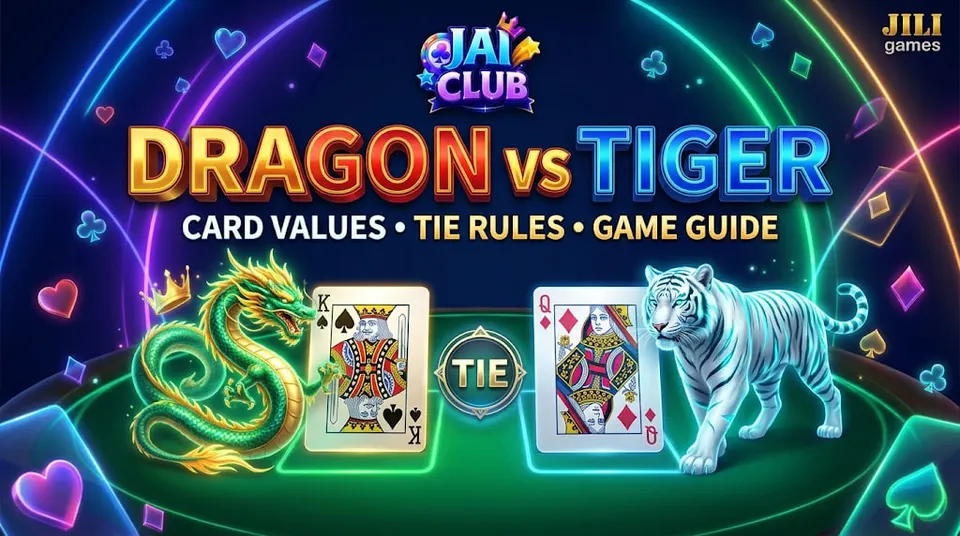
Dragon Tiger is a card-comparison game in which two cards are drawn and assigned to separate positions. One belongs to Dragon and the other to Tiger. The higher-ranking card determines which side wins under the standard rules.
Unlike poker, the basic Dragon Tiger format does not require players to build a five-card hand, understand complex combinations or compare several rounds of community cards. Its main result is determined by two individual cards, making it structurally different from traditional poker games.
Dragon Tiger may be presented as a live-dealer casino game or through a digital interface. A live-dealer version normally displays a real dealer handling physical cards, while a computer-generated version may show animated cards.
The appearance of either format does not establish that its exact rules are identical to another provider's version. Deck configuration, side-result options and Tie settlement conditions can vary.
How Dragon and Tiger Card Values Work
The standard Dragon Tiger format ranks cards according to their face value rather than the strength of a poker hand. Ace is commonly the lowest card, followed by the numbers 2 through 10, then Jack, Queen and King.
This is an important distinction because some other card games treat Ace as either high or low depending on the circumstances. In the standard Dragon Tiger ranking, Ace is lower than 2, while King is the highest card.
| Card | Standard rank |
|---|---|
| Ace | 1 — Lowest |
| 2 | 2 |
| 3 | 3 |
| 4 | 4 |
| 5 | 5 |
| 6 | 6 |
| 7 | 7 |
| 8 | 8 |
| 9 | 9 |
| 10 | 10 |
| Jack | 11 |
| Queen | 12 |
| King | 13 — Highest |
These values describe a standard Dragon Tiger rule set. Any Jai Club-related version should be checked against the particular provider's published rules before assuming the ranking applies unchanged.
Dragon vs Tiger: How the Result Is Determined
When the two cards are compared, the higher-ranking card determines the winning side. For example, if Dragon receives a Queen and Tiger receives a 7, Dragon has the higher card because Queen ranks above 7.
If Dragon receives a 4 and Tiger receives a Jack, Tiger has the higher card. The result is based on card rank rather than the relative position of the cards on the screen.
A card's suit generally does not affect the main Dragon-versus-Tiger comparison. A King of Hearts and a King of Spades are equal in rank, even though their suits differ.
However, suits may become relevant to additional side-result categories in some versions, particularly where a Suited Tie is recognised.
What Happens When Dragon and Tiger Have the Same Card?
A Tie occurs when both cards have the same rank. For example, Dragon receiving an 8 and Tiger receiving another 8 produces a tied result under the standard comparison rules.
A Tie does not require the two cards to have the same suit. Two Queens with different suits still have equal ranks, and two Kings likewise form a Tie even if their suits differ.
This distinction matters because some Dragon Tiger versions offer a separate Suited Tie category. A standard Tie concerns equal ranks, while a Suited Tie commonly requires an additional suit-matching condition.
The effect of a Tie on an individual selection depends on the provider's settlement rules. Some established live-dealer versions return part of a Dragon or Tiger stake when the cards tie, while others may use different arrangements.
A result should therefore be evaluated through the actual game rules, not merely by recognising that the two displayed cards have matching numbers.
Dragon Tiger Result Examples
The following fictional examples illustrate how standard card comparisons work.
| Dragon card | Tiger card | Result |
|---|---|---|
| King of Hearts | 9 of Clubs | Dragon |
| 4 of Spades | Jack of Diamonds | Tiger |
| 7 of Hearts | 7 of Clubs | Tie |
| Ace of Spades | 2 of Hearts | Tiger |
| Queen of Clubs | Queen of Diamonds | Tie |
| 10 of Hearts | 6 of Spades | Dragon |
These examples use conventional card rankings and do not reproduce live Jai Club outcomes.
Notice that the first two cards in a tied result do not need identical suits. The deciding factor for a standard Tie is the rank displayed on each card.
What Is a Suited Tie in Dragon Tiger?
A Suited Tie is an additional result category used in some Dragon Tiger versions. It generally means that the two cards have the same rank and suit, subject to the provider's deck and game configuration.
For example, a Dragon card showing 9 of Hearts and a Tiger card showing another 9 of Hearts could satisfy a Suited Tie condition in a multi-deck game. Two physical cards with identical ranks and suits can exist when a game uses multiple decks.
By contrast, 9 of Hearts against 9 of Spades would represent a standard Tie because their ranks are equal but their suits differ.
Not every Dragon Tiger implementation offers Suited Tie as a separate category. A reader should not assume that a Tie payout or Suited Tie feature exists simply because another provider supports it.
Dragon Tiger vs Traditional Poker
Although Dragon Tiger is sometimes listed alongside poker or other card games, its mechanics differ considerably from traditional poker formats.
Poker commonly involves hands containing multiple cards, with outcomes determined by combinations such as pairs, straights, flushes and other recognised hand rankings. In many poker formats, players must also account for decisions taken during a hand.
Dragon Tiger is much simpler in its basic form. It commonly uses one card per side and compares the two ranks directly. A Queen beats a 10, and equal ranks produce a Tie.
| Feature | Dragon Tiger | Traditional Poker |
|---|---|---|
| Standard comparison | Two individual cards | Multi-card hands |
| Main result | Higher-ranked card or Tie | Hand ranking |
| Ace treatment | Commonly lowest | Depends on poker rules |
| Suit importance | Usually not for main comparison | Important for flushes and other hands |
| Typical structure | Short card-comparison round | Often multiple stages |
| Tie conditions | Equal card ranks | Depends on hand comparison |
This is why a website category named PVC Poker should not automatically be interpreted as proof that every title within it follows conventional poker rules.
Is Dragon Tiger Part of Jai Club PVC Poker?
Some third-party Jai Club catalogues describe a category called PVC Poker or another card-game section. Dragon Tiger is also mentioned among the card-game titles associated with certain Jai Club-themed websites.
However, the existence of those names does not independently verify which specific Dragon Tiger provider is currently available or whether the game sits under PVC Poker, Live Casino or Mini Games in a particular service.
Different gaming catalogues can organise the same game format differently. A title may be classified by its underlying card mechanics on one website and by its live-dealer presentation on another.
Readers should treat such category labels as navigation tools rather than evidence that the rules or available games are identical across platforms.
For a broader overview of the game formats discussed on this website, visit the Jai Club Games & Features page.
Live Dragon Tiger vs Digital Dragon Tiger
A live-dealer Dragon Tiger game usually shows a real dealer and physical cards through a video stream. The dealer reveals one card for each side and the result is determined using the applicable table rules.
A digital version may use computer-generated cards and animations instead of a live video feed. It may present similar result labels while using a different visual interface.
Neither format is automatically more transparent or trustworthy simply because one uses physical cards and the other uses software. Relevant considerations include the provider, game rules, auditing information and whether the displayed outcome can be reliably verified.
The available side-result options can also differ. Some live-dealer versions provide Suited Tie, Odd/Even or additional card classifications, while others focus only on Dragon, Tiger and Tie.
A game should not be described as offering such features unless the specific version confirms them.
What Do Big and Small Mean in Dragon Tiger?
Certain Dragon Tiger variations include additional result categories associated with card ranks. These may be labelled Big and Small, although their exact numerical boundaries can differ between providers.
For example, one established regulated rule set defines Big as cards ranked 8 or higher and Small as cards ranked 6 or lower, with 7 treated separately. This is not a universal rule for all Dragon Tiger games.
The meaning of Big and Small in Dragon Tiger should also not be confused with the number groups used in WinGo. A common WinGo format classifies digits 0 through 4 as Small and digits 5 through 9 as Big.
These are different number systems with different underlying values. One uses a single digit from 0 to 9, while the other uses a card ranking structure from Ace through King.
For an explanation of WinGo's numerical labels, browse the Jai Club WinGo category.
Why Dragon Tiger Is Different From K3 Dice
K3 is commonly associated with three six-sided dice, while Dragon Tiger uses two cards. The numerical structure is therefore different.
A conventional K3 result contains three component values, which can be added to produce a total between 3 and 18. Dragon Tiger instead compares two card ranks, typically between Ace and King.
K3 results may also involve matching dice combinations such as Doubles and Triples. Those terms do not describe the main comparison used in standard Dragon Tiger.
Although both formats involve recognisable numerical values, their outcomes should not be interpreted using the same charts or probability assumptions.
The Jai Club K3 vs 5D comparison explains how number-based formats differ from one another, providing a useful contrast with card-comparison games.
Does Dragon Tiger Have Result History?
Many digital and live-dealer card games display historical outcomes. A Dragon Tiger history panel might record previous rounds using labels such as Dragon, Tiger and Tie.
Some versions may also display the actual card values, round identifiers or other information about completed results. The exact history format depends on the provider.
A history showing Dragon three times followed by Tiger twice describes five completed rounds. It does not establish that the next round must produce a particular side.
Similarly, a long sequence without a Tie does not prove that a Tie is guaranteed soon. Past card comparisons are not sufficient evidence of the next outcome.
The appropriate use of result history is to understand what previously occurred, not to assume that visual sequences reveal future cards.
Can Dragon Tiger Patterns Predict the Next Card?
The idea that previous Dragon Tiger outcomes reveal the next card is a common misunderstanding.
In a card game using physical decks, probabilities can depend on the shoe configuration and the cards remaining. However, this does not mean a simple history of Dragon and Tiger labels provides enough information to determine the next result.
In computer-generated versions, the outcome mechanism may be different again. The actual probability structure depends on the provider's software and rules.
Claims that a repeated Dragon streak guarantees Tiger next, or that a Tie must appear after a fixed number of rounds, are not supported merely by historical patterns.
A genuine mathematical assessment requires the applicable deck configuration, card information and settlement rules. A short sequence of completed results cannot substitute for those details.
Why the Number of Decks Matters
Dragon Tiger can be played using multiple standard decks of cards. A multi-deck shoe contains repeated card ranks and suits, which affects the possible combinations of cards.
For example, two cards with the same rank and suit cannot be drawn from a single ordinary deck because that exact card appears only once. In a multi-deck shoe, identical cards can exist in more than one deck.
This is relevant to versions offering a Suited Tie category.
The number of decks can also affect the probability of certain outcomes, so it should not be assumed that calculations derived from one provider apply to another.
Some established live Dragon Tiger versions use eight decks, but individual games must be checked separately before applying a specific mathematical model.
Does a Tie Have the Same Settlement Rules Everywhere?
No. Tie settlement is one of the most important provider-specific details.
Some established versions treat a Tie as a separate qualifying outcome and apply special rules to Dragon or Tiger selections when both cards have the same rank. The exact treatment can involve a partial return or another settlement method.
Different table configurations may also offer different side-result options and payout values.
A reader comparing Dragon Tiger games should therefore check the paytable for the specific service rather than rely on a generic statement such as "a Tie always pays the same amount".
This guide intentionally does not provide unverified Jai Club payout amounts or promotional claims.
Dragon Tiger vs Jai Club Mini Games
Dragon Tiger may appear alongside compact digital games in certain catalogues, but its card-based mechanics differ from the formats usually associated with Mines, Plinko or Limbo.
Mines uses concealed grid positions. Plinko presents a falling ball and landing slots. Limbo uses target and result multipliers. Dragon Tiger instead depends on comparing two card ranks.
These differences matter because a result-history label from one game cannot be interpreted using the rules of another.
For further background, read the Jai Club Mini Games List, which explores several different compact gaming formats.
What Should Readers Check About a Dragon Tiger Game?
The most important information is the specific version of Dragon Tiger being discussed. Relevant details include the card-ranking rules, deck count, available result categories and treatment of ties.
It is also useful to identify whether the game uses a live dealer or computer-generated results. This can affect how outcomes are presented and what verification information is available.
Where a game involves real money, its payout table, eligibility conditions and financial risks should be understood separately from the visual simplicity of the two-card comparison.
A short round and easy-to-understand rules do not mean that a game provides a reliable income opportunity or a favourable expected return.
Frequently Asked Questions
What is Jai Club Dragon Tiger Game?
It refers to a Dragon Tiger-style card game discussed in the Jai Club search context. Its basic format compares one card for Dragon with one for Tiger, although current availability on a particular platform must be verified.
How does Dragon Tiger work?
In the standard format, each side receives one card. The higher-ranked card determines whether Dragon or Tiger wins, while equal card ranks produce a Tie.
Is Ace high or low in Dragon Tiger?
Ace is commonly the lowest card, ranking below 2. King is the highest card.
What happens if Dragon and Tiger have the same number?
Matching ranks produce a Tie under standard Dragon Tiger rules. Settlement conditions depend on the specific game version.
Do suits matter in Dragon Tiger?
Suits usually do not affect the main Dragon-versus-Tiger comparison. Some versions use suits for additional categories such as Suited Tie.
What is a Suited Tie?
It is a special result category in some versions requiring the two cards to match in both rank and suit.
Is Dragon Tiger the same as poker?
No. Dragon Tiger commonly compares two individual cards, while traditional poker evaluates multi-card hands.
Is Dragon Tiger available in Jai Club Live Casino?
Some third-party Jai Club-related sources mention Dragon Tiger and card-game categories, but its current live availability and provider have not been independently verified.
Can previous Dragon Tiger results predict the next winner?
A sequence of previous Dragon, Tiger and Tie outcomes does not reliably identify the next result.
Does every Dragon Tiger game use eight decks?
No. Deck configurations can vary between providers. Eight decks are common in certain established live versions but should not be assumed universally.
Conclusion
Dragon Tiger stands apart from the number-based and multiplier-based games commonly discussed in Jai Club-related content. Its central mechanic is a direct comparison between two card ranks, with Dragon, Tiger and Tie representing the main possible outcomes.
Understanding the Ace-to-King ranking, the difference between ordinary Tie and Suited Tie, and the role of provider-specific rules makes the game easier to interpret without relying on misleading assumptions.
The same game name can appear under different categories or be offered by different providers. Its exact availability, deck configuration and settlement rules should therefore be checked against reliable information for the relevant version.
Disclaimer: JaiClubGame.online is an independent educational website and is not officially affiliated with Jai Club. This article explains general Dragon Tiger card-game mechanics and does not confirm the current availability or exact rules of any particular Jai Club platform. It does not provide betting strategies or guaranteed predictions. Real-money gaming involves financial risk and may be restricted or prohibited under applicable laws.