A Colour Trading Website Isn't Always the Same as Its App
Compare Colour Trading websites and Android applications, including interface versions, authentication, embedded web content, update methods and result records.
In this article
- Why a Website and App Can Look Different
- Colour Trading Website vs App
- Colour Trading Website Ka Version Kaise Change Hota Hai?
- Why an App May Have Different Menus
- Does a Different Layout Mean Different Results?
- Comparing the Same Game Round
- Why the Same Period Number Matters
- Can Website and App Login Sessions Differ?
- Is a Web-Based App the Same as a Native App?
- Colour Trading Website Aur APK Same Hai?
- What About Different App Permissions?
- Why a Website May Load Faster Than an App
- Can a Browser Update Affect the Website?
- What If One Interface Shows an Old Result?
- Are There Different Rules in App and Website Versions?
- How to Compare Interfaces Without Guessing
- Frequently Asked Questions
- Is a Colour Trading website always identical to its app?
- Can the same game be displayed through both?
- Does a different interface mean a different result?
- Why does the app show older information?
- Is an APK the same as a website?
- Do browser and app login sessions always match?
- Does a website redesign change game odds?
- Conclusion
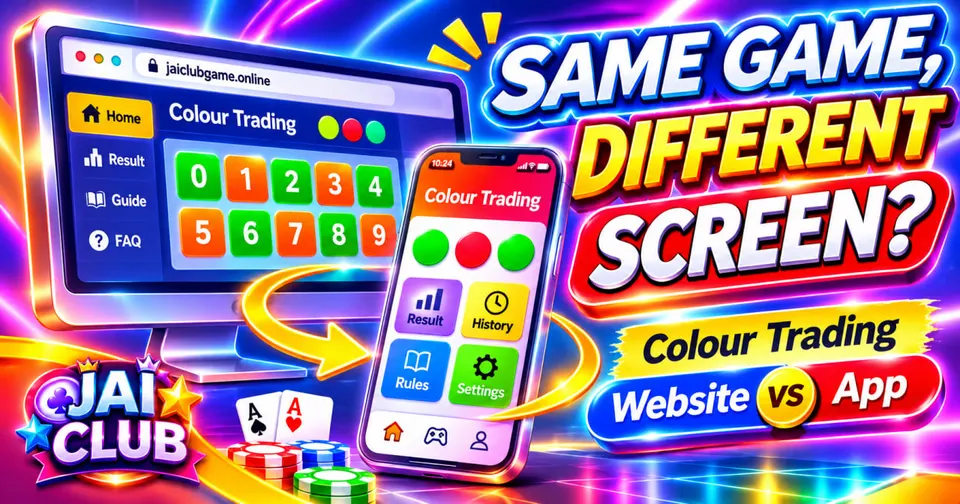
A Colour Trading website and an Android application may use similar branding while displaying different layouts, features or software versions. This does not automatically mean that the underlying game results are different.
A website is accessed through web technology, while an installed application may contain native Android components, embedded web pages or a combination of both.
People researching the Jai Club Colour Trading website should understand how these systems are related before treating a design difference, loading problem or missing feature as evidence of a different game.
This guide focuses on interface identity, software versions and data consistency rather than making unsupported claims about an unverified application.
Why a Website and App Can Look Different
A website and an application are separate presentation environments.
A website may use responsive layouts that change according to screen size. An Android app may have dedicated navigation elements and operating-system controls.
Even when both access similar information, their menus and animations can look different.
A website may also receive visual updates without requiring users to install new software.
An application can use a different release cycle.
Therefore, two interfaces do not need to look identical to refer to the same service.
Colour Trading Website vs App
| Feature | Website | Android app |
|---|---|---|
| Access method | Browser or web interface | Installed application |
| Navigation | Browser-based | Native, hybrid or embedded |
| Update process | Website deployment | App release and/or web update |
| Local storage | Browser-managed | App-managed |
| Login state | Browser session | App or embedded-web session |
| Game resources | Web resources | Native or web resources |
| Result records | Provider-dependent | Provider-dependent |
The table describes general software differences.
It does not confirm the specific implementation of any Jai Club application.
Colour Trading Website Ka Version Kaise Change Hota Hai?
A website publisher can change the content and design served from its website.
Those changes may become visible after reloading the page.
However, cached resources can sometimes make an older interface appear temporarily.
An installed application may need a software update for changes to packaged components.
Hybrid apps can combine packaged navigation with remotely updated web content.
This creates several reasons why two screens can look different without changing the actual game rules.
Why an App May Have Different Menus
A mobile app can use navigation designed for one device type.
A responsive website may move menus into a collapsed panel or display categories in a different order.
Some features may also be restricted by software version, device compatibility or account state.
For example, an app might show a compact game selector while a desktop website presents a larger navigation bar.
The difference could be purely visual.
A missing button should not automatically be interpreted as a missing game or changed result.
Does a Different Layout Mean Different Results?
Not necessarily.
If the website and app both reference the same game provider, mode and round, they may display the same authoritative outcome.
However, similar branding is not enough to establish that they reference identical data.
One interface could be displaying an older completed period, a different game mode or another provider product.
The correct comparison requires matching identifiers.
A result displayed without its period number is difficult to verify accurately.
Comparing the Same Game Round
Consider a fictional example involving two interfaces.
| Detail | Website | App |
|---|---|---|
| Game mode | Demo 1-minute | Demo 1-minute |
| Period | DEMO-901 | DEMO-901 |
| Completed digit | 6 | 6 |
| Colour label | Provider-defined | Provider-defined |
| Display time | 14:00 | 14:00 |
| Visual design | Compact table | Large result tile |
EXAMPLE ONLY: These are fictional values.
The two layouts differ, but both identify the same result digit for the same example period.
This illustrates why the record itself matters more than the graphical design.
Why the Same Period Number Matters
A period identifier distinguishes one game event from another.
Without it, users may accidentally compare a completed result with the current active round.
For example, one screen may have updated to period DEMO-902 while another still displays DEMO-901.
Different visible numbers would not necessarily mean the same round produced different outcomes.
The first task is to identify which period each number belongs to.
To understand period and result fields, read the Colour Trading Result History guide.
Can Website and App Login Sessions Differ?
Yes.
A browser and an application can maintain authentication information through different storage environments.
For example, a user may remain signed in on an app while needing to authenticate again in a browser.
That does not automatically establish that the accounts are different.
A session is a mechanism for maintaining authenticated access.
It is not the same as a game result or an account balance.
Session behaviour depends on how the relevant service is built.
Is a Web-Based App the Same as a Native App?
Not exactly.
A web-based application relies heavily on web technologies.
A native Android app uses platform-specific software components.
A hybrid app may use both approaches.
Some installed apps contain embedded web interfaces, allowing a screen to resemble a browser page.
This explains why an app may load some content in a way similar to a website.
The software format does not, by itself, determine whether the underlying game is legitimate or secure.
Colour Trading Website Aur APK Same Hai?
A website address and an APK package represent different technical things.
A website address identifies a web destination.
An APK is a package format used to distribute Android applications.
An APK may contain a web-based interface, but it is still an installed software package.
A matching logo or product name does not prove that a downloaded APK belongs to the website operator.
Software identity must be verified through reliable publisher information.
What About Different App Permissions?
A browser and a native application can request access to device capabilities in different ways.
For example, an app may ask for notification permission under Android's permission system.
A website may ask for notification permission through the browser.
The existence of a permission request does not establish that it is necessary or appropriate.
Users should understand why software requests particular access.
For more details, see the Jai Club App Permissions guide.
Why a Website May Load Faster Than an App
A website and an app can use different resources, caching methods and rendering components.
Network speed, device performance and software optimisation also matter.
A website may appear faster when it loads only a small amount of content.
An app may perform better when it has useful resources stored locally.
There is no universal rule that one platform always loads faster.
A fair performance comparison requires similar network conditions and the same game content.
Can a Browser Update Affect the Website?
Yes.
Browser updates may change rendering behaviour, supported technologies and security controls.
An older browser might have trouble displaying newer web features.
An installed hybrid app may also depend on Android components that render web content.
However, a rendering change does not automatically imply a change to the game's outcome-generation algorithm.
Interface compatibility and game mathematics are separate issues.
What If One Interface Shows an Old Result?
First, identify whether both screens are displaying the same game and mode.
Next, check whether the current period and latest completed period are aligned.
A delayed update could explain why one screen shows an earlier result.
However, that explanation should not be assumed without checking.
A genuine discrepancy requires comparison with the authoritative completed record.
A screenshot alone may not provide enough information to establish the cause.
Are There Different Rules in App and Website Versions?
Different products or releases can use different feature configurations.
However, an app and website referring to the same game version should not automatically be assumed to have different rules.
The relevant information is the game's published paytable and version details.
A redesigned navigation bar does not prove that probabilities or multipliers have changed.
Conversely, identical visual design does not prove that two providers use identical mathematical models.
How to Compare Interfaces Without Guessing
Identify the exact software name and version when available.
Confirm that both interfaces reference the same game title and mode.
Compare the relevant period identifier and completion status.
Check whether the difference concerns layout, timing, result information or account access.
These are different categories of discrepancy and may have different explanations.
Keeping them separate helps avoid unsupported conclusions about the software.
Frequently Asked Questions
Is a Colour Trading website always identical to its app?
No. Layouts, navigation and software versions can differ.
Can the same game be displayed through both?
Some services support multiple interfaces, but the exact arrangement depends on the provider.
Does a different interface mean a different result?
Not necessarily. Matching game and period identifiers is more important.
Why does the app show older information?
Possible reasons include update timing, caching or a different selected mode. The cause requires verification.
Is an APK the same as a website?
No. An APK is an Android application package, while a website is a web destination.
Do browser and app login sessions always match?
No. They may use separate session environments.
Does a website redesign change game odds?
A visual redesign does not automatically change the game's mathematical model.
Conclusion
A Colour Trading website and Android app can differ in appearance, update timing and software architecture while still presenting related information.
The important task is to distinguish a visual difference from a result discrepancy.
Readers should compare the same game, mode and period before drawing conclusions and should verify software identity rather than rely only on familiar branding.
Editorial disclosure: The comparison uses general software principles and fictional examples. No unverified Jai Club APK has been installed or tested.
Disclaimer: JaiClubGame.online is an independent educational website and does not authenticate third-party software or account systems.