How SMS Task Apps Work and What the WinGo Case Revealed
Explains the basic model of SMS task applications, why people may be offered rewards for message activity, and how the reported Wingo case illustrates telecom security concerns.
In this article
- What Is an SMS Task App?
- SMS Task App Me Kya Hota Hai?
- Why Would an App Offer Rewards?
- What the Wingo Case Reportedly Involved
- EXAMPLE: A Fictional Message Task
- Why a Mobile Number Matters
- Task Completion vs Message Content
- Is Sending SMS Automatically Suspicious?
- Can a Task App Operate Through a Remote Server?
- SMS Tasks vs Number Games
- What Should an App Disclose?
- Frequently Asked Questions
- What is a WinGo SMS task?
- Do all SMS task apps operate the same way?
- Can SMS tasks involve a user's mobile number?
- Does receiving reward points make an app safe?
- Was the Wingo case connected to alleged telecom misuse?
- Is a WinGo number game automatically an SMS task app?
- Conclusion
SMS task apps are applications that ask users to perform messaging-related activities, sometimes in exchange for advertised rewards.
The Wingo case in India became an important example of why such arrangements deserve scrutiny. In January 2026, authorities warned about a particular Wingo application and alleged that mobile devices were being used to transmit fraudulent messages.
However, SMS tasks are not all identical.
Some legitimate services use messaging for customer communication or other authorised functions. The relevant concerns arise when an application hides its purpose, misuses subscriber resources or involves users in activities they do not understand.
This guide explains the general model and the reported security issues.
What Is an SMS Task App?
An SMS task app is software that associates certain activities with SMS messaging.
The application may present tasks, track completion or offer a reward system.
However, the exact function depends on its developer.
A legitimate message-related service should clearly explain what communication activity takes place and who is responsible for it.
An unfamiliar earning application may provide much less information.
The presence of a task counter or reward display does not establish that its underlying operation is trustworthy.
SMS Task App Me Kya Hota Hai?
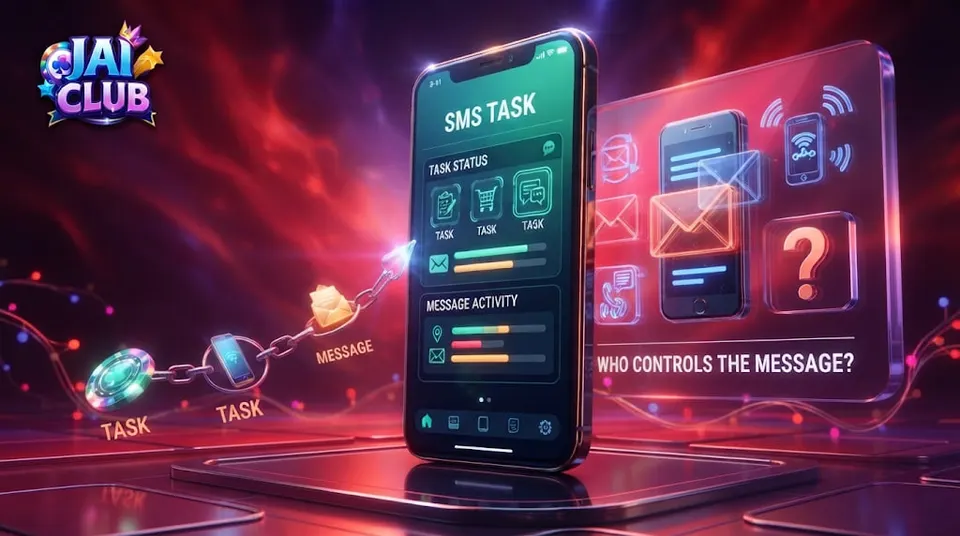
A fictional SMS task app might display a task description and completion counter.
It could also show a reward value associated with the task.
However, the meaning of the reward does not explain whether the message content is authorised or appropriate.
For example, a user might see a task labelled Send Message without understanding who selected the recipient.
That lack of visibility creates an important question about the application's purpose.
The actual behaviour must be verified rather than guessed from a promotional screenshot.
Why Would an App Offer Rewards?
Reward systems can encourage users to perform repeated activities.
In some legitimate applications, rewards are connected to authorised tasks.
In other cases, promotional rewards may be used to recruit participants for questionable operations.
A displayed earning amount does not establish that the reward is genuine or that participation is safe.
Financial claims should therefore be evaluated separately from technical functionality.
The January 2026 Wingo reports described SMS-based earning activities as part of the application under investigation.
What the Wingo Case Reportedly Involved
Indian news reports published on 30 January 2026 described government action against an app named Wingo.
The Indian Cyber Crime Coordination Centre warned about its alleged use of mobile devices for fraudulent SMS activity.
Authorities described the operation as involving telecom mule services.
Reports also discussed restrictions on associated technical infrastructure.
These reported allegations concern the named operation.
They should not be interpreted as findings about every SMS-task application.
EXAMPLE: A Fictional Message Task
Consider a fictional app that displays the following information:
| Field | Example value |
|---|---|
| Task type | Send message |
| Task status | Pending |
| Recipient selection | Controlled remotely |
| Reward | 5 example points |
| Message content | Not displayed |
| Sender resource | User's mobile connection |
EXAMPLE ONLY: This table is hypothetical, not a recreation of Wingo.
The important issue is that the interface does not disclose the message content.
Without that information, the user cannot properly assess the communication being transmitted.
The problem is not simply the existence of a reward.
It is the lack of transparency and control over a sensitive activity.
Why a Mobile Number Matters
SMS messages are normally sent through telecommunications resources associated with a subscriber.
A message recipient may see or otherwise encounter information related to the sender.
If a device is used to transmit messages on behalf of an unknown third party, the subscriber's resources may become part of a wider communication operation.
This can have privacy, security and service-related implications.
The exact risks depend on the messages, software and telecom environment.
A normal personal SMS and an unknown automated task are not necessarily equivalent.
Task Completion vs Message Content
A task interface may show only whether an action succeeded.
That does not explain the full content of the transmitted message.
For example, a task marked Completed may simply indicate that the application considers an action finished.
It does not establish that the message was legitimate.
Similarly, a reward counter is not proof that the device was used appropriately.
The underlying communication should be understood before its completion status is interpreted.
Is Sending SMS Automatically Suspicious?
No.
SMS remains a widely used communication technology.
Legitimate uses include personal messages, service notifications and authorised business communication.
The concern arises when an application uses messaging capabilities in unexpected or deceptive ways.
For example, an app claiming to display gaming statistics has no obvious reason to send large numbers of messages on behalf of an unknown operator.
The actual function and permissions matter.
A simple presence of SMS technology is not evidence of wrongdoing.
Can a Task App Operate Through a Remote Server?
Applications often communicate with remote systems.
For example, an app may receive task information from a backend service.
That is a normal architectural possibility.
However, remote instructions can become a concern when they trigger sensitive actions without adequate transparency.
A user's ability to understand and control the activity becomes important.
This guide does not claim to know the precise software architecture of the reported Wingo application.
The published warnings do not substitute for an independent code audit.
SMS Tasks vs Number Games
An SMS task app centres on messaging activity.
A WinGo-style number game centres on completed numerical results.
These are different product categories.
For example, a number game might show a grid of digits from 0 to 9.
An SMS app might show task status and message activity.
Similar names do not prove a relationship.
Readers should not assume that a game using the WinGo name participates in the activities alleged in the January 2026 reporting.
What Should an App Disclose?
A transparent message-related application should make its publisher and legitimate purpose understandable.
It should also provide appropriate information about access to device capabilities.
Users should know whether the application handles personal messages or sends messages on their behalf.
Unclear reward claims, unexpected permissions and opaque recipients deserve careful review.
No single interface element provides complete assurance.
The combination of publisher identity, permissions and actual behaviour is more informative.
Frequently Asked Questions
What is a WinGo SMS task?
In the January 2026 reporting, Wingo was associated with earning opportunities based on SMS activities.
Do all SMS task apps operate the same way?
No. Their features and purposes vary.
Can SMS tasks involve a user's mobile number?
Yes, depending on how the application handles message transmission.
Does receiving reward points make an app safe?
No. Rewards do not establish the legitimacy of underlying activities.
Was the Wingo case connected to alleged telecom misuse?
Yes. Indian authorities described concerns about telecom resources being used for fraudulent messaging.
Is a WinGo number game automatically an SMS task app?
No. Similar names do not establish a product relationship.
Conclusion
SMS task apps can appear straightforward because they present simple activities and reward counters.
However, the underlying message content, sender resources and control of the tasks matter.
The reported Wingo case illustrates why these details deserve scrutiny, especially when an application offers rewards for using a personal mobile connection.
Editorial disclosure: All technical examples are fictional. This article does not reproduce Wingo's private code or task records.
Disclaimer: JaiClubGame.online is an independent educational website and does not provide SMS-task earning services.