Keno Game Me Numbers Match Kaise Hote Hain? Grid & Draw Guide
Learn how Keno number grids, selected numbers, drawn numbers and matching results work, with clear examples and comparisons to Jaiclub Lottery formats.
In this article
- What Is the Keno Game?
- Keno Game Me Number Grid Kaise Work Karta Hai?
- Selected Numbers vs Drawn Numbers
- Keno Draw Me Matching Numbers Kaise Count Hote Hain?
- Example Keno Matching Table
- What Does 20 From 80 Mean in Keno?
- Does Keno Use a Timer?
- Keno vs WinGo: What Is Different?
- Keno vs 5D: Number Sets and Number Positions
- Why Number Order Matters Less in Keno
- Does Keno Use the Same Probability as WinGo?
- Can Keno Draw Results Repeat?
- Does a Keno Number Pattern Predict the Next Draw?
- What Does a Keno Result History Show?
- Is Keno Currently Available on Jaiclub?
- Frequently Asked Questions
- What is the Jaiclub Keno Game?
- Keno Me Numbers Match Kaise Hote Hain?
- How many numbers are used in traditional Keno?
- Does Keno use the same rules as WinGo?
- Does number order matter in Keno?
- Can one number appear in consecutive Keno draws?
- Can Keno history predict the next draw?
- Conclusion
Jaiclub Keno Game is a search topic associated with Keno, a number-draw game that uses a grid of numbers and a matching system. Unlike WinGo, which commonly produces one digit, or 5D, which uses five number positions, traditional Keno compares a selected group of numbers with numbers drawn during a completed round.
In a widely used Keno format, the game has 80 possible numbers and 20 are drawn. The number of matches depends on how many of the selected numbers appear in that draw. However, Keno rules vary by provider, and the exact format available on a Jaiclub-related platform has not been independently confirmed.
This guide explains how Keno number grids work, what a matching number means, how draw results are counted and why Keno should not be confused with other number-based Mini Games.
What Is the Keno Game?
Keno is a game built around matching selected numbers with numbers drawn from a defined pool.
Traditional Keno often uses numbers 1 through 80, although different versions can use different ranges or draw conditions.
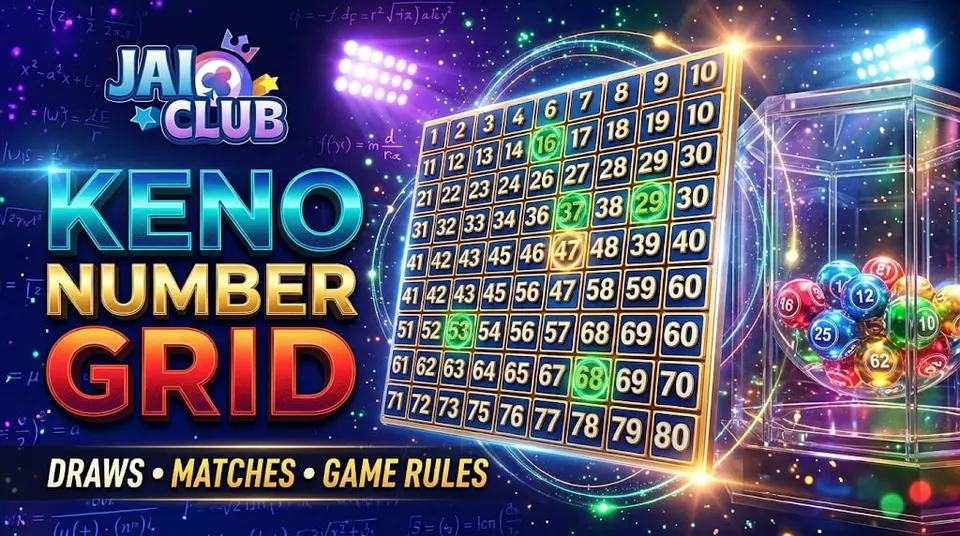
The game interface commonly presents a number grid, a set of selected numbers and a result display showing the numbers drawn.
The central result is the number of matches between the two sets.
This makes Keno structurally different from a game based on one digit or a sequence of ordered positions.
Keno Game Me Number Grid Kaise Work Karta Hai?
A Keno grid is a visual arrangement of available numbers.
For example, a standard 80-number grid might display numbers from 1 through 80 across multiple rows.
The position of a number on the grid makes it easier to locate, but the visual position does not necessarily affect its mathematical probability.
Number 12 appearing near the top of a grid does not automatically make it more likely to be drawn than number 72 near the bottom.
The important information is the actual number, not the colour or location of its tile.
Selected Numbers vs Drawn Numbers
Selected numbers are the numbers identified before the draw under a particular Keno rule set.
Drawn numbers are the results generated during the draw.
A match occurs when a selected number also appears in the drawn set.
For example, suppose a fictional selected group contains:
4, 12, 25, 38 and 61
A completed illustrative draw includes 4, 12 and 61, along with other numbers.
The selected group contains three matches because three selected values also appear in the draw.
The remaining selected numbers, 25 and 38, do not match in this example.
Keno Draw Me Matching Numbers Kaise Count Hote Hain?
The number of matches is calculated by counting the values shared between the selected set and the drawn set.
A Keno result therefore depends on set membership rather than the order in which numbers appear on the screen.
If the selected numbers are 4, 12, 25, 38 and 61, and the drawn numbers include 61, 4 and 12, the number of matches is still three.
Rearranging the displayed order of the matching numbers does not change the count.
The exact prize or settlement conditions, where applicable, depend on the provider's published rules.
Example Keno Matching Table
The following table uses fictional examples to explain number matching.
| Selected numbers | Numbers appearing in draw | Matches |
|---|---|---|
| 4, 12, 25 | 4, 12 | 2 |
| 7, 19, 44 | 19 | 1 |
| 3, 15, 27 | None | 0 |
| 10, 20, 30, 40 | 10, 20, 30 | 3 |
| 5, 11, 18, 26 | 5, 11, 18, 26 | 4 |
The middle column shows only matching drawn values, not a complete 20-number result.
These examples illustrate set matching and do not represent actual Jaiclub Keno records.
What Does 20 From 80 Mean in Keno?
A standard Keno format can use a pool of 80 possible numbers, from which 20 distinct numbers are drawn.
The phrase 20 from 80 describes the number pool and the draw size.
It does not mean that a participant must select twenty numbers. Some traditional Keno products allow different selection counts.
For example, the Missouri Lottery's Club Keno rules describe a format in which participants can select between one and ten numbers while twenty numbers are drawn from eighty possibilities.
This is an example of a documented Keno implementation, not a verified Jaiclub-specific rule.
Does Keno Use a Timer?
Digital Keno games may use scheduled draws, short round timers or instant-result formats.
A timer can identify when a particular drawing starts or finishes, but it does not necessarily determine how the numbers are generated.
Some providers display a countdown, while others show a button that starts an individual game event.
For this reason, the presence of a timer alone does not establish that Keno operates like WinGo.
The actual draw schedule and result process must be checked through the specific game's rules.
Keno vs WinGo: What Is Different?
WinGo commonly uses one digit from 0 through 9, with additional colour or Big/Small classifications depending on the format.
Keno uses a group of numbers and evaluates matches between selected and drawn sets.
A WinGo result can therefore be represented by one primary number, whereas Keno generally needs several drawn values to explain its result.
| Feature | Keno | WinGo |
|---|---|---|
| Main result | Group of drawn numbers | Commonly one digit |
| Primary comparison | Number matches | Number or category |
| Common number range | 1–80 in traditional format | 0–9 |
| Result order | Usually not central to matching | Single-number result |
| Main interface | Number grid | Number and colour display |
These differences explain why a WinGo result chart cannot be used as a Keno matching guide.
Readers can explore the WinGo category for further information about digit-based formats.
Keno vs 5D: Number Sets and Number Positions
Keno and 5D both use numbers, but their result structures are different.
A 5D game commonly displays five labelled positions, such as A, B, C, D and E. The position of each digit matters because the same value in a different position creates a different ordered result.
Keno usually focuses on whether selected numbers appear within the drawn set, not on their order within that set.
For example, the five-digit sequence 1-2-3-4-5 is different from 5-4-3-2-1 when treated as an ordered 5D result.
In ordinary Keno set matching, the selected set containing 1, 2, 3, 4 and 5 represents the same numbers regardless of display order.
The Jai Club 5D Game guide explains how ordered positions work in that format.
Why Number Order Matters Less in Keno
Keno matching usually depends on which numbers appear, not on the sequence in which the drawn numbers are displayed.
For example, suppose the selected group is 6, 14 and 28.
A draw containing those values in the order 28, 6 and 14 still contains three matches.
The order may appear different in the interface, but the set of matching values has not changed.
This differs from number formats where each digit belongs to a fixed labelled position.
Does Keno Use the Same Probability as WinGo?
No. Keno and WinGo have different result spaces.
In a hypothetical uniform 80-number Keno draw where twenty distinct numbers are selected, the chance that any specified individual number appears in the draw is 20 divided by 80, or 25%.
This is different from a hypothetical uniform WinGo result where one digit is selected from ten possibilities, giving each specified digit a 10% probability.
These calculations describe mathematical assumptions. They do not establish the actual probabilities or payout conditions of any specific Jaiclub game.
Can Keno Draw Results Repeat?
Yes. A number can appear in more than one completed draw, assuming it remains eligible in each new drawing.
A repeated number does not automatically indicate a technical problem or a predictable pattern.
For example, seeing number 21 in one completed result does not establish that it must be absent from the next independent draw.
Similarly, an earlier draw containing several matching numbers does not guarantee that a future draw will produce the same match count.
Each result should be interpreted according to the game's actual mathematical model.
Does a Keno Number Pattern Predict the Next Draw?
A previous number pattern does not establish a reliable prediction of the next independently generated result.
People naturally notice repeated numbers, diagonal shapes and clusters of adjacent tiles. However, these visual patterns can occur naturally in random number sets.
A group of drawn numbers appearing close together on the grid does not mean that nearby numbers are more likely next.
The grid arrangement is a display system, not a verified map of future outcomes.
Any claims about a guaranteed Keno formula should be assessed against reliable mathematical evidence.
What Does a Keno Result History Show?
A result-history panel may display previously drawn numbers, round identifiers and the number of matches associated with a particular selection.
The exact information depends on the provider.
A history of completed draws is useful for understanding what happened, but it does not necessarily show the algorithm responsible for generating the results.
Readers should also distinguish the complete drawn set from the smaller subset of numbers that matched a previous selection.
If only matching numbers are highlighted, the remaining drawn numbers may still be visible elsewhere in the interface.
Is Keno Currently Available on Jaiclub?
Keno is a well-established game format, but its current availability and exact rules on a specific Jaiclub platform have not been independently verified for this article.
The game should therefore be described through its documented general mechanics rather than presented as a confirmed live Jaiclub feature.
Any platform-specific claims about draw duration, selection limits or payout tables require direct verification.
Frequently Asked Questions
What is the Jaiclub Keno Game?
It is a search topic referring to Keno, a number-matching game. A specific live Jaiclub implementation has not been confirmed.
Keno Me Numbers Match Kaise Hote Hain?
A match occurs when a selected number also appears in the set of drawn numbers.
How many numbers are used in traditional Keno?
A common format uses eighty possible numbers and draws twenty.
Does Keno use the same rules as WinGo?
No. WinGo commonly uses one digit, while Keno compares groups of numbers.
Does number order matter in Keno?
Under ordinary set-matching rules, the order of the drawn numbers does not change the number of matches.
Can one number appear in consecutive Keno draws?
Yes. Repetition across independent draws is mathematically possible.
Can Keno history predict the next draw?
No reliable prediction follows from previous results alone.
Conclusion
Keno is different from many other number-based games because its central result concerns matching selected numbers with a larger drawn set.
Understanding the number grid, selected values, drawn values and match count makes it easier to interpret Keno results without confusing the format with WinGo or 5D.
The exact rules of any Jaiclub Keno implementation should be verified separately. General mathematical examples do not establish a particular provider's payout conditions or available features.
Disclaimer: JaiClubGame.online is an independent educational website and is not officially affiliated with Jaiclub or any Keno provider. This guide explains general Keno mechanics without verifying a current Jaiclub integration. Real-money gaming involves financial risk.