WinGo Telegram Signals Claim High Accuracy, but What Happens When Every Prediction Is Counted?
Learn how to evaluate WinGo Telegram signal accuracy using complete pre-result prediction histories, correct denominators, timestamps, edited messages and suitable probability baselines.
In this article
- What Is a WinGo Telegram Signal?
- What Does Accuracy Mean?
- Why Every Prediction Must Be Counted
- EXAMPLE: Selected Screenshots vs Full Record
- Prediction Timestamp Kyu Important Hai?
- EXAMPLE: Before and After a Round
- Why Edited Telegram Messages Matter
- Deleted Losses and Selective Reporting
- Exact Digit vs Colour vs Big Small
- EXAMPLE: Why Two Accuracy Rates Are Not Equivalent
- Can a Channel Claim Accuracy Without a Sample Size?
- How to Build an Accuracy Record
- EXAMPLE: A Five-Signal Test
- What if the Message Predicts Multiple Outcomes?
- Can AI Telegram Signals Predict WinGo?
- Does a Paid VIP Channel Provide Better Evidence?
- Why Result History Is Not Prediction History
- Frequently Asked Questions
- Can WinGo Telegram signals achieve 90% accuracy?
- Are screenshots of successful signals reliable proof?
- Why should deleted predictions matter?
- Is a Big/Small prediction the same as an exact-digit forecast?
- Can edited Telegram messages distort accuracy?
- Does AI guarantee better WinGo predictions?
- Are paid VIP predictions automatically more accurate?
- What is the basic accuracy formula?
- Conclusion
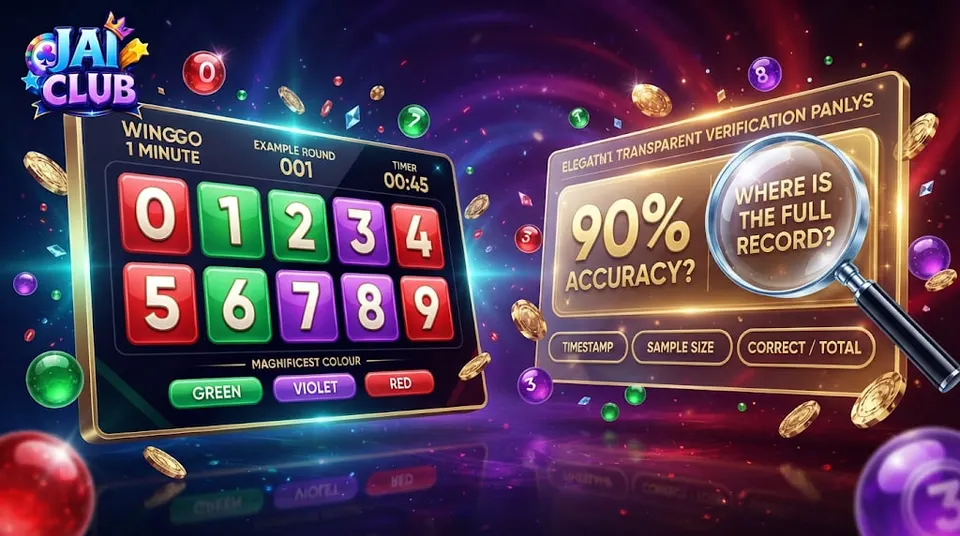
A WinGo Telegram channel can publish predictions, screenshots and accuracy percentages. However, a claim of 90% or 95% success is meaningful only when every relevant forecast is included in the calculation.
For example, a channel could show nine correct predictions while hiding twenty-one unsuccessful ones.
The nine successful screenshots may be genuine, but they would not represent the complete record.
A reliable accuracy assessment needs predictions recorded before their outcomes, matching game periods, a defined target and an honest count of failures.
This guide explains how to evaluate WinGo Telegram signals without assuming that any particular channel has been independently tested.
What Is a WinGo Telegram Signal?
A WinGo Telegram signal is a message claiming or suggesting an outcome for a future game period.
It may identify a digit, colour or Big/Small category.
Some messages also include confidence percentages or screenshots of completed results.
However, the word signal does not establish that the prediction comes from an authentic game provider.
A Telegram account can publish information without having privileged access to game systems.
The content must be evaluated based on its evidence.
What Does Accuracy Mean?
Accuracy measures the share of predictions that meet a clearly defined success condition.
The basic formula is:
Accuracy = Correct predictions ÷ Total predictions × 100.
For example, if a channel publishes one hundred forecasts and forty-five are correct, the observed accuracy is 45%.
However, the definition of a correct prediction matters.
Forecasting an exact digit and forecasting Big/Small are different tasks.
Their expected success rates can differ substantially.
The reported percentage is incomplete without identifying what was predicted.
Why Every Prediction Must Be Counted
A channel's published highlights may show only successful examples.
A complete performance assessment must also include unsuccessful forecasts.
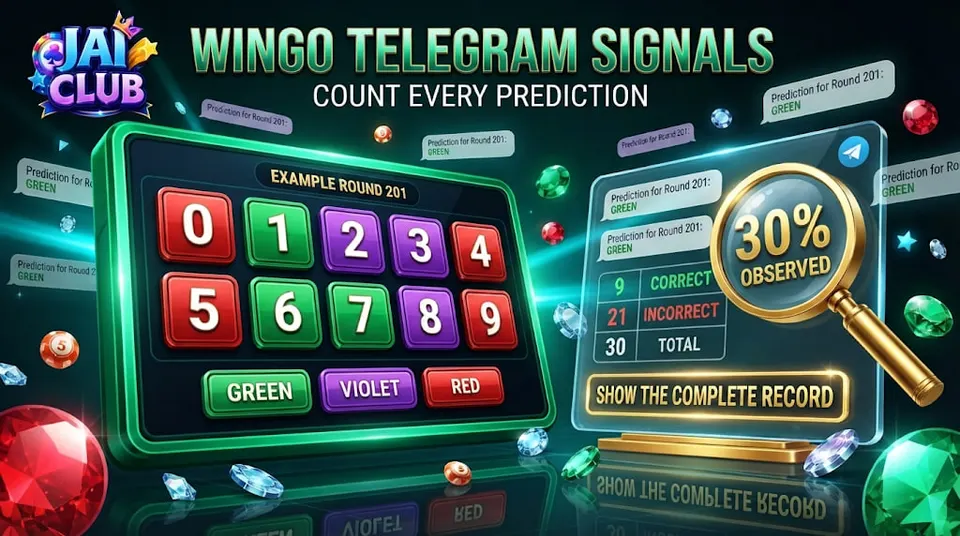
Suppose a group posts thirty predictions.
Nine are correct and twenty-one are incorrect.
The observed accuracy is:
9 ÷ 30 × 100 = 30%.
If the channel shares only the nine successful screenshots, viewers may see what appears to be a perfect record.
However, the complete success rate remains 30%.
Selected highlights do not establish overall performance.
EXAMPLE: Selected Screenshots vs Full Record
| Measurement | Selected screenshots | Complete history |
|---|---|---|
| Correct predictions shown | 9 | 9 |
| Incorrect predictions included | 0 | 21 |
| Total counted | 9 | 30 |
| Displayed accuracy | 100% | 30% |
EXAMPLE ONLY: These figures are fictional and do not describe a real Telegram channel.
The difference comes entirely from which predictions are included.
This demonstrates why the denominator is as important as the number of successful forecasts.
Prediction Timestamp Kyu Important Hai?
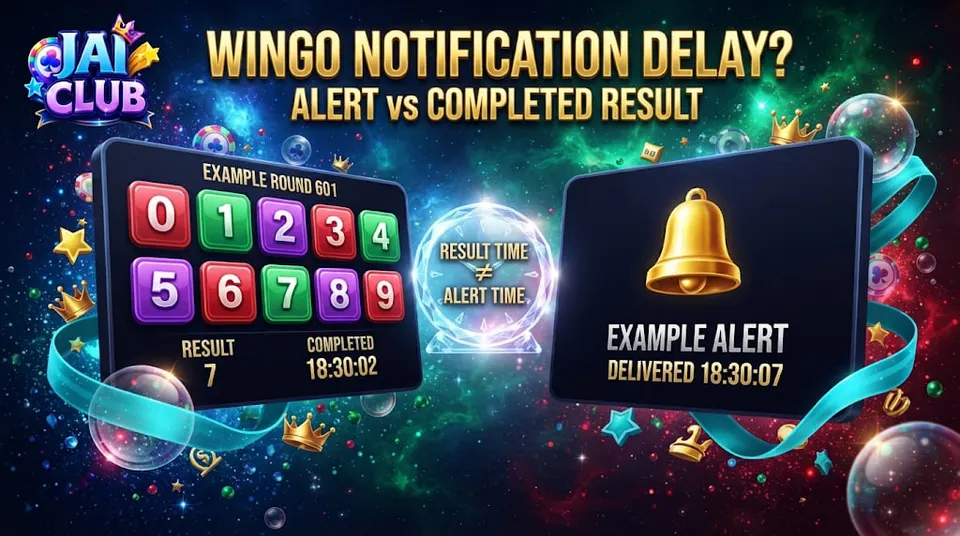
A genuine forecast must exist before the corresponding outcome becomes available.
For example, a message describing result digit 7 after period DEMO-W101 has completed is not an advance prediction.
It may be accurate historical reporting.
However, it does not establish forecasting ability.
A valid prediction record should contain a reliable timestamp and the relevant upcoming period.
The prediction also needs to remain unchanged during evaluation.
Without this chronology, screenshots can be misleading.
EXAMPLE: Before and After a Round
Imagine a fictional WinGo period closing at 18:30 IST.
Prediction A is recorded at 18:29 IST for that period.
Prediction B is recorded at 18:31 IST after the outcome becomes available.
Prediction A could be evaluated as a genuine advance forecast.
Prediction B cannot be treated the same way because the result was already known.
EXAMPLE ONLY: These are fictional timestamps.
The important issue is whether the forecast existed before the relevant event was completed.
Why Edited Telegram Messages Matter
Digital messages can sometimes be edited or deleted.
A displayed screenshot does not necessarily reveal the full history of those changes.
For example, an earlier incorrect prediction might be replaced with a correct result after the round.
A performance assessment that uses only the final edited text would be unreliable.
A trustworthy archive should preserve the original forecast and any subsequent changes.
The verification method must also establish chronology independently.
A channel's own edited history should not be accepted uncritically.
Deleted Losses and Selective Reporting
If unsuccessful predictions disappear from the history, the remaining messages no longer represent the complete sample.
This is a form of selection bias.
For example, a publisher could retain winning examples and remove failed ones.
The visible channel might then appear consistently successful.
However, its performance could be much lower when every original forecast is considered.
An evaluation needs complete, reliable records rather than a selection chosen by the publisher.
Missing information should be reported as a limitation.
It should not automatically be counted as success.
Exact Digit vs Colour vs Big Small
Different prediction targets require different baselines.
Under a hypothetical independent uniform model generating digits 0 through 9, a random exact-digit forecast has a 10% success probability.
If the digits are divided into two equal Big/Small groups, a random category forecast has a 50% probability.
Colour prediction depends on the actual colour-mapping rules.
Some game formats also use overlapping special-colour classifications.
Therefore, a channel's claimed 70% accuracy cannot be interpreted properly without knowing the target category.
EXAMPLE: Why Two Accuracy Rates Are Not Equivalent
Channel A publishes exact-digit predictions and reports 15 correct results from 100 forecasts.
Channel B publishes Big/Small predictions and reports 55 correct results from 100 forecasts.
Channel A has an observed hit rate of 15%.
Channel B has an observed hit rate of 55%.
However, these percentages cannot be compared directly because the prediction tasks have different probability baselines.
The relevant question is whether performance exceeds an appropriate baseline by a meaningful amount in a reliable test.
A larger raw percentage does not automatically mean a more effective method.
Can a Channel Claim Accuracy Without a Sample Size?
It can display a percentage, but readers cannot evaluate the claim properly.
For example, 90% accuracy could mean nine successes from ten predictions.
It could also mean nine thousand successes from ten thousand predictions.
Those samples provide different levels of statistical information.
The claim must include the number of observations.
Even a large sample needs valid timestamps, complete records and an appropriate testing design.
A percentage without the underlying evidence is a marketing claim rather than an independently verified result.
How to Build an Accuracy Record
A useful evaluation table should include the game mode, predicted period and forecast.
The original publication time should be recorded.
Once the round is completed, the actual outcome can be added.
A separate field should identify whether the forecast was correct under the predefined rule.
Every forecast should remain included, including failures.
A complete record should also note edited, deleted or ambiguous predictions.
Unverifiable forecasts should not be silently converted into successful ones.
EXAMPLE: A Five-Signal Test
| Fictional period | Forecast | Actual result | Correct? |
|---|---|---|---|
| DEMO-W201 | Big | Small | No |
| DEMO-W202 | Green | Green | Yes |
| DEMO-W203 | 7 | 2 | No |
| DEMO-W204 | Small | Small | Yes |
| DEMO-W205 | 5 | 1 | No |
EXAMPLE ONLY: This illustrative table mixes targets solely to demonstrate record fields.
Two of five forecasts appear correct under their stated individual labels.
However, a proper statistical test should evaluate exact-digit, colour and Big/Small predictions separately because their baselines differ.
A mixed-target percentage without careful definitions can be misleading.
What if the Message Predicts Multiple Outcomes?
Some messages offer several possible numbers or colours.
For example, a signal might say "2, 4 or 6".
Such a forecast covers three possible digits rather than one.
Under a hypothetical uniform 0–9 model, randomly selecting three different digits covers 30% of possible outcomes.
That is not equivalent to a single-digit forecast with a 10% baseline.
A publisher should clearly disclose how multi-choice predictions are scored.
Otherwise, an apparent accuracy advantage may simply reflect the larger number of allowed answers.
Can AI Telegram Signals Predict WinGo?
An AI model can organise historical data and produce forecasts.
However, using AI does not establish predictive advantage.
If the game generates independent random outcomes, earlier digits may contain no useful information about the next result.
A claimed AI signal should therefore be evaluated using the same prospective testing method.
Every forecast must be counted.
The model's branding, complexity or confidence score is not independent evidence of accuracy.
Does a Paid VIP Channel Provide Better Evidence?
Payment does not establish forecasting performance.
A paid channel may publish more messages, exclusive content or additional visual reports.
However, those services do not automatically prove that its predictions are reliable.
A VIP label should not be treated as evidence of privileged provider access.
A meaningful assessment still requires complete original forecasts, reliable timestamps and verified completed outcomes.
Promotional screenshots are not a substitute for those records.
Why Result History Is Not Prediction History
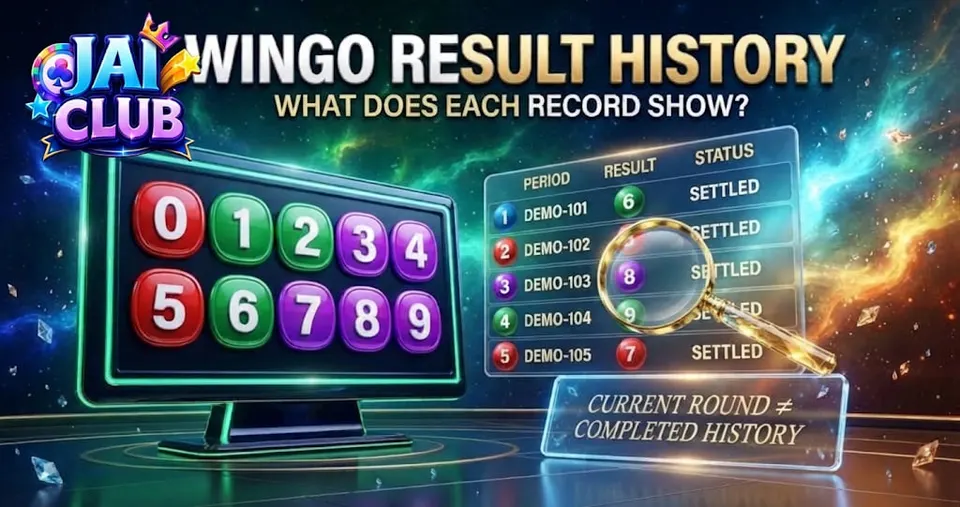
A result-history table shows completed events.
A prediction-history archive should show forecasts made before those events.
The two are different.
For example, a channel that posts the correct WinGo digit after each round can achieve perfect historical reporting without ever predicting an unknown outcome.
To test forecasting performance, the prediction must precede the result.
For more on the difference, read the Jai Club Game FAQ.
Frequently Asked Questions
Can WinGo Telegram signals achieve 90% accuracy?
Such a claim requires complete prospective records and independent verification. A percentage alone is insufficient.
Are screenshots of successful signals reliable proof?
Not by themselves. They may omit losses or lack trustworthy timestamps.
Why should deleted predictions matter?
Removing unsuccessful forecasts can inflate the visible hit rate.
Is a Big/Small prediction the same as an exact-digit forecast?
No. They have different targets and probability baselines.
Can edited Telegram messages distort accuracy?
Yes. Changes made after the outcome can undermine chronological evidence.
Does AI guarantee better WinGo predictions?
No. The method must demonstrate performance on previously unseen outcomes.
Are paid VIP predictions automatically more accurate?
No. Payment status does not establish predictive ability.
What is the basic accuracy formula?
Correct forecasts divided by all evaluated forecasts, multiplied by 100.
Conclusion
WinGo Telegram signal accuracy cannot be established through selected winning screenshots.
A credible evaluation must identify the prediction target, preserve the original forecasts and count every eligible success and failure.
The reported hit rate should then be compared with an appropriate baseline.
Without those steps, a large percentage is not reliable evidence that a channel can forecast future WinGo results.
Editorial method: All Telegram records and accuracy calculations are fictional. No specific channel was independently audited for this article.
Disclaimer: JaiClubGame.online is an independent educational website. It does not endorse guaranteed WinGo prediction services.