Rocket vs Aviator: Crash Multiplier Games Me Kya Difference Hai?
Compare Rocket and Aviator crash games, including rocket and aircraft animations, multiplier rounds, cash-out controls, providers, game history and key mechanical differences.
In this article
- Rocket vs Aviator: Main Difference
- Rocket Aur Aviator Me Multiplier Kaise Work Karta Hai?
- How an Aviator Round Works
- How a Rocket Crash Game Works
- Rocket vs Aviator Feature Comparison
- Auto Cashout vs Manual Cashout
- What Happens When the Rocket or Plane Disappears?
- Does a Rocket Fly Higher Than Aviator?
- Game History Me Crash Point Ka Matlab Kya Hai?
- Does Rocket Have Better RTP Than Aviator?
- Can a Rocket Game Have More Features?
- Rocket vs Aviator on Mobile Devices
- Frequently Asked Questions
- Is Rocket the same game as Aviator?
- Rocket Aur Aviator Me Kya Farak Hai?
- Do both games use multipliers?
- Can Rocket have auto cash-out?
- Is a higher rocket animation a guaranteed win?
- Which game has higher RTP?
- Can previous crash results predict the next one?
- Conclusion
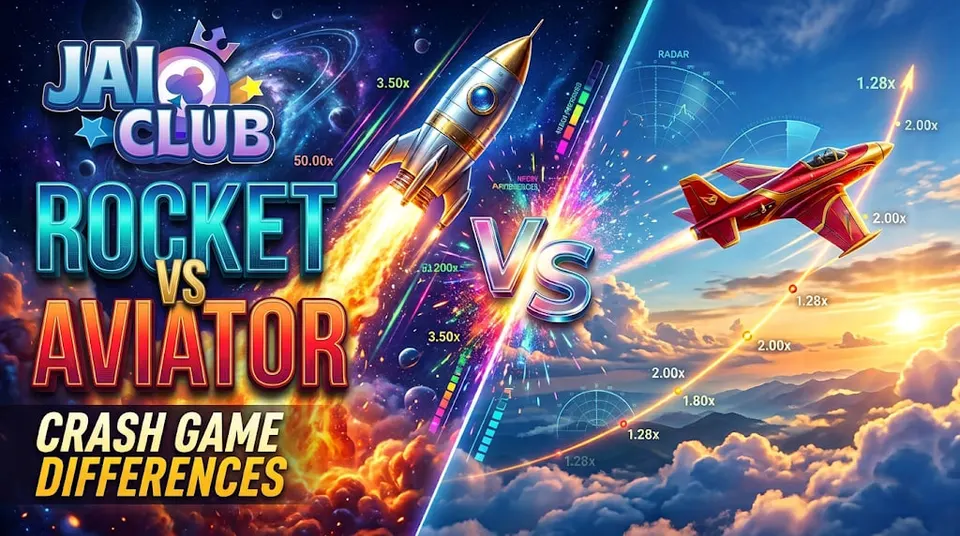
Rocket vs Aviator is a comparison between two familiar visual themes found in crash-style multiplier games. One uses the image of a rocket travelling through space, while the other uses an aircraft flying across the screen. Both can involve a rising multiplier and an unpredictable round-ending point, but similar visuals do not guarantee identical rules.
Aviator is a specific crash game developed by SPRIBE. The name Rocket, however, can refer to different rocket-themed games from different providers. This makes it important to identify the actual product before comparing detailed features or mathematical values.
This guide explains the main crash-game concepts, how Rocket and Aviator presentations differ and why the provider, controls and settlement rules matter more than the visual theme.
Rocket vs Aviator: Main Difference
The most obvious difference is the presentation. Aviator uses an aircraft, whereas a Rocket game commonly uses a rocket or spacecraft.
In a conventional crash format, both themes can represent the same basic idea: a multiplier increases during a round and the event ends at an unpredictable point.
However, the word Rocket does not identify one universally standardised product. Different developers may create rocket-themed games with different interfaces and options.
Aviator, by comparison, is a named title with a recognisable provider identity.
Rocket Aur Aviator Me Multiplier Kaise Work Karta Hai?
A multiplier is a number used to calculate a result relative to a base amount.
In conventional crash games, the displayed multiplier commonly begins near 1x and increases while the round remains active.
If a position is successfully settled at a displayed multiplier, the gross result is typically determined by multiplying the base amount by the accepted value.
For example, 100 units at 2x correspond to 200 units gross. At 3x, the corresponding amount is 300 units.
These are illustrative calculations. They do not establish the payout rules for a particular Rocket implementation.
The important point is that a displayed multiplier and an accepted settlement are not necessarily the same thing.
How an Aviator Round Works
Aviator uses a recognisable aircraft animation. The multiplier increases while the plane remains in flight.
An active position can be settled according to the game's cash-out rules before the aircraft flies away.
If the round ends before the cash-out is accepted, the unsettled position is lost under the standard rules.
The result is commonly represented by the multiplier reached when the round ends.
This simple structure is one reason crash-game interfaces are easy to recognise even when their visual themes differ.
For a dedicated explanation, read the Jai Club Aviator Game guide.
How a Rocket Crash Game Works
A generic rocket-themed crash game may present a rising multiplier alongside a spacecraft or rocket animation.
The rocket may climb vertically, travel through a tunnel or move across a stylised space background.
However, the visual path does not establish the mathematics.
Some rocket-themed titles use conventional crash-round rules, while others offer additional features such as different settlement options or special game modes.
Without the exact title and provider, it is not possible to confirm those details.
A game should not be described as identical to Aviator merely because both show a moving object and changing multiplier.
Rocket vs Aviator Feature Comparison
| Feature | Rocket-Themed Crash Game | Aviator |
|---|---|---|
| Main visual | Rocket or spacecraft | Aircraft |
| Provider | Depends on exact title | SPRIBE |
| Core result | Provider-dependent crash format | Rising crash multiplier |
| Cash-out | Depends on implementation | Supported |
| Multiple positions | Must be verified | Supported in documented versions |
| Result history | Depends on version | Commonly available |
| Verification features | Provider-specific | Documented game-specific mechanism |
| Maximum multiplier | Depends on title | Depends on published rules |
This table compares general characteristics. It does not represent a verified feature list for a specific Jaiclub Rocket integration.
Auto Cashout vs Manual Cashout
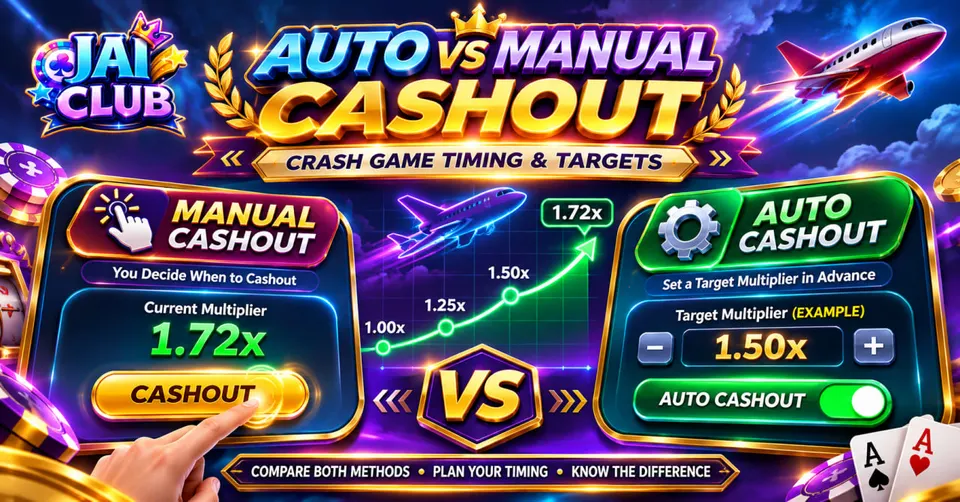
In a game offering manual cash-out, the user submits a settlement request during the active round. The request must be accepted according to the game's timing rules.
An auto-cash-out feature, when supported, can be configured to request settlement at a selected multiplier.
These two options differ in how the request is initiated, but neither changes the underlying crash point.
A high target does not become more likely simply because it is entered into an automated field.
It is also important to recognise that not every Rocket game necessarily provides the same automatic controls as Aviator.
What Happens When the Rocket or Plane Disappears?
In a conventional crash game, the disappearance or destruction of the animated object generally marks the conclusion of the round.
The completed multiplier is then recorded according to the game's rules.
However, animation timing and server-side settlement can be separate technical processes.
A delay in the visual display does not necessarily mean the game's internal result has changed.
When assessing a disputed result, the authoritative round record is more relevant than the exact position of a sprite in an animation.
Does a Rocket Fly Higher Than Aviator?
Visual height is not a meaningful way to compare game results.
A rocket may appear to travel much farther across the screen than an aircraft because the graphics use a different scale.
The important comparison is the multiplier and the rules attached to that value.
A 3x result remains a multiplier of three under the relevant calculation, regardless of whether it appears beside a rocket in space or an aircraft above a field.
Visual effects should therefore not be used to infer the probability of future outcomes.
Game History Me Crash Point Ka Matlab Kya Hai?
A crash point is the ending multiplier associated with a completed round in the conventional crash format.
A history panel might show fictional values such as 1.12x, 4.50x and 2.08x.
These numbers describe completed outcomes, not a sequence that guarantees a particular next result.
A repeated low multiplier does not establish that a large multiplier must follow.
Similarly, a previous high result does not increase the probability of another high result unless a verified game model specifically supports such a relationship.
Does Rocket Have Better RTP Than Aviator?
There is no single RTP value for every game carrying a Rocket name.
Aviator has publicly documented theoretical return information through its provider and game references, but comparing that value with an unidentified Rocket game would be misleading.
RTP is a long-term theoretical measure. It does not describe what one individual session must return.
A proper comparison requires the actual Rocket developer, exact title, published RTP and applicable game version.
Without those details, any claim that Rocket is mathematically better than Aviator would be unsupported.
Can a Rocket Game Have More Features?
Yes. Different developers can include different controls, visual effects, verification information or round options.
However, additional features do not automatically improve the mathematical outcome.
Two games can share the same basic crash idea while giving users different ways to view or settle an active position.
The correct method is to compare documented features rather than count the number of buttons or animated effects on the screen.
Rocket vs Aviator on Mobile Devices
Aviator and rocket-themed games may be accessible through mobile-friendly interfaces, depending on the platform distributing them.
Screen size can affect the layout of multiplier displays, cash-out controls and history panels.
A portrait layout may place controls beneath the animation, while a desktop version may display more information beside it.
These visual differences do not establish that the two platforms use the same software.
The actual game version and provider should be checked independently.
Frequently Asked Questions
Is Rocket the same game as Aviator?
No. Aviator is a specific SPRIBE title, while Rocket can refer to several different games.
Rocket Aur Aviator Me Kya Farak Hai?
Their visual themes differ, and their exact controls and mathematical rules may also differ by provider.
Do both games use multipliers?
Conventional rocket-themed crash games and Aviator use multipliers, but the exact rules must be verified.
Can Rocket have auto cash-out?
Some rocket-themed games offer it. Availability depends on the particular title.
Is a higher rocket animation a guaranteed win?
No. Visual movement does not guarantee an outcome.
Which game has higher RTP?
That cannot be answered reliably without identifying the exact Rocket game and its documented RTP.
Can previous crash results predict the next one?
A history of previous outcomes does not provide a reliable prediction of future independent crash points.
Conclusion
Rocket and Aviator share the visual language of crash-style multiplier games, but they should not be treated as identical products.
Aviator is a specific game, while Rocket can refer to different implementations. The developer, payout rules, available controls and verification method are more important than whether the screen displays a rocket or an aircraft.
Understanding those distinctions makes it possible to compare the games without relying on misleading visual assumptions or unsupported RTP claims.
Disclaimer: JaiClubGame.online is an independent educational website and is not affiliated with Jaiclub, SPRIBE or any Rocket game provider. This article discusses general game mechanics and does not verify a specific Jaiclub Rocket integration. Real-money gaming involves financial risk.